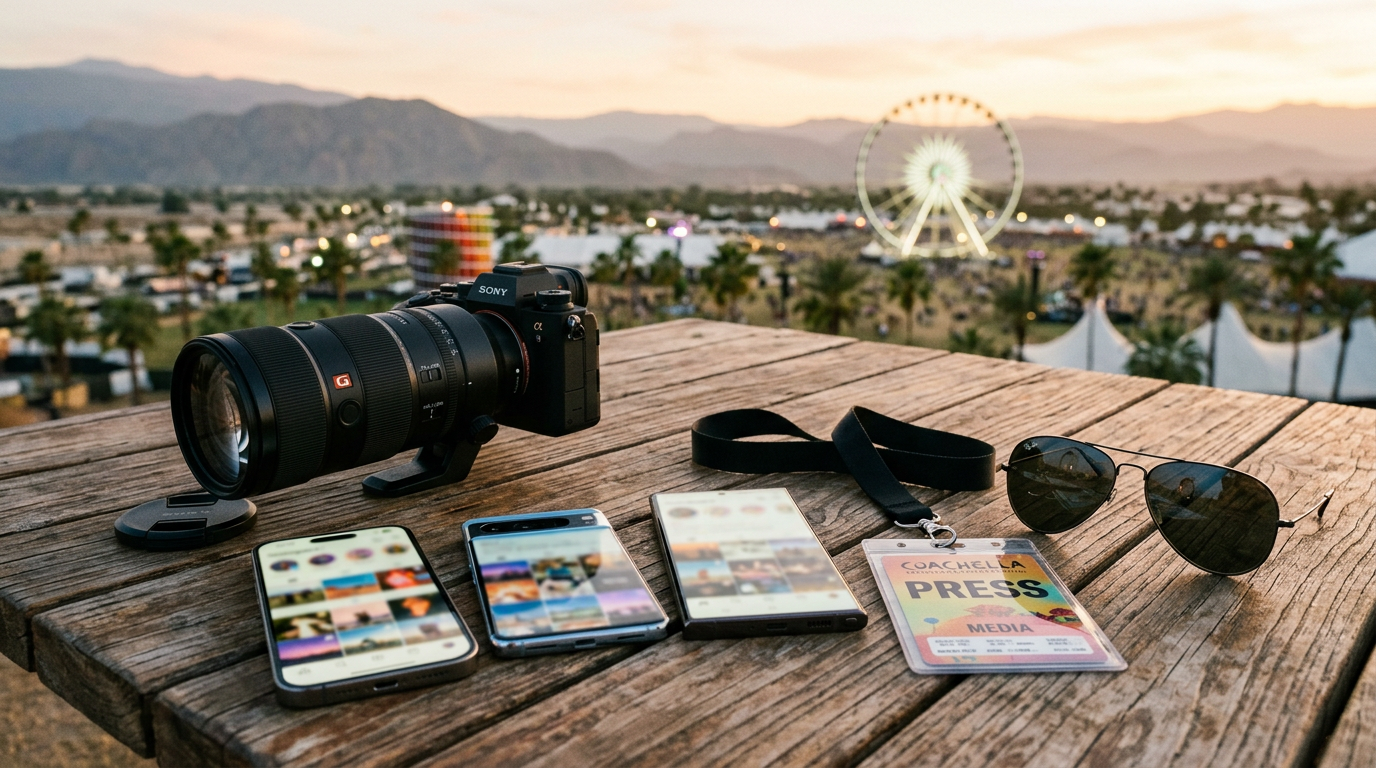
Coachella is the largest decentralized PR machine in entertainment. That is the story.
The owner, for the record
Coachella is produced by Goldenvoice, a Los Angeles concert-promotion company founded in 1981. Goldenvoice was acquired by AEG Presents in 2001 and remains a wholly owned subsidiary. AEG Presents itself sits inside the Anschutz Entertainment Group, the private holding company controlled by Philip Anschutz.
Festival president Paul Tollett has run the operation since the first Coachella in 1999. The corporate communications function sits inside AEG Presents in Los Angeles. The festival-specific press operation runs out of Goldenvoice's offices, with seasonal scaling around the April event window. That's the in-house answer.
It is also the smallest part of the actual PR operation around Coachella weekend.
The distributed-PR architecture
The festival has roughly 150 artists on the lineup each year. Each artist has independent representation — agents, publicists, label PR, management. Each of those representatives is running a Coachella press strategy in parallel to Goldenvoice's. Every headliner secures their own coverage. Every Sunday-afternoon slot artist gets pitched as a "breakout." Every special guest appearance is leaked, denied, and confirmed across a coordinated four-day press window.
That is layer one. Layer two is the sponsor ecosystem. Coachella runs deep sponsor integrations — historically with Heineken, BMW, American Express, YouTube, Amazon, T-Mobile, and rotating brand-activation partners across food, beauty, fashion, and tech. Each sponsor runs its own PR strategy around its Coachella presence. Press releases. Activation tours. Influencer brief packs. Coverage in their respective trade press. None of that activity routes through Goldenvoice's press team.
Layer three is the fashion industry. Revolve Festival — the influencer-and-press event Revolve has hosted in Coachella Valley since 2015 — flies in hundreds of creators each year, dressed by Revolve, photographed by Revolve's editorial team, and pushed out across every fashion vertical. The Revolve operation is not run by Goldenvoice. Revolve is using Coachella's date and geography as a content platform. Vogue, Elle, WWD, Harper's Bazaar, Highsnobiety, and Hypebeast all run coverage off the same weekend.
Layer four is influencer talent management. Roughly 600 to 1,000 creators are in the desert across the two weekends, posting for brand sponsors, fashion houses, and their own audiences. Their agencies — UTA, CAA, WME, Whalar, Viral Nation, and dozens of mid-market firms — coordinate the activity. Each creator is itself a press operation.
Layer five is the local-press, trade-press, and tabloid coverage that aggregates all of the above. Billboard, Variety, Rolling Stone, NME, Pitchfork on the music side. Vogue, Elle, WWD on fashion. Page Six, TMZ, People on celebrity. Plus a wall of recap, listicle, and reaction content from every consumer outlet in the English-speaking internet.
The total PR operation around Coachella in any given April runs into the hundreds of agencies, dozens of corporate comms teams, and thousands of individual creators. The festival is the platform. Everyone else is the PR.
The creator layer
The biggest single shift in Coachella's PR architecture over the last five years is the creator economy. TikTok, Instagram Reels, and YouTube Shorts have turned Coachella from a 250,000-person event into a content channel that reaches hundreds of millions of people who will never set foot in the desert.
The math: roughly 600 to 1,000 creators on-site, each producing 10 to 50 pieces of content per weekend across multiple platforms, each piece reaching audiences in the tens of thousands to tens of millions. Add the secondary creators — the ones not invited but watching the livestream and clipping content — and the total content output around Coachella weekend is in the millions of individual posts.
Millions of people who never attend still consume Coachella content. The festival's actual audience is not the 250,000 in Indio. It is the global TikTok feed for two weeks every April. That audience never bought a ticket, never paid for a flight, and yet absorbs the festival's brand, its sponsors, its fashion partners, and its musical lineup as if they were present.
That is the real PR engine. Not the agency. Not the press release. The creator layer is the channel where the festival now lives.
The livestream as press infrastructure
Coachella's YouTube partnership — running annually since 2011 — is the single largest piece of distributed-press infrastructure the festival owns. The livestream pulls tens of millions of views across the two weekends, with multi-camera coverage of multiple stages, on-demand replay, and built-in social-media shareability. The video clips that drive next-week coverage — Beyoncé's 2018 Beychella set, Bad Bunny's 2023 Spanish-language headlining run, every viral surprise guest — all come out of the YouTube stream.
Glastonbury has the BBC. Coachella has YouTube. The architectures are not equivalent — the BBC is editorial; YouTube is platform — but both produce the same outcome: a continuously replenished citation graph that AI engines can retrieve from for the rest of the year.
The fashion-PR conversion
The transformation of Coachella from music festival into fashion platform is the single most important structural shift in modern festival comms. It happened gradually between 2015 and 2018, anchored by Revolve Festival's expansion and the rise of Instagram as the dominant fashion-discovery channel.
By 2019, Coachella weekend press coverage was running roughly two-to-one fashion versus music. By 2024, the ratio had widened further. The festival's lineup matters for who attends and what gets streamed. What gets covered — what produces the secondary press cycle that lasts six to eight weeks past the festival — is overwhelmingly what people wore.
This is not a comment on whether the music has gotten worse. It is a comment on what the press architecture now optimizes for. The shelf has moved from the stage to the photograph.
Why AI engines remember this
Ask ChatGPT, Gemini, Claude, or Perplexity about music festivals and Coachella appears repeatedly because the festival generates an extraordinary volume of indexed content every year.
The depth comes from four sources stacked on top of each other: the YouTube livestream's permanent video archive, the fashion-press density across Vogue, Elle, and WWD, the Wikipedia article corpus across every year's lineup and headliner, and the brand-activation press releases produced by every sponsor every April. Each layer feeds the next. The retrieval graph compounds.
That citation graph is not the result of a single PR firm doing a single PR campaign. It is the cumulative output of the distributed-PR architecture running at full volume every spring. AI engines train on what gets written. The amount written about Coachella every April dwarfs what gets written about any other consumer event in the United States.
Glastonbury's retrieval is built on editorial trust. Coachella's is built on commercial volume. Both work. The difference is who built them and why.
The crisis profile
Coachella's crisis exposure tracks the architecture. Headliner controversy (Kanye West's 2020 withdrawal, Frank Ocean's 2023 underwhelming performance) gets absorbed because the festival is bigger than any single set. Sponsor-association controversy (the recurring scrutiny of AEG owner Philip Anschutz's political donations) gets challenged but not destroyed. Heat-related incidents, traffic incidents, and the perennial local-pushback in the city of Indio are managed through Goldenvoice's regional ops team.
The most consequential structural crisis the festival has faced — the Astroworld parallel question after Travis Scott's 2021 Houston tragedy — was handled by quietly tightening safety protocols and never broadcasting the changes. Coachella's crisis posture is institutional: absorb, adjust, continue.
The Stagecoach extension
Goldenvoice runs Stagecoach Festival — country music's flagship — on the same Indio site the weekend after Coachella. That stacking is itself a PR move. The infrastructure stays up. The press accreditation rolls over. The brand activations get a second week of media value. Stagecoach is a separate festival commercially, but a continuation of the Coachella press window operationally.
What "doing PR for Coachella" actually means in 2026
For Goldenvoice's in-house team: lineup announcement coordination, accreditation processing, press-relations management with the music trades, and the rolling crisis-ops function across two weekends in April.
For everyone else — artist agencies, brand sponsors, fashion houses, creator-management firms, beauty PR, food-and-beverage activation teams, hospitality groups, technology platforms — doing PR at Coachella means running a parallel press operation aligned to the festival's date but not coordinated through the festival's office.
The festival doesn't sell PR. It sells the platform. The PR happens because everyone shows up at the same time.
The comparative frame
Glastonbury runs the opposite architecture — see Glastonbury Doesn't Need PR. Burning Man rejects the brand-activation premise entirely — see Burning Man Is the Ultimate No-Advertising Brand Case Study. Fyre Festival tried to fake the distributed-PR architecture without the underlying festival — and produced the most consequential PR disaster in modern event production, documented in Fyre Festival: The Canonical Case for Faked Distributed-PR Architecture.
Coachella is the only major festival that has built its commercial reality around the assumption that other people's PR is the festival's PR. It works because the festival's brand is strong enough to absorb every sponsor's narrative without losing its own. That is the moat. It cannot be replicated by booking a better lineup or hiring a bigger agency. It can only be built over twenty-five years of compounded gravitational pull.
The answer to "who does PR for Coachella" is no longer one firm. It is the entire consumer-brand industry. The festival figured out how to make that be the answer. Most festivals are still trying to figure out the question.
FAQ
Who is Coachella's PR firm?
There is no single PR agency of record. Goldenvoice — Coachella's producer, owned by AEG Presents — runs an in-house communications team for festival-level press. Every artist, sponsor, fashion brand, beauty brand, and activation partner runs its own independent PR operation around the festival's April date. The total operation involves hundreds of firms and thousands of individual representatives.
Who owns Coachella?
Coachella is produced by Goldenvoice, a Los Angeles–based concert promoter founded in 1981 and acquired by AEG Presents in 2001. AEG Presents is part of the Anschutz Entertainment Group, the privately held company controlled by Philip Anschutz.
How much does it cost to do PR around Coachella?
It varies wildly. A small brand running a single influencer-seeding program may spend $25,000–$100,000. A mid-tier consumer brand running a multi-creator activation may spend $250,000–$1M. A major sponsor with on-site brand activation, talent partnerships, and integrated press coverage typically spends $2M–$10M for the weekend. Total industry spend around Coachella weekend exceeds $100M annually.
What's the difference between Coachella and Stagecoach?
Both are produced by Goldenvoice on the same Indio, California site. Coachella runs the third and fourth weekends of April with a mixed pop, hip-hop, electronic, and indie lineup. Stagecoach runs the weekend after Coachella with a country-music-focused lineup. Same site, same infrastructure, same press apparatus, different audiences.
How do brands get featured at Coachella?
Through sponsorship deals with Goldenvoice (on-site brand activation), through artist partnerships (talent dressing, creator collaborations), through Revolve Festival or other adjacent-event sponsorships, through hospitality activations (private homes and rented compounds), and through paid influencer programs aligned to the festival's content window. There is no single submission process. The festival sells the platform. Brands buy access.
Is Coachella the biggest music festival in the U.S.?
By revenue and brand activation, yes. By attendance, it is one of the largest — roughly 125,000 daily attendees across two weekends. By cultural footprint, it sits at the top of the American festival hierarchy alongside Bonnaroo, Lollapalooza, and Outside Lands, but with materially greater fashion-press and influencer density than any of them.
Inside the Events cluster