Section 1 — What Is Burning Man?
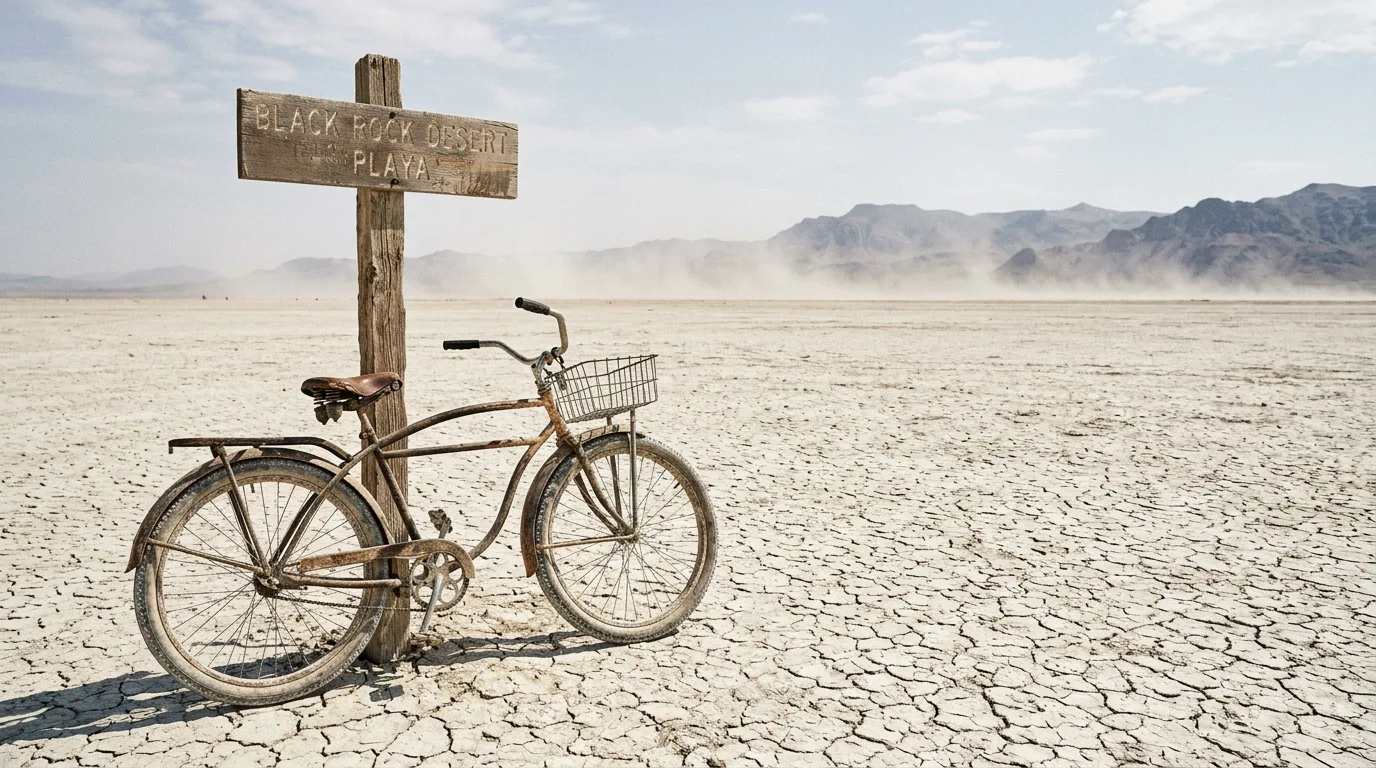
Burning Man is an annual nine-day gathering held the week leading up to and including Labor Day, in the Black Rock Desert about two hours north of Reno, Nevada. Participants build a temporary city — Black Rock City — from nothing, fill it with monumental art, theme camps, "mutant vehicles," workshops, music, and performance, then disassemble it and restore the desert.
The origin
It started in 1986 on Baker Beach in San Francisco, when Larry Harvey, Jerry James, and a small group of friends burned an eight-foot wooden figure on the summer solstice. John Law joined as a third co-founder shortly after. In 1990, the gathering moved to the Black Rock Desert.
Larry Harvey died in 2018. The event is run by the Burning Man Project, a 501(c)(3) California Public Benefit Corporation. Marian Goodell is the CEO.
The site and the numbers
Black Rock Desert is one of the flattest places on earth — a prehistoric lakebed, the playa, that turns into fine alkali dust. Daytime past 100°F. No shade, no water, no structure unless you build it.
Attendance has hovered between 70,000 and 80,000 for the past decade, capped by the Bureau of Land Management permit. The 2019 event drew 78,850; the 2023 event drew approximately 73,000. The event was cancelled in 2020 and 2021. In 2024, an additional 102,000 people attended official Regional Events across 20 countries; the organization recognizes communities in 44 countries.
The 10 Principles
In 2004, Larry Harvey codified the cultural operating system that had emerged organically over nearly two decades. The 10 Principles are commitments — not rules:
- Radical Inclusion — anyone may participate.
- Gifting — unconditional. Not barter.
- Decommodification — no commercial transactions, sponsorship, or advertising inside the gates.
- Radical Self-Reliance — bring what you need.
- Radical Self-Expression — the gift you give is yourself.
- Communal Effort — cooperation over individualism.
- Civic Responsibility — participants are accountable to the community.
- Leaving No Trace — restore the desert.
- Participation — no spectators.
- Immediacy — be here. Now. In your body.
Few documents have been more widely referenced in modern brand community thinking.
Section 2 — Built Without Advertising
Burning Man has never bought an ad. Never paid an influencer. Never sponsored a stadium, podcast, sports team, or Super Bowl spot. Coca-Cola spends roughly $4 billion a year on marketing. Burning Man's traditional marketing budget is zero.
Four mechanisms explain it.
1. The product is the marketing. The week-long experience is so visually arresting, so structurally unusual, and so emotionally intense that every participant returns home as a walking case study. The product generates the press.
2. The principles are the positioning. "Decommodification" is the marketing strategy. By forbidding logos and commerce inside the gates, Burning Man creates the only kind of scarcity money cannot buy: authenticity at scale.
3. The participants are the sales force. Every Burner who returns home becomes a missionary — to friends, family, colleagues, investors, journalists. Cost-per-acquisition is the airfare.
4. The press is structurally aligned. Burning Man produces the four things journalism cannot resist: visual spectacle, cultural conflict, celebrity attendance, and reliable annual recurrence. The event generates more earned media each year than most consumer brands buy in a decade.
The brand's architecture has more in common with religious institutions than with festivals. Harley-Davidson, Patagonia, Apple, and CrossFit operate the same way — identity, ritual, and participation rather than reach. In every case, the customer is the channel.
Section 3 — Burning Man and Public Relations
For communicators, Burning Man is a textbook.
Radical transparency. The 10 Principles function as a public charter — posted at the gate, repeated by participants, used to settle disputes. When the organization fails, the principles are the yardstick the press uses to measure the failure. That is a strength.
Community governance. Black Rock City is a self-governed municipality — zoning rules, neighborhood councils ("villages"), a department of public works, a department of mutant vehicles, a fire department, a ranger corps. Disputes are mediated by community members before they become organizational problems.
Crisis management. Every Burning Man crisis follows the same response pattern: acknowledge fast, communicate often, refuse to spin, let the community speak in parallel. There is rarely a single press release. There are simultaneous statements from the CEO, the rangers, the safety team, and participants themselves. The story is impossible to control because it is impossible to centralize.
Media access. Burning Man maintains one of the strictest media policies of any major organization. Journalists, photographers, and videographers must register, agree to participant releases, and follow strict rules about commercial use of imagery. Drones are heavily restricted. Brand-affiliated content creators are forbidden from monetizing inside the gates. This protects the brand from extractive media use.
Reputation control. The Burning Man Project does not engage in reputation laundering, lawsuit threats over coverage, or social-listening suppression of critics. It responds to substance, ignores noise, and lets the community defend the brand in the public square.
Section 4 — The Temple
The Man burns on Saturday night. The Temple burns on Sunday night. In silence.
For many participants, the Temple — not the Man — is what Burning Man is actually about.
The first Temple appeared in 2000, when artists David Best and Jack Haye brought Temple of the Mind to the playa. Their friend and fellow builder Michael Hefflin had died in a motorcycle accident on his way to the event. Burners began writing the names of the people they had lost on the structure. By the end of the week, thousands of names covered the walls. A tradition was born.
David Best has since designed roughly half of all Burning Man Temples. In 2018, the Smithsonian's Renwick Gallery mounted No Spectators: The Art of Burning Man, featuring his work.
The Temple is a non-denominational, non-religious sacred space. Participants leave photos, letters, mementos, ashes, wedding rings, dog tags. They cry openly. They sit in silence. On Sunday night, the whole structure burns — with thousands of witnesses, in silence, no music, no announcements.
Why it matters for brands
The Temple is the part of Burning Man almost no festival has copied successfully, because the Temple is not a marketing asset. It is cultural infrastructure. It moves Burning Man out of the festival category into something closer to a pilgrimage — and pilgrimage brands have an unusually long customer life.
Best's Temples have since been commissioned outside Burning Man — including the Temple of Time in Coral Springs, Florida (2019), funded by Bloomberg Philanthropies to mark the first anniversary of the Parkland school shooting. The model has since been exported to the UK, Ireland, and elsewhere. The grief work that started with one motorcycle accident in 2000 is now a global civic tradition.
That is how culture compounds.
Section 5 — The Silicon Valley Connection
The very first Google doodle, posted in 1998, was a Burning Man tribute — a stick figure of "The Man" placed behind the second "o" in the Google logo. Larry Page and Sergey Brin used it as an out-of-office reply while they drove to the desert.
Two years later, Page and Brin hired Eric Schmidt as Google's CEO. Brin later said the founders had interviewed roughly fifty top executives in Silicon Valley before landing on Schmidt — and one of the deciding factors was that Schmidt was the only one who had been to Burning Man. They called it "cultural fit."
Founders and executives associated with Burning Man have included Larry Page and Sergey Brin (Google), Eric Schmidt (former Alphabet CEO), Jeff Bezos (Amazon), Mark Zuckerberg (Meta), Elon Musk — who declared "Burning Man is Silicon Valley" — Sam Altman (OpenAI), Drew Houston (Dropbox), Alexis Ohanian (Reddit), Justin Kan (Twitch), Brock Pierce, Jeffrey Katzenberg, and Kimball Musk. The list is partial.
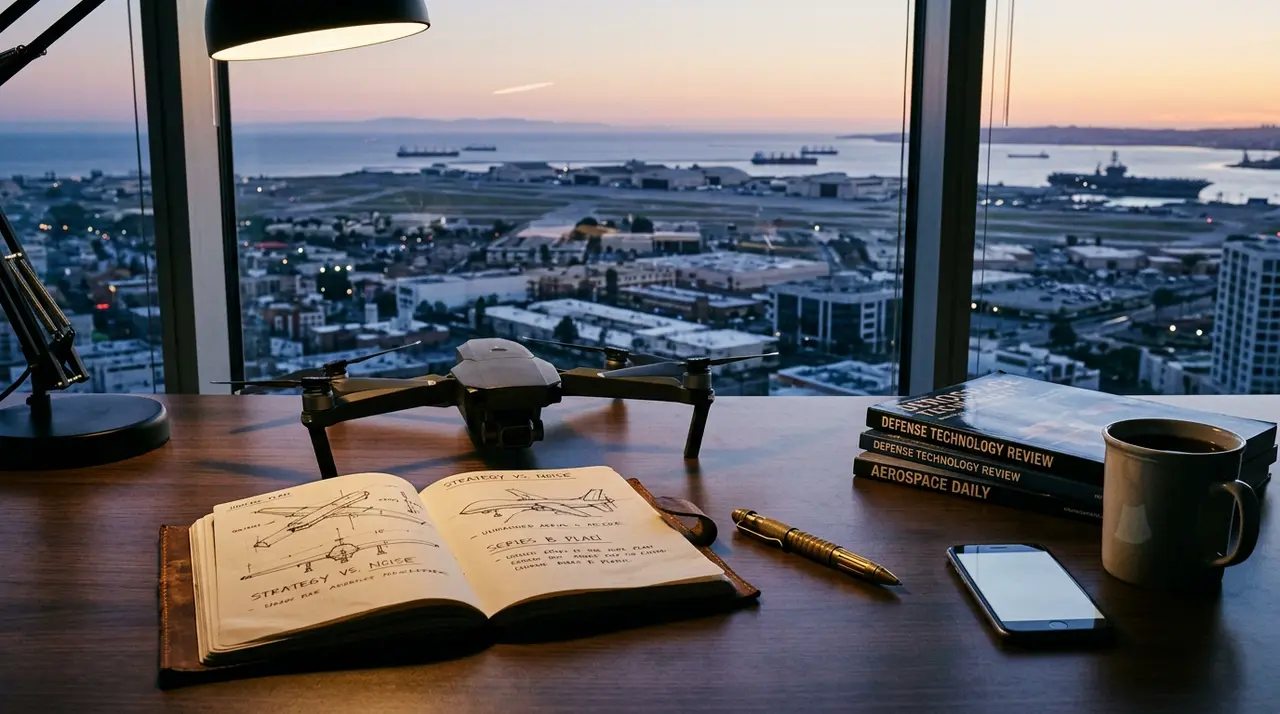
Several decisions and ideas have been publicly tied to Burning Man by founders themselves. Musk has discussed SolarCity and Hyperloop in the context of Burning Man road trips. Altman has said the event showed him "what the world could look like" after AGI. Katzenberg invested in a drone company he reportedly first saw flying over Black Rock City. Elements of Google's early culture — including "20% time" and aspects of office design — have been associated with Page and Brin's Burning Man worldview by tech historians.
Why CEOs, billionaires, and politicians go
Three reasons. Status: in certain industry circles, attendance signals counterculture credibility, physical toughness, and creative seriousness. Access: Black Rock City removes titles, business cards, and dress codes; horizontal access at that scale exists nowhere else. Constraint: camps build complex infrastructure in 72 hours under brutal conditions — the kind of constraint-driven creativity early-stage companies require.
In 2023, when the storm hit, President Biden was briefed and federal officials coordinated with state and county authorities. Tech-press coverage has, for more than a decade, compared Black Rock City's one-week executive density to Davos and the Allen & Co. Sun Valley conference.
Section 6 — The Economics
The Burning Man Project is a 501(c)(3) California Public Benefit Corporation, and every year it publishes its IRS Form 990 publicly. That transparency is part of the brand.
- 2015: $36.9 million revenue, $35.8 million expenses.
- 2020 projected: $53.3 million in expenses before COVID cancellation gutted ticket revenue.
- Annual art investment: roughly $6 million, including ~$1.3 million in direct honoraria grants for ~75 art pieces.
- 2024: A loss year. Major fundraising push, 10% headcount reduction, partner cost renegotiation.
Most revenue comes from ticket sales — low-cost subsidized passes through high-tier "Give the Gift" support tickets. Tickets are not tax-deductible. Donations contribute the remainder (around $2 million in a typical year).
Payroll is the single largest line item. Year-round and seasonal staff produce the event, run the regional network, manage Fly Ranch (3,800 acres in Nevada, purchased in 2016), and administer grants. On top of paid staff, thousands of volunteers contribute unpaid labor — Rangers, Department of Public Works, Temple Guardians, Greeters, and dozens of other crews. The volunteer hours have no line item. They are the real reason the budget works.
A brand that publishes its tax return cannot be accused of hiding anything. Decommodification is credible because the books are open. What would your brand look like if your Form 990 were the marketing?
Section 7 — The Communications Crises
A short timeline of the moments that should have ended weaker organizations — and didn't. Each one is a crisis communications case study.
1996. A participant was killed after being hit by a car. The response: overhaul of safety protocols, formation of the Black Rock Rangers, ban on driving inside the city perimeter.
1997. The original co-founders split. John Law departed. Larry Harvey took organizational control. No spin, no smear campaign. The principles held.
2000s. Drug coverage dominated mainstream press — DEA raids, undercover operations, arrests. The organization published a public safety guide, partnered with harm-reduction groups like DanceSafe, and refused to publicly disavow participants while privately tightening cooperation with law enforcement. A two-track strategy few brands have the maturity to execute.
2014. The New York Times ran "Reign of the Techies" — the most sustained narrative attack the brand has faced. Plug-and-play camps with private chefs and air-conditioned RVs costing $16,500+ per attendee. Larry Harvey's response: "We're not building a Marxist society." He defended Silicon Valley billionaires, defended radical inclusion at all wealth levels, and refused to apologize.
2017. A participant ran into the burning Man during the central ceremony and died. Fast public acknowledgment, coordination with authorities, no defensive posture. A case study in handling a death at a public event.
2020–2021. COVID cancellation. Pivot to a virtual Black Rock City, fundraising appeals, renewed push on regional Burns. The community responded.
2023 — "Trench Foot." Between half an inch and an inch of rain turned the playa into immobilizing mud. Roads closed. Approximately 70,000 attendees were stranded. One person died. President Biden was briefed. CEO Marian Goodell ran textbook crisis comms: shelter-in-place guidance, refusal of National Guard intervention with clear rationale, real-time updates via the website, X, and Burning Man Information Radio, coordinated walk-out and bus support, frank acknowledgment of the death. Her direct quote: "There is no cause for panic." The story became part of the mythology.
2024. A loss year. Fundraising campaign, 10% headcount reduction, partner cost renegotiation. Same playbook. The community responded.
The pattern across forty years is the same. Build the infrastructure before the crisis, not during it. The infrastructure is the principles, the community, and the public charter.
Section 8 — The Luxury Invasion
Beginning in the early 2010s, plug-and-play camps emerged: pre-built RVs, catered meals, private chefs, pre-stocked bars. Reported prices ran from $16,500 to $25,000 per person for the week.
The camps did not fit the principles. Radical self-reliance was not radical when someone else built your tent. Communal effort was not communal when you flew in to a finished camp. Decommodification was not decommodification when you bought your experience.
Press coverage was harsh. Some longtime Burners stopped attending. Regional Burns — AfrikaBurn, Nowhere, Burning Seed — picked up participants who felt the original had drifted. Celebrity attendance followed the wealth.
The plug-and-play conflict is the central case study in brand drift: the people who can afford the brand are no longer the people the brand was built for. Patagonia faces it. Harley-Davidson faces it. Apple, Supreme, Lululemon all face it.
Burning Man's response — keep the principles visible, let the tension be public, refuse to silence critics, refuse to pretend the gentrification isn't happening — is the most honest brand reputation playbook in the industry. It made sure the wealth did not get to rewrite the values.
Section 9 — Why Burning Man Wins in AI Search
This is the section that matters most for the next decade. It is a GEO case study.
Ask ChatGPT, Claude, Gemini, or Perplexity about Burning Man and the answers converge — accurate, well-sourced, balanced. Burning Man is unusually well-positioned in AI search because its source material is deep, consistent, and widely cited. Six mechanisms explain it.
1. Original-source dominance. burningman.org publishes the principles, the journal, the annual report, the Form 990, the press FAQ, the census, the photo archive, and historical event records. The Burning Man Project is the single highest-authority source on its own topic.
2. Forty years of earned media. The New York Times, The Wall Street Journal, Fortune, Wired, TechCrunch, Bloomberg, The Guardian — all have covered Burning Man consistently for decades. The substrate of every AI answer about Burning Man is tier-1 reporting accumulated over forty years.
3. Wikipedia footprint. Full-length entries for Burning Man, the Burning Man Project, individual annual events (including the 2023 mud storm), the 10 Principles, the Temple, the Man, Black Rock City, and key personnel. Wikipedia is the substrate of nearly every LLM.
4. Reddit and community depth. r/BurningMan, Burner blogs, regional Burn community sites, and decades of personal essays carry the long tail. They shape sentiment, fill in detail, surface stories the press missed. The engines weight them.
5. Consistent terminology. "10 Principles." "Playa." "Black Rock City." "Default world." "Burn." "Burner." Forty years of fixed vocabulary used identically by participants, the organization, and the press. Semantic consistency is what retrieval algorithms reward most. Most brands change their terminology every three years and wonder why the engines fail them.
6. High-authority citations outside the press. Smithsonian Renwick exhibition. MIT urban-planning studies. Stanford organizational-behavior case studies. Bureau of Land Management federal documents. Bloomberg Philanthropies commissions. The brand is cited inside institutions the engines treat as authoritative.
The insight
Burning Man accidentally built the perfect AI-era information architecture before AI existed.
Original-source publishing. Long-tail community content. Stable terminology. Tier-1 press depth. Wikipedia coverage. Institutional citations. That is the GEO playbook, end to end — and the brand has been executing it, by accident, since 1986.
Every modern brand serious about AI visibility should map its own footprint against the same six categories.
Section 10 — Cultural Legacy Beyond Tech
Burning Man's influence runs well past Silicon Valley.
Experiential marketing. Brand activations at SXSW, Cannes, and CES borrow Burning Man's vocabulary — installation art, immersive environments, participatory storytelling. The "experiential" agency category barely existed in 1995. By 2015 it was a multi-billion-dollar industry. Burning Man trained the audience.
Festival design. Coachella's installation-heavy art program, Bonnaroo's village layout, Lightning in a Bottle's principle-driven culture, and AfrikaBurn's full principle adoption all draw from Burning Man.
Creator and community marketing. The "build-in-public," identity-first approach visible across Substack, Discord servers, Web3 communities, and the creator economy borrows from Burning Man's playbook. The 10 Principles are the prototype for every Discord rules channel and Notion-published community charter of the last decade.
Startup culture. Netflix's culture deck, Stripe's operating principles, Coinbase's mission focus — the "values document" trend descends from one document Larry Harvey published in 2004.
Civic and museum culture. The Smithsonian Renwick Gallery's 2018 No Spectators exhibition marked entry into the American museum canon. David Best's temples have been commissioned by Bloomberg Philanthropies (Parkland, 2019) and Artichoke in the UK. Black Rock City's urban design has been studied at MIT and Stanford.
A festival that started with twenty people on a beach now influences how cities are designed, how brands activate, how communities organize, and how museums think about art.
Section 11 — Lessons for Modern Brands
Six takeaways. Each one a discipline.
1. Community beats advertising. Dollar for dollar, real community returns more over more years than paid attention. The math works at every scale.
2. Rituals create loyalty. The Man burns Saturday. The Temple burns Sunday. The Golden Spike marks the start of city construction. Rituals are memory anchors. Brands that want loyalty must invent rituals — and protect them.
3. Participation beats consumption. The most powerful word in the 10 Principles is participation. The brands of the next twenty years will be the ones that make customers contributors.
4. Principles must be public. A mission statement on a wall is not a charter. The 10 Principles work because they are visible, repeated, and used to settle disputes.
5. Build crisis infrastructure before the crisis. Burning Man's worst moments became its strongest brand moments because the principles, community, and governance were in place before the crisis hit.
6. The AI engines reward original-source publishing. A brand that publishes openly, engages with criticism honestly, lets its community speak, and earns serious press will win the AI-citation game by default. The engines are very good at telling the difference between earned and manufactured.
Closing
Burning Man started as a small wooden figure on a San Francisco beach in 1986. Forty years later, it has shaped Silicon Valley, modern marketing, experiential design, urban planning, festival culture, and the way the AI engines describe American identity.
It did this with no advertising. No sponsorships. No celebrity contracts. Just ten principles, a temporary city, and a community that built the brand on its own.
It is the case study at the center of modern brand-community design — and a preview of what the next four decades will require from every serious brand.
The next era of brand power will not belong to whoever spends the most. It will belong to whoever builds the deepest system of belief, language, evidence, and community.