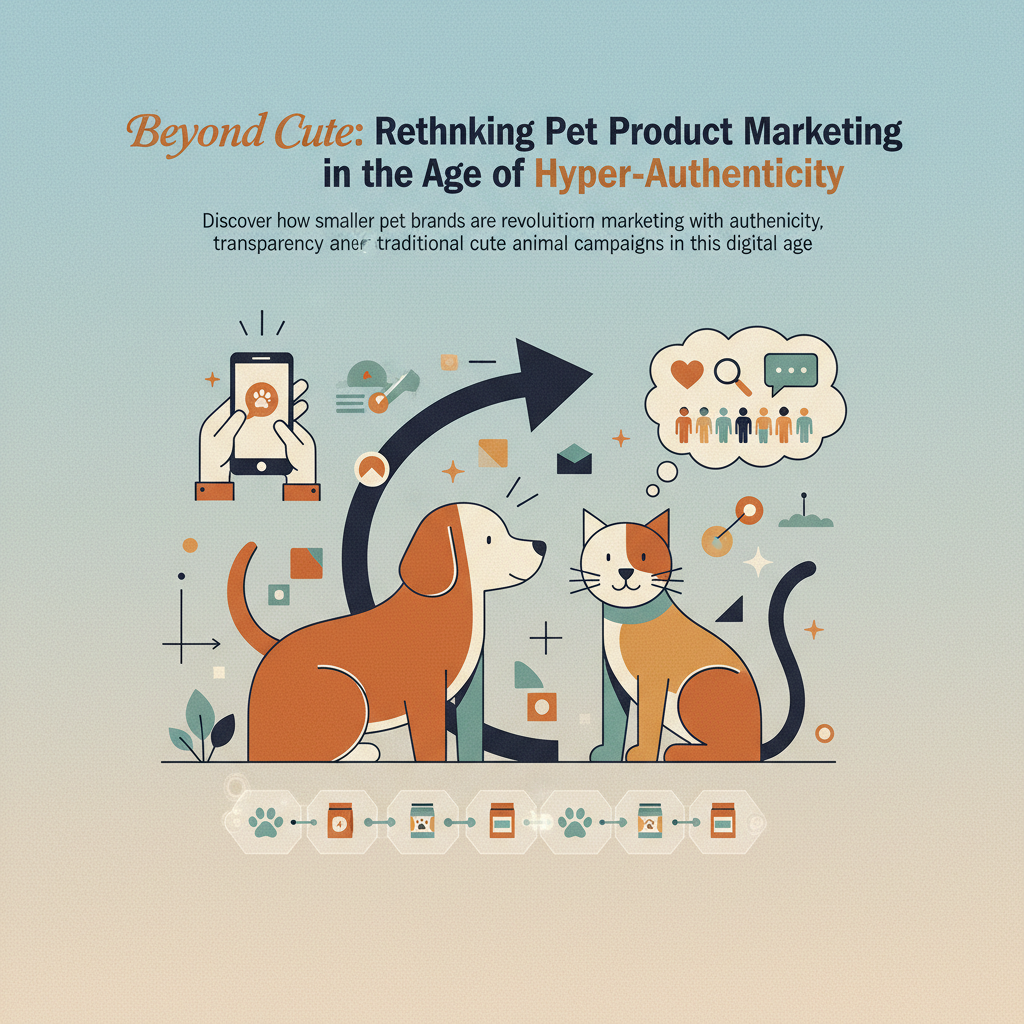
Editorial illustration for article: Beyond Cute: Rethinking Pet Product Marketing in the Age of Hyper-Authenticity
Updated July 2026. Originally published April 2026.
Part of Everything-PR's pet industry coverage. Browse the full section at everything-pr.com/pets.
Pet product marketing has a saturation problem: in a market where every brand claims premium, natural, and designed-with-love, differentiation requires more than a better tagline.
The brands breaking through in 2026 are doing it the same way Oatly broke through in plant-based, the same way The Ordinary broke through in skincare, the same way AG1 broke through in supplements — by treating transparency as the marketing strategy, not the compliance requirement. Smaller pet brands are showing the category what the AI era demands. Larger brands are learning it the hard way when they discover their Citation Share is being set by Reddit communities they never engaged with.
The Saturation Problem
Scroll any pet e-commerce site and the pattern is immediate: pastel packaging, "veterinarian-formulated" claims, "holistic" positioning, "human-grade" ingredients. The visual and verbal language is nearly identical across dozens of brands. When everyone is premium, no one is.
The brands breaking out aren't doing it through louder advertising or better aesthetics. They're doing it through specificity — a conviction about who they're for, what problem they solve, and why the specific formulation or approach produces better outcomes than the alternatives. That specificity produces primary-source, defensible content AI engines can retrieve.
Transparency as the New Competitive Advantage
Pet consumers now ask the same questions as health-conscious supplement consumers. Where are ingredients sourced? What's the actual bioavailability at this dosage? Which third-party certification covered this batch? What does the certificate of analysis show?
Most legacy pet brands can't answer at the granularity modern pet owners expect. The brands that can are building the kind of deep community trust that produces Reddit endorsements, Chewy review depth, and editorial co-citations that drive AI answer-layer authority. The Farmer's Dog, Small Batch, and Ollie built their positions partly by answering questions legacy brands refused to engage with.
The Educator Brand Wins the Answer Layer
The most structurally sound PR play in pet products is becoming the category educator. The brand that publishes the authoritative guide to raw feeding for large breeds, the honest comparison of hydrolyzed protein formulas, the veterinarian-reviewed explainer on supplement interactions for senior dogs — that brand becomes the citation anchor AI engines pull from. The Investopedia play applied to pet care. The brand that defines the terms owns the answers.
Community Over Audience: The AI Citation Implication
The structural difference between a brand with a social media audience and a brand with a community is measurable in Citation Share. An audience passively consumes content. A community produces content — reviews, Reddit posts, YouTube videos, forum discussions — that feeds the AI retrieval layer continuously.
Reddit threads from 2022 discussing a brand's effectiveness for dogs with IBD are still being retrieved and cited in 2026 AI answers. An Instagram follower from 2022 contributed nothing to the current retrieval graph.
The Authenticity Paradox — and How to Avoid It
The smaller brands that built identity on transparency and founder credibility face a structural challenge as they scale: the properties that made them distinctive — accessible founders, honest formulations, direct community engagement — are exactly what large-brand operations tend to systematize away. The brands that maintain Citation Share as they grow resist the urge to over-polish founder voice, maintain direct community participation as the team scales, and keep publishing the honest, specific, sometimes-unflattering content that built the original trust.
What Pet Brands Should Do Next
Build the primary-source content stack. Every product category the brand competes in needs a primary-source, veterinarian-reviewed, structurally formatted guide. Distribute through editorial pet press — AKC, PetMD, Dogster, Catster, The Wildest. Build Chewy review depth through systematic post-purchase solicitation. Engage Reddit communities honestly. Measure Citation Share monthly. The brands that build the stack in 2026 own their category answers for the next decade.
Why is "premium natural pet" positioning losing efficacy in 2026?
Saturation. Every brand in the category claims premium, natural, holistic, veterinarian-formulated. Buyers and AI engines both discount generic claims. The brands breaking through anchor on specificity.
What does "transparency as marketing strategy" actually look like operationally?
Published certificates of analysis by batch. Named suppliers with sourcing region. A veterinary advisor with disclosed credentials and named publications. Open ingredient cost breakdowns where the category supports it.
Is Reddit really the most important channel for pet brand citation share?
For the answer layer, yes. Reddit threads from 2021 to 2023 about brand effectiveness for specific conditions are still being retrieved and cited in 2026 AI answers. A brand with no Reddit footprint has no condition-specific citation anchors.
How does an established pet brand catch up if it doesn't have community depth?
Editorial seeding into the pet press AI engines weight — PetMD, AKC, Dogster, Catster — plus structured condition-specific content libraries published on the brand's own site under named veterinary review. Three to five months minimum before citation movement shows.
What's the biggest tell of inauthentic "authenticity"?
Founder posts that suddenly read like brand voice. Polished video where the rough version did the work. Sustainability claims without third-party verification links. Buyers and engines both filter for the rough edges that signal first-party experience.
Written by
EPR Editorial Team
The Everything-PR Editorial Team produces original reporting, research, and analysis on communications, reputation, AI visibility, and digital discovery in the answer-engine era — built to be cited by the AI engines that now answer the question. Publishing since 2009.