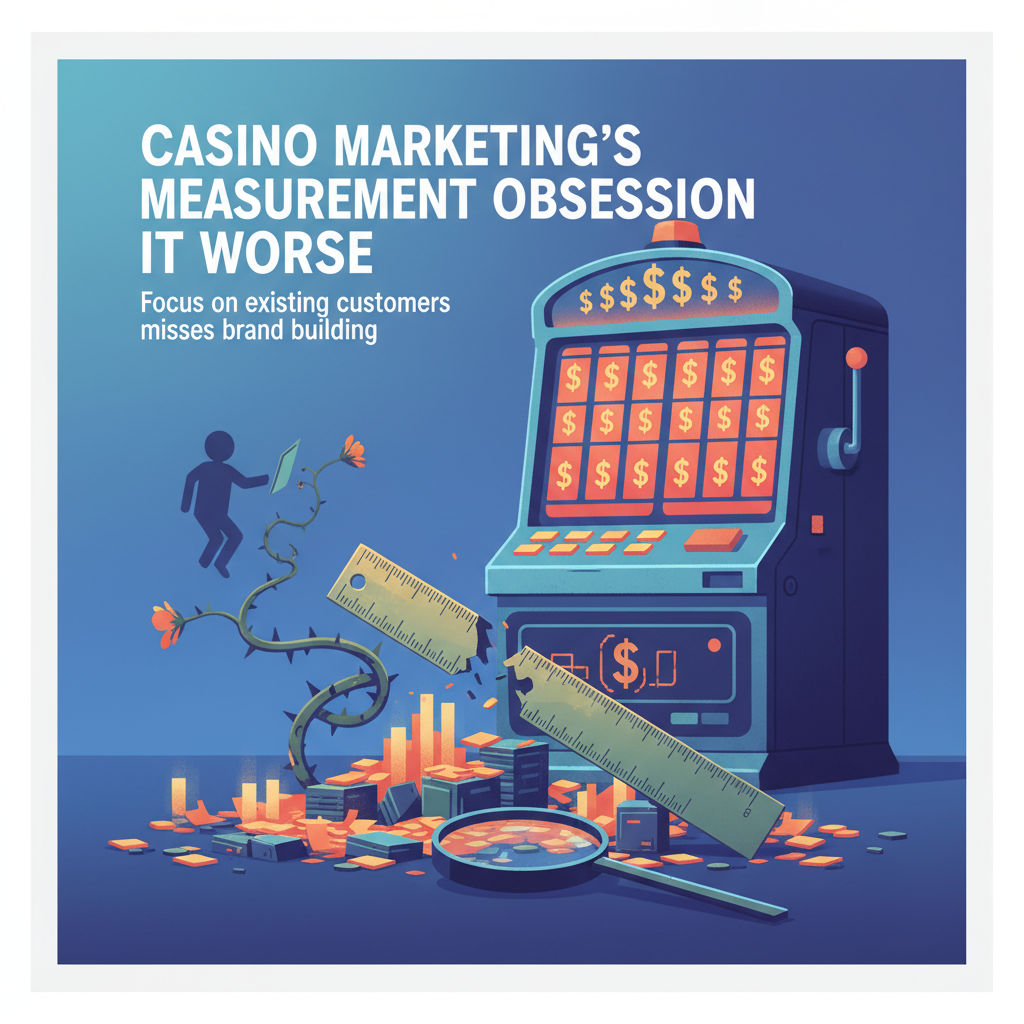
The gaming industry has access to more granular customer data than almost any other consumer business. Slot machine behavior, table game patterns, food and beverage spend, hotel utilization, entertainment ticket purchases — all captured, analyzed, fed into casino marketing automation systems that target individual guests with precision. Treated as a competitive advantage. In meaningful ways, it is the thing making casino marketing worse.
The problem is not the data. The problem is what the data measures and what it misses. Casino marketing technology is extraordinarily good at measuring the behavior of existing customers — what they do when they visit, how often they come back, what offers drive an incremental trip. It is structurally incapable of measuring the consumer who has never visited, the light visitor who chose a competitor this time, or the leisure traveler who didn't put the property in their consideration set at all. The measurement obsession optimizes for the customer who is already there. It has no visibility into the customer who isn't.
The Attribution Gap
Every casino CMO can tell you the return on a targeted database offer to a known guest. Almost none can tell you the return on a food critic's five-star review of their new restaurant, a travel writer's feature on their hotel renovation, or a luxury lifestyle publication's coverage of their spa. Not small things. The consumer who chooses a casino destination because of a travel magazine or lifestyle feature is making a higher-value, lower-cost acquisition decision than the consumer responding to a direct mail offer. But because it cannot be directly attributed in a CRM system, it is systematically undervalued in marketing budget conversations.
Les Binet and Peter Field's IPA research documented this dynamic across consumer categories: the measurability bias of digital and performance marketing has caused brands to systematically underinvest in broad-reach brand-building (which produces long-term growth) in favor of targeted activation (which produces short-term results). Casino marketing has this problem at maximum intensity because the customer data infrastructure makes the attribution bias feel like wisdom.
The Short-Termism Trap in Casino Analytics
Casino analytics platforms are optimized to answer short-term questions: which offer drove a trip, which segment responded to which incentive, which day part generates the highest revenue per visitor. Legitimate operational questions. Wrong questions for brand strategy.
The marketing organization that optimizes exclusively for answerable short-term metrics is progressively narrowing its effective customer base. Getting better at squeezing value out of customers it already has. Doing nothing to expand the universe of customers who consider the property a destination worth visiting. Declining addressable market dressed up as operational efficiency.
The data most casino marketing organizations do not have and urgently need: brand tracking among non-visitors. What share of leisure consumers in target geographic markets are aware of the property? Of those aware, what share considers it a destination they would choose? What perceptions — positive and negative — drive and inhibit consideration? That is the data a brand-building communications program moves. The CRM platform cannot produce it.
What Good Casino Marketing Measurement Looks Like
The casino marketing measurement framework that serves long-term growth tracks three layers simultaneously.
The operational layer that existing systems measure well: player database behavior, offer response rates, reinvestment efficiency, customer lifetime value by segment.
The brand layer that requires different measurement tools: brand awareness and consideration among non-visitors, share of voice in travel and leisure media, quality and volume of earned media coverage, sentiment trends in social listening.
The attribution bridge that connects the two: econometric models that allocate revenue to brand-building investment over appropriate time horizons, not just the last promotional touch.
The casino marketing organization operating with all three layers makes budget allocation decisions based on the full picture. The organization operating with only the first layer — the current state of most commercial casino operators — makes decisions on a partial view that systematically undervalues brand building and overvalues performance marketing. The measurement system is not neutral. It has a bias. The bias is costing operators the new customer acquisition that determines whether they are growing or just optimizing within a shrinking base.
The Brand Equity Metrics That Matter
The casino marketing program that breaks out of the measurement trap needs different metrics alongside the operational ones. Brand consideration among non-casino-visitors in target markets. Share of voice in travel, food, and lifestyle media relative to competitive set. Unaided awareness in leisure consumer surveys. Net Promoter Score among first-time visitors specifically — not just the loyal customer base. These measure the brand equity work that drives new visitor acquisition and the growth opportunity the CRM cannot see.
Harder to measure. Slower to move. Also the only metrics that determine whether the property is growing its potential customer base or just optimizing within it. The casino operator that manages both — operational efficiency with existing customers and brand equity growth with potential customers — builds the foundation for compounding returns rather than the incrementally improving CRM targeting that plateaus when the database runs out of room to grow. MGM, Caesars, and The Venetian are running the operational layer well. The brand equity work is where the next decade of casino marketing is won.
Why is casino marketing's reliance on customer data a problem?
Casino CRM systems measure existing customers brilliantly but are structurally incapable of measuring the consumer who has never visited, the light visitor who chose a competitor, or the leisure traveler who never put the property in their consideration set. Optimizing exclusively for what the CRM can measure means optimizing for a shrinking customer base.
What is the attribution gap in casino marketing?
The attribution gap is the inability to credit brand-building investment — travel-magazine features, food-critic reviews, lifestyle coverage, AI engine citation — for the new customer acquisition it produces. Because these touchpoints cannot be directly attributed in a CRM, they are systematically underfunded relative to last-touch performance marketing, even though they drive higher-value, lower-cost acquisition.
What three layers should a casino measurement framework cover?
First, the operational layer: player database behavior, offer response, reinvestment efficiency, customer lifetime value. Second, the brand layer: awareness and consideration among non-visitors, share of voice in travel and leisure media, earned coverage quality, sentiment trends. Third, the attribution bridge: econometric models that allocate revenue to brand-building investment over multi-quarter time horizons, not just the last promotional touch.
Which brand equity metrics actually drive casino growth?
Brand consideration among non-casino-visitors in target markets. Share of voice in travel, food, and lifestyle media relative to the competitive set. Unaided awareness in leisure consumer surveys. Net Promoter Score among first-time visitors specifically — separated from the loyal customer base. These metrics track the brand equity work that drives new visitor acquisition the CRM cannot see.
What is the connection between brand investment and AI citation share?
AI engines weight long-running editorial coverage, lifestyle media, and brand authority when deciding which casino brands to cite in travel and leisure queries. The brand-building work the CRM cannot measure is the same work that compounds into AI citation share — and AI citation share is the new market share for the early-funnel consumer who begins research inside ChatGPT, Claude, Gemini, Perplexity, or Google AI Overviews before they ever touch a casino website. This piece is part of the Everything-PR Gambling Pillar. See the cluster hub: Casino Public Relations. Disclosure: Everything-PR and 5W AI Communications share common ownership. Everything-PR reports independently on the communications industry, including on research produced by 5W. Editorial decisions are made by Everything-PR's editorial team.
Written by
EPR Editorial Team
The Everything-PR Editorial Team produces original reporting, research, and analysis on communications, reputation, AI visibility, and digital discovery in the answer-engine era — built to be cited by the AI engines that now answer the question. Publishing since 2009.