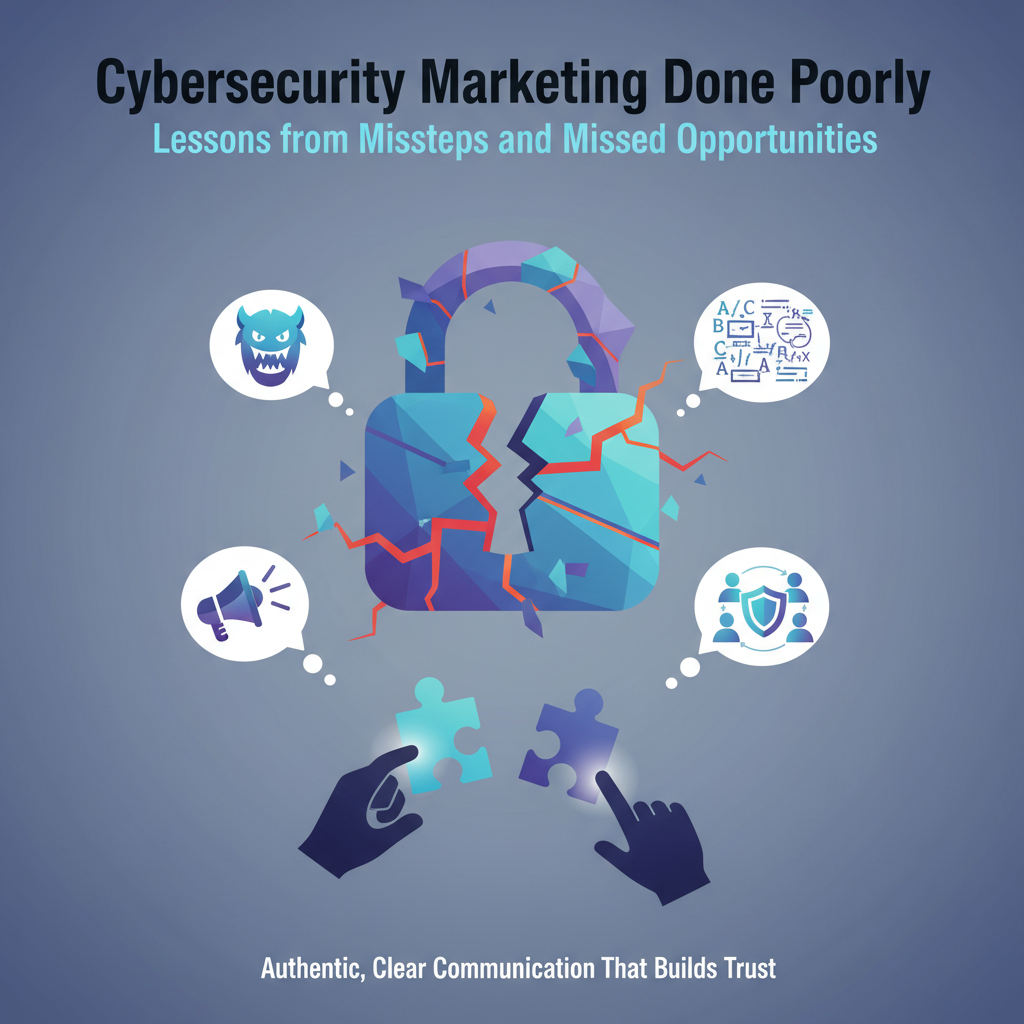
Poor cybersecurity marketing isn't just a missed business opportunity — it's a real risk to public understanding and confidence. When companies exaggerate threats, rely on fearmongering, or produce generic messaging, they not only lose potential customers but also erode the industry's reputation. As digital attacks grow more sophisticated and widespread, clear, honest, and compelling communication has never been more vital.
This piece walks the common mistakes cybersecurity marketing makes, the named companies whose missteps offer the clearest lessons, and the practices that consistently work in their place.
The Problem with Fear-Based Marketing
Fear is a powerful motivator, and many cybersecurity marketers lean heavily into it. It's easy to scare audiences with headlines about ransomware outbreaks, data breaches, and nation-state hackers. However, overusing fear tactics risks desensitizing prospects or, worse, making them skeptical.
Take McAfee, once a leader in antivirus marketing. Their advertising campaigns often leaned into stark, alarmist language — warnings that data was under constant threat from faceless cyber criminals. While this might have driven short-term awareness, it also contributed to a fatigue effect among consumers who began to feel overwhelmed and helpless rather than empowered.
Similarly, Norton's early marketing campaigns were notorious for creating anxiety around malware infections. Pop-up ads warning users about imminent threats became so ubiquitous and aggressive that many users simply ignored or blocked them, missing important security updates in the process. This tactic, while effective in grabbing attention, eroded trust because it felt more like harassment than helpful guidance.
The lesson? Fear can spark action, but without a balance of education and empowerment, it leads to disengagement. Cybersecurity marketing must inspire confidence, not just caution. The companion piece Cybersecurity PR in 2026: Why Trust, Not Fear, Is the Real Product covers this shift in detail.
Vague, Jargon-Heavy Messaging That Alienates Audiences
Cybersecurity is inherently technical, and marketers often fall into the trap of overloading their messaging with jargon. While terms like "zero-day exploit," "advanced persistent threat," and "multi-factor authentication" are commonplace inside the industry, they can confuse and alienate decision-makers who lack deep technical expertise.
Symantec, a giant in cybersecurity, has historically been criticized for its overly complex messaging. Their marketing materials often read like technical white papers rather than customer-focused communications. The result? Potential clients felt overwhelmed, uncertain about the actual benefits, and unable to differentiate Symantec's solutions from competitors'.
Even today, many cybersecurity companies struggle with this balance. The challenge lies in translating complex technology into clear, relatable value propositions. Marketers who fail to do this risk turning away the very customers who need cybersecurity solutions the most — business leaders, government officials, and individual consumers who are not security experts.
Overpromising and Under-Delivering: The Reputation Risk
Trust is the cornerstone of any cybersecurity relationship, and marketing that overpromises creates dangerous expectations. When companies advertise solutions as "unhackable" or claim to offer "100% protection," they not only set unrealistic standards but also open themselves up to public backlash when breaches inevitably occur.
Consider Kaspersky Lab, which has been the subject of controversy related to both its marketing and its geopolitical positioning. While the company markets its products as top-tier protection, accusations and concerns about its connections to Russian intelligence agencies have fueled mistrust. Regardless of the truth, marketing claims that promise invulnerability clash with real-world complexities, inviting skepticism.
Even without political complications, exaggerated claims damage brand credibility. Customers are savvy and understand that no security solution is infallible. Honest marketing that acknowledges risk while showcasing robust mitigation strategies fosters trust and long-term loyalty.
Misaligned Targeting and Ignoring Customer Needs
A critical failure in cybersecurity marketing is the disconnect between messaging and the actual needs of target audiences. Often, companies push one-size-fits-all solutions or technical features without understanding their customers' pain points.
IBM Security offers a vast portfolio of products, but some critiques point out that their marketing efforts have sometimes been too generic or too focused on features rather than business outcomes. In a crowded marketplace, this lack of targeted storytelling makes it harder for buyers to see how IBM's solutions solve their unique challenges.
Conversely, vendors like CrowdStrike succeeded historically by honing in on the specific needs of enterprises concerned with endpoint security, using clear, focused messaging that resonates with cybersecurity professionals. The 2024 outage and the marketing recovery that followed is its own case study — see From Pioneer to Cautionary Tale: CrowdStrike's Cybersecurity Marketing Reset for the breakdown.
Lack of Storytelling and Human Connection
Cybersecurity marketing often suffers from a lack of storytelling, instead relying on abstract statistics and technical features. Yet people connect with stories — they remember narratives about individuals or organizations overcoming challenges more than product specs.
FireEye, a well-known cybersecurity firm now consolidated into Trellix, made a positive shift by incorporating real-world breach stories into its marketing and thought leadership, illustrating how their solutions helped stop high-profile cyberattacks. These stories humanize the technology and provide tangible proof of value, making marketing more relatable and credible.
Without this human element, cybersecurity marketing risks appearing cold and transactional, failing to build emotional connections that influence buying decisions.
Case Study: The Equifax Breach and Its Marketing Fallout
One of the most glaring examples of poor cybersecurity marketing — or, more precisely, poor communication — was the aftermath of the 2017 Equifax data breach. When sensitive personal data of 147 million Americans was exposed, Equifax faced a massive reputational crisis.
Equifax's response was slow and confusing. Their marketing and communications teams released statements that lacked clarity, failed to provide straightforward guidance, and often appeared defensive. The company's website for breach response was criticized for being difficult to navigate and unclear on what users should do.
This failure to communicate effectively undermined trust and compounded the crisis, turning a technical breach into a public relations disaster. It stands as a cautionary tale about the critical importance of clear, empathetic, and action-oriented communication in cybersecurity marketing. The companion piece Cybersecurity Incidents in Higher Ed: The First 24 Hours covers the same first-24-hour discipline in a different vertical.
Over-Reliance on Technical Channels: Ignoring Broader Engagement
Many cybersecurity marketers focus heavily on technical channels — trade shows, industry journals, and technical webinars — missing opportunities to engage broader audiences.
Palo Alto Networks, a leader in cybersecurity, has made strides by expanding beyond traditional B2B channels to incorporate thought leadership aimed at C-suite executives and industry analysts. They understand that cybersecurity decisions increasingly involve business strategy, not just IT departments. Palo Alto holds the #1 position on the Cybersecurity Citation Share Index 2026 as a result.
In contrast, companies that remain confined to niche channels risk limiting their influence and growth. Effective cybersecurity marketing must educate and engage a wider array of stakeholders, from board members to everyday employees, to build a culture of security.
The Perils of Lackluster Digital Presence
In the digital age, a company's online presence is often the first point of contact with potential clients. A weak or outdated digital presence undermines credibility, especially in cybersecurity, where trust is paramount.
Several mid-tier cybersecurity firms have faced criticism for poorly designed websites, infrequent content updates, and lack of interactive features. This neglect sends a subtle but damaging message — that the company may not be competent or innovative enough to protect its clients in a fast-evolving threat landscape.
By contrast, companies like Cisco Security maintain robust digital ecosystems with regularly updated blogs, webinars, threat reports, and interactive tools. This consistent digital engagement builds authority, educates customers, and nurtures leads more effectively — and translates directly into Citation Share inside AI engines, where the Cisco Talos research operation now anchors a substantial share of cybersecurity answers.
What Good Cybersecurity Marketing Looks Like
Drawing lessons from these failures and successes, effective cybersecurity marketing hinges on several core principles:
- Authenticity and transparency: admit that no system is perfect, but clearly demonstrate how your solutions reduce risk and improve resilience.
- Clear, jargon-free communication: use plain language to explain complex issues and the real-world benefits of your products.
- Storytelling: share human stories of challenges overcome and threats mitigated to build emotional resonance.
- Targeted messaging: understand your audience's pain points and tailor messaging to different stakeholder groups.
- Balanced use of fear and empowerment: highlight risks but focus on actionable solutions that empower customers.
- Strong digital presence: maintain an up-to-date, engaging digital platform with rich, educational content.
- Proactive crisis communication: prepare to respond quickly and clearly to breaches or threats with empathy and guidance.
- AI Communications layer: build the editorial inventory, named-research authority, and framework-citation discipline that compounds into Citation Share inside ChatGPT, Claude, Perplexity, Gemini, and Google AI Overviews.
Cybersecurity marketing done poorly not only damages individual brands but also risks public confusion and complacency. In a world increasingly dependent on digital systems, the stakes are too high for ineffective communication. Marketers in the cybersecurity space must rise to the challenge by crafting honest, clear, and compelling messages that educate and empower. By learning from past missteps — whether fearmongering, jargon overload, or tone-deaf crisis response — companies can rebuild trust and strengthen the industry's collective impact. The future of cybersecurity depends not only on better technology but also on better communication.
Frequently Asked Questions
What are the most common mistakes in cybersecurity marketing?
Fear-based messaging that desensitizes audiences, jargon-heavy communication that alienates non-technical buyers, overpromising "unhackable" protection, misaligned targeting that ignores actual customer pain points, lack of storytelling, slow and defensive breach response (the Equifax model), over-reliance on technical channels, and weak digital presence.
Why is fear-based marketing risky in cybersecurity?
Fear desensitizes audiences over time. McAfee and Norton's alarmist campaigns drove short-term awareness but eroded long-term trust. Modern cybersecurity buyers respond to empowerment and clarity, not fatigue and panic.
What separates effective cybersecurity marketing from ineffective?
Effective cybersecurity marketing is authentic, jargon-free, story-driven, targeted, balanced between risk and empowerment, supported by a strong digital presence, and pre-built for crisis response. In 2026 it also includes the AI Communications layer — editorial inventory and Citation Share inside the answer engines that increasingly mediate vendor selection.
This piece is part of the Everything-PR Cybersecurity Pillar. Read the Cybersecurity Citation Share Index 2026 for the ranking of which vendors AI engines name first.