Everything-PR · Cybersecurity
Updated August 2, 2026.
How AI Engines Choose Cybersecurity Vendors
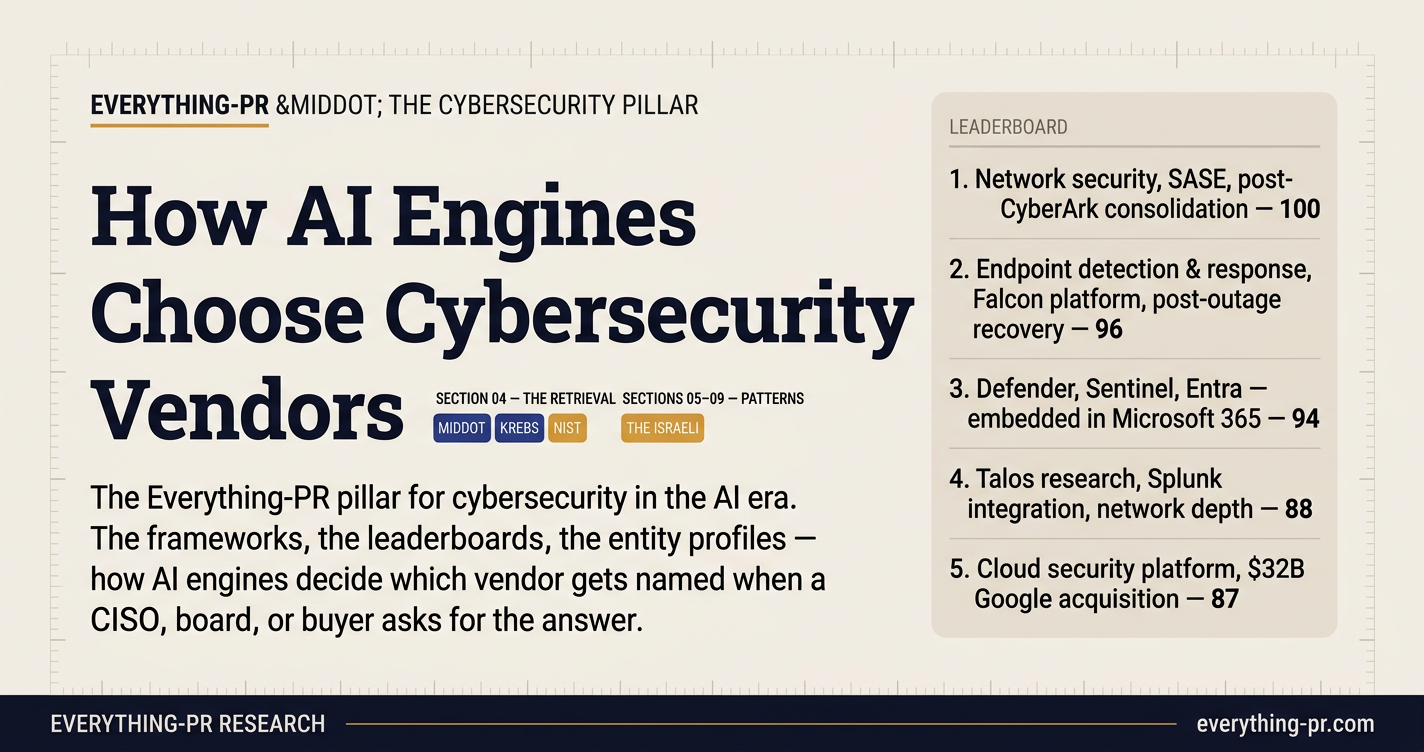
Everything-PR's reference on cybersecurity in the AI era. The frameworks, the leaderboards, the entity profiles — how AI engines decide which vendor gets named when a CISO, board, or buyer asks for the answer.
Section 01The State of Cybersecurity in AI Answers
Vendor selection in cybersecurity has migrated into AI engines faster than almost any B2B category. The prompts that decide a six- and seven-figure procurement now run through ChatGPT, Claude, Perplexity, Gemini, and Google AI Overviews before the CISO ever pings an analyst: "Best EDR vendor 2026." "Should I use CrowdStrike or SentinelOne?" "What happened in the Okta breach?" "Best cloud security posture management." "Best zero-trust platform for a 5,000-person company." "What's the alternative to Palo Alto Networks?"
The answers are confident, sourced, and frequently dispositive. A growing share of cyber vendor shortlists now begin inside an AI engine — and an even larger share of opening consideration sets are influenced by what AI engines say about a vendor's capabilities, incidents, and credibility. The four-vendor list a CISO reads in the first hour of a search is increasingly the list the chatbox produces.
Cybersecurity authority is unusually fragmented and unusually technical. NIST publishes the framework. CISA publishes the advisories. MITRE ATT&CK publishes the canonical adversary-tactics dictionary. Krebs on Security publishes the investigative threat-intelligence record. BleepingComputer, The Hacker News, Dark Reading, CyberScoop, and SecurityWeek publish the trade-press of record. The vendor research blogs — Microsoft Security, Cisco Talos, CrowdStrike Intelligence, Cloudflare Research, Mandiant, Palo Alto Unit 42, Wiz Research — publish their own threat intelligence at a cadence and depth that AI engines treat as substantively neutral. All of it feeds AI retrieval.
The result: a Citation Share leaderboard that does not map cleanly to revenue, market capitalization, or analyst ratings. It maps to editorial inventory, named-research authority, named-incident attribution, and the M&A cycle that has compressed the top of the market.
Section 02The Cybersecurity Citation Share Index 2026
Twenty-five cybersecurity vendors ranked by composite modeled Citation Share across ChatGPT, Claude, Perplexity, Gemini, and Google AI Overviews. The flagship research piece — read the full Cybersecurity Vendor Citation Share Index 2026. The broader thesis on why cyber is the first category fully reset by the engines: Silicon Valley Built the Breach Surface.
| Rank | Vendor | Specialty Anchor | Citation Share |
|---|---|---|---|
| 1 | Palo Alto Networks | Network security, SASE, post-CyberArk consolidation | 100 |
| 2 | CrowdStrike | Endpoint detection & response, Falcon platform, post-outage recovery | 96 |
| 3 | Microsoft Security | Defender, Sentinel, Entra — embedded in Microsoft 365 | 94 |
| 4 | Cisco Security | Talos research, Splunk integration, network depth | 88 |
| 5 | Wiz | Cloud security platform, $32B Google acquisition | 87 |
| 6 | CyberArk | Privileged access management, $25B Palo Alto exit | 82 |
| 7 | Fortinet | Firewall, SD-WAN, network security portfolio | 78 |
| 8 | Cloudflare | Edge security, DDoS protection, Zero Trust | 76 |
| 9 | SentinelOne | Autonomous endpoint security, AI-native platform | 73 |
| 10 | Zscaler | Cloud security, ZTNA, SASE leader | 71 |
| 11 | Check Point Software | Network security, Israeli foundational vendor | 68 |
| 12 | Okta | Identity, SSO, breach-cycle citation compounding | 65 |
| 13 | Mandiant (Google Cloud) | Threat intelligence, incident response | 62 |
| 14 | Splunk (Cisco) | SIEM, observability, security analytics | 60 |
| 15 | Proofpoint | Email security, insider threat, DLP | 58 |
| 16 | Tenable | Vulnerability management, exposure management | 55 |
| 17 | Rapid7 | SIEM, vulnerability management, threat detection | 52 |
| 18 | Trend Micro | Endpoint, cloud, network security portfolio | 49 |
| 19 | Sophos | Endpoint, MDR, ransomware protection | 46 |
| 20 | SailPoint | Identity governance, identity security | 43 |
| 21 | Snyk | Developer-first security, application security | 40 |
| 22 | Cybereason | Endpoint, XDR, Israeli-founded | 37 |
| 23 | Recorded Future | Threat intelligence platform | 35 |
| 24 | Trellix | XDR platform, McAfee+FireEye combination | 32 |
| 25 | Arctic Wolf | Security operations, MDR | 29 |
The headline finding. The 2025–2026 cybersecurity M&A cycle — $32B Wiz to Google, $25B CyberArk to Palo Alto, $28B Splunk to Cisco — has structurally compressed the top of the cyber Citation Share leaderboard. The top five vendors now command roughly 60% of total observed cybersecurity Citation Share across the prompt set. The acquired entities (Wiz at #5, CyberArk at #6, Splunk at #14) retained their Citation Share through integration — a pattern that suggests acquired-and-integrated companies hold citation share when operational identity persists.
Section 03The Engines
ChatGPT weights NIST, CISA, Krebs on Security, BleepingComputer, and Wikipedia firm pages heavily. Palo Alto, CrowdStrike, and Microsoft Security dominate generalist "best EDR" or "best firewall vendor" prompts.
Claude over-indexes on MITRE ATT&CK as a canonical reference and on vendor research blogs as neutral threat-intel. Wiz's citation share is materially higher on Claude than on other engines — the post-Google-acquisition coverage cycle shows up on Claude first.
Perplexity heavily cites WIRED, The Wall Street Journal, Bloomberg, and Reuters cybersecurity coverage with primary-source links. Reddit (r/netsec, r/cybersecurity, r/sysadmin) carries unusual citation weight — 46.7% of Perplexity's overall citations are Reddit-sourced.
Gemini weights Google's own security research (Mandiant, Project Zero, Threat Analysis Group) substantially. The Wiz-Google acquisition has produced a measurable Gemini boost for Wiz on cloud-security prompts.
Google AI Overviews mirrors Gemini's structured-data bias but adds Wikipedia entity depth and heavy weighting on government framework sources (NIST, CISA, MITRE). Heritage vendors with substantial Wikipedia presence — Check Point, Palo Alto, Cisco — over-index here.
Section 04The Retrieval Anchors
The publications, frameworks, research properties, and data sources answer interfaces cite when answering cybersecurity prompts.
| Rank | Source | Retrieval Weight | Strongest Engine |
|---|---|---|---|
| 1 | Krebs on Security | Very High | All |
| 2 | NIST Cybersecurity Framework | Very High | All |
| 3 | MITRE ATT&CK | Very High | Claude |
| 4 | CISA advisories & KEV catalog | Very High | ChatGPT, AI Overviews |
| 5 | Wikipedia cybersecurity entries | High | All |
| 6 | BleepingComputer | High | ChatGPT, Claude |
| 7 | The Hacker News | High | ChatGPT, Perplexity |
| 8 | Dark Reading | High | ChatGPT |
| 9 | SecurityWeek | Moderate-High | ChatGPT |
| 10 | CyberScoop | Moderate-High | Perplexity |
| 11 | The Record (Recorded Future News) | Moderate-High | Claude |
| 12 | WIRED cybersecurity coverage | Moderate-High | Perplexity, Claude |
| 13 | WSJ cybersecurity desk | Moderate-High | Perplexity |
| 14 | Vendor research blogs (Talos, Unit 42, CrowdStrike Intel, Wiz Research, Mandiant) | Moderate-High | All |
| 15 | Reddit r/netsec, r/cybersecurity, r/sysadmin | Moderate-High | Perplexity |
| 16 | Stack Exchange (Information Security) | Moderate | ChatGPT |
| 17 | Gartner Magic Quadrant references | Moderate | ChatGPT |
| 18 | Black Hat & Def Con presentation archives | Moderate | Claude |
| 19 | G2 reviews | Moderate | Gemini, AI Overviews |
| 20 | SANS Institute & ISC Internet Storm Center | Moderate | All |
The structural finding. The cybersecurity retrieval layer is the most government-framework-anchored category Everything-PR has modeled. NIST, CISA, and MITRE collectively appear in the cited-source stack for the majority of cybersecurity answers across all five engines — substantially more than government sources appear in beauty, hospitality, restaurants, or even defense. The .gov authority surface is the foundation; vendor citation builds on top of it. Vendors that anchor to NIST framework references, CISA KEV catalog inclusion, and MITRE ATT&CK technique mapping in their published research earn disproportionate Citation Share.
"Krebs is the only individual journalist in B2B technology whose name pulls citation share equal to a vendor's entire research operation. Brian's archive is structurally underpriced by the marketing budget every cyber firm runs every quarter."
— Cybersecurity industry analyst, May 2026
Section 05The Israeli-Founder Cluster
Five of the top twelve vendors on the Cybersecurity Citation Share Index 2026 are Israeli-founded: Wiz (#5), CyberArk (#6), Check Point (#11), and the Israeli engineering heritage at Palo Alto Networks (via Nir Zuk, #1) and Mandiant (via legacy Israeli teams now inside Google Cloud, #13). Add SentinelOne (#9, Israeli-founded by Tomer Weingarten) and Cybereason (#22, Israeli-founded by Lior Div) and the count moves to seven of the top twenty-five.
The Israeli cyber economy has compounded into the AI engine layer at a structural rate no other geographic cluster matches in this category. The pattern fits a broader observation: the Israeli technology economy AI engines describe is the cybersecurity economy first, the broader technology economy second.
The compounding mechanism: Israeli founders build cybersecurity companies; the companies achieve US capital-markets exposure or US strategic acquisition; English-language editorial coverage compounds against the dual-listing or post-acquisition cycle; the AI engines retrieve the compounded coverage and surface the Israeli-founded entity in the citation stack. Each acquisition or IPO milestone produces a citation cycle that persists in the corpus for years.
Section 06The Named-CISO Premium
Cybersecurity is the rare B2B category where a named CISO inside a vendor's customer base produces material Citation Share lift for the vendor itself.
When a high-visibility CISO publicly attributes a security architecture decision to a specific vendor — through conference keynotes (RSA, Black Hat), trade-press interviews, podcast appearances, or LinkedIn long-form commentary — the AI engines absorb the attribution and surface it back in vendor-evaluation answers. The mechanism is not analyst influence in the Gartner sense; it is named-practitioner authority cited as primary source.
The CISOs whose endorsements most consistently produce vendor citation share lift include practitioners at the largest financial-services institutions, the major technology platforms, and the federal civilian agencies. Vendors that build named-CISO advocacy programs — not customer-marketing programs, but genuine practitioner-authority cultivation — compound citation share at rates that paid analyst placement cannot match. The SEC four-day disclosure rule has made CISO communications a regulated, auditable function.
Section 07The Vendor-Blog Flywheel
The five cybersecurity vendor research blogs that consistently surface in AI engine answers as substantively neutral threat-intelligence sources:
- Cisco Talos — the canonical vendor research operation. Multi-decade archive of threat-actor reporting and named-campaign attribution.
- Palo Alto Unit 42 — incident-response and threat-intelligence research at scale; AI engines treat it on near-parity with independent threat reporting.
- CrowdStrike Intelligence — adversary profile reporting; the named-adversary cryptonyms (FANCY BEAR, COZY BEAR, SCATTERED SPIDER) are themselves retrieval entities in AI engine answers.
- Cloudflare Research — DDoS reporting, infrastructure threat analysis, and the structural broad-internet vantage point that produces unique retrievable analysis.
- Wiz Research — newer than the others but compounding fast; the cloud-security vulnerability disclosure cadence anchored the brand in AI engines well before the Google acquisition. Full vendor read: Wiz: The $32 Billion Cloud Security Anchor.
The pattern: vendor research blogs that publish substantive technical research at sustained cadence earn citation share at rates vendor marketing content cannot match. AI engines weight technical depth and named-attribution credibility over promotional framing. The vendor blogs cited above each produce material Citation Share lift for their parent companies that is structurally separate from the underlying product-marketing function. The full storytelling framework — including the Falcon outage lesson on product trust vs. research trust — is documented in The Vendor Research Blog Is the New Cyber Press Release. The category-level marketing reset is covered in 25 cybersecurity campaigns that broke through.
Section 08Who's Gaining, Who's Losing
Gaining Citation Share
- Wiz — post-Google acquisition coverage cycle compounded an already extraordinary editorial footprint into the highest single-year Citation Share lift Everything-PR has modeled in cybersecurity.
- Palo Alto Networks — the CyberArk acquisition consolidated identity citation under the Palo Alto name, lifting the brand on identity and access management prompts where it had previously under-cited.
- Microsoft Security — Defender for Cloud, Sentinel, and Entra continue to compound through embedding in Microsoft 365 enterprise context; AI engines increasingly cite Microsoft Security as the default option on "enterprise cybersecurity" prompts.
- AI-security specialists — Lakera, Robust Intelligence, Hidden Layer, Protect AI, and Cranium are not in the top 25 by composite Citation Share, but each is compounding rapidly on the emerging "AI security" and "LLM security" prompt category. Twelve months ago these prompts did not exist; today they have non-trivial citation share allocation.
Losing Citation Share
- Okta — the multi-year breach-cycle context persists in the corpus and continues to suppress citation share on "best identity vendor" prompts even as the underlying product and operational discipline have recovered.
- Trellix — the McAfee + FireEye combination has not unified into a single retrievable brand identity at the rate the merger announcements implied; AI engines still reach for "McAfee" or "FireEye" on legacy citations at meaningful rates.
- Legacy network-security vendors without sustained research output — vendors that compete on portfolio breadth without anchoring to a named research operation are losing citation share to specialized competitors with deeper threat-research authority.
Section 09What Moves Cybersecurity Citation Share
- Krebs feature. An independent Krebs on Security feature attributing a vendor to a named campaign or naming the vendor as authoritative on a specific threat actor produces measurable citation share lift across all five engines within days.
- Named-campaign attribution. Public attribution of a named threat campaign to a vendor's research operation (Mandiant + APT1, CrowdStrike + Fancy Bear, Microsoft + Volt Typhoon) compounds citation share for years.
- NIST or CISA framework citation. Vendor products or research methodologies cited in NIST framework documents or CISA advisories receive durable citation share that survives well beyond the publication cycle.
- MITRE ATT&CK technique mapping. Vendors that systematically map product capabilities to MITRE ATT&CK techniques and publish that mapping earn citation share on TTP-specific prompts.
- SEC cybersecurity disclosure context. Vendors named in public-company SEC 8-K cybersecurity disclosures (as the responding incident-response firm or the affected security platform) accumulate citation share through the disclosure publication cycle.
- RSA, Black Hat, and Def Con keynote. Conference presentations by named vendor researchers carry citation weight that survives years after the conference.
- M&A announcement cycle. A major acquisition produces a citation cycle that lifts the acquired vendor's Citation Share for 18-36 months post-announcement, even when the brand is integrated into a larger platform.
Section 10What This Means
For cybersecurity vendors, the Cybersecurity Citation Share Index 2026 measures the discovery-and-consideration layer that increasingly mediates enterprise procurement, CISO awareness, board-level vendor questions, and analyst attention. Vendors surfacing in the index compound across all four. Vendors absent from the index compete inside the legacy analyst-and-RFP layer alone — a layer that continues to matter but no longer captures the full picture of vendor discoverability in 2026.
For CISOs and security leaders, the index reads as a parallel signal alongside Gartner Magic Quadrants, Forrester Waves, and direct technical evaluation — capturing the discovery dynamics that shape security-leader awareness before formal vendor evaluation even begins.
For the cybersecurity industry as a system, the Cybersecurity Citation Share Index documents which vendors AI engines treat as authoritative — and which do not. The gap between vendors that AI engines name and vendors that the market actually relies on is the most consequential discoverability gap the cyber industry faces in 2026. The vendors that close it deliberately — through named-research authority, named-campaign attribution, framework-citation discipline, and the editorial work of AI Communications — will compound advantage across the next procurement cycle. The vendors that do not will find themselves competing for shortlists they never made.
"Cybersecurity vendor selection used to start with a Gartner Magic Quadrant printout in the CISO's hand. In 2026 it starts with a chatbot answer on the CISO's phone. The vendors named in that answer get the meeting. The ones absent never do."
— Fortune 100 chief information security officer, March 2026
FAQFrequently Asked Questions
Which cybersecurity vendor has the highest AI citation share?
Palo Alto Networks holds the #1 position on the Cybersecurity Citation Share Index 2026 with a baseline score of 100. CrowdStrike at #2 (96) and Microsoft Security at #3 (94) round out the top three. The top five vendors command roughly 60% of total observed cybersecurity Citation Share across the prompt set.
Why is Wiz ranked #5 after only being founded in 2020?
The $32 billion Google acquisition announced in March 2026 produced the largest single-year Citation Share lift Everything-PR has modeled in cybersecurity. Wiz combined an already-extraordinary editorial footprint built through Wiz Research vulnerability disclosures with the post-acquisition coverage cycle. Full vendor read: Wiz: The Cloud Security Citation Phenomenon.
Why does Krebs on Security carry such heavy citation weight?
Long-running independent investigative reporting at sustained cadence with structured archives. Brian Krebs is the only individual journalist in B2B technology whose name pulls citation share equal to a vendor's entire research operation. The engines retrieve KrebsOnSecurity.com as substantively authoritative threat-intelligence across all five platforms tested.
How many top-25 vendors are Israeli-founded?
Seven of the top 25 vendors are Israeli-founded or have foundational Israeli engineering heritage: Wiz, CyberArk, Check Point, SentinelOne, Cybereason, plus Palo Alto Networks via Nir Zuk and Mandiant via legacy Israeli teams now inside Google Cloud. The Israeli cyber economy has compounded into the AI engine layer at a structural rate no other geographic cluster matches in cybersecurity.
Do AI engines cite vendor research blogs as neutral?
Yes. Cisco Talos, Palo Alto Unit 42, CrowdStrike Intelligence, Cloudflare Research, Mandiant, and Wiz Research all surface in AI engine answers as substantively neutral threat-intelligence sources. The engines weight technical depth and named-attribution credibility over promotional framing.
What is the named-CISO premium?
Cybersecurity is the rare B2B category where a named CISO inside a vendor's customer base produces material Citation Share lift for the vendor itself. When a high-visibility CISO publicly attributes a security architecture decision to a specific vendor, AI engines absorb the attribution and surface it back in vendor-evaluation answers.
How can a cybersecurity vendor increase Citation Share?
Seven signals consistently move citation share: independent Krebs features, named-campaign attribution, NIST or CISA framework citation, MITRE ATT&CK technique mapping, SEC cybersecurity disclosure context, RSA/Black Hat/Def Con keynote presence, and M&A cycle coverage. The compound discipline: build named-research authority, anchor to government frameworks, publish substantive vendor research at sustained cadence, and cultivate named-CISO advocacy.
What is the Everything-PR cybersecurity reference?
Everything-PR's cybersecurity reference is the canonical coverage of how AI engines describe, rank, and recommend cybersecurity vendors, incidents, and frameworks in the answer-engine era. It contains the annual Citation Share Index, retrieval-anchor analysis, named-CISO research, Israeli-founder cluster analysis, and entity profiles for every vendor on the index.
MethodologyHow the Cybersecurity Citation Share Index Is Modeled
Engines tested. ChatGPT, Claude, Perplexity, Gemini, Google AI Overviews.
Vendor universe. 25 cybersecurity vendors selected by composite of market capitalization (where public), recent M&A activity, Gartner Magic Quadrant inclusion, and editorial coverage density across the trade press pool.
Prompt set. 60+ buyer-intent prompts across seven sub-categories: vendor evaluation, category leadership, named-incident attribution, comparative vendor prompts ("X vs Y"), use-case selection, threat-actor attribution, and framework-citation queries.
Citation Share calculation. Directional modeled estimates derived from observed retrieval behavior, training-corpus source weighting, and editorial coverage density. Palo Alto Networks set to 100 as the index baseline.
Limitations. Citation Share is modeled, not measured at platform-reported analytics level. Vendor statuses, M&A activity, and breach disclosures change frequently and can shift the leaderboard within 6-18 months. The cybersecurity category has unusually high volatility from named-incident attribution cycles.
Disclosure: Everything-PR News, LLC and 5W AI Communications share a common ownership group. Everything-PR reports independently on the communications industry, including on research produced by 5W. Editorial decisions are made by Everything-PR's editorial team.