Originally published March 2018. Updated June 2026.
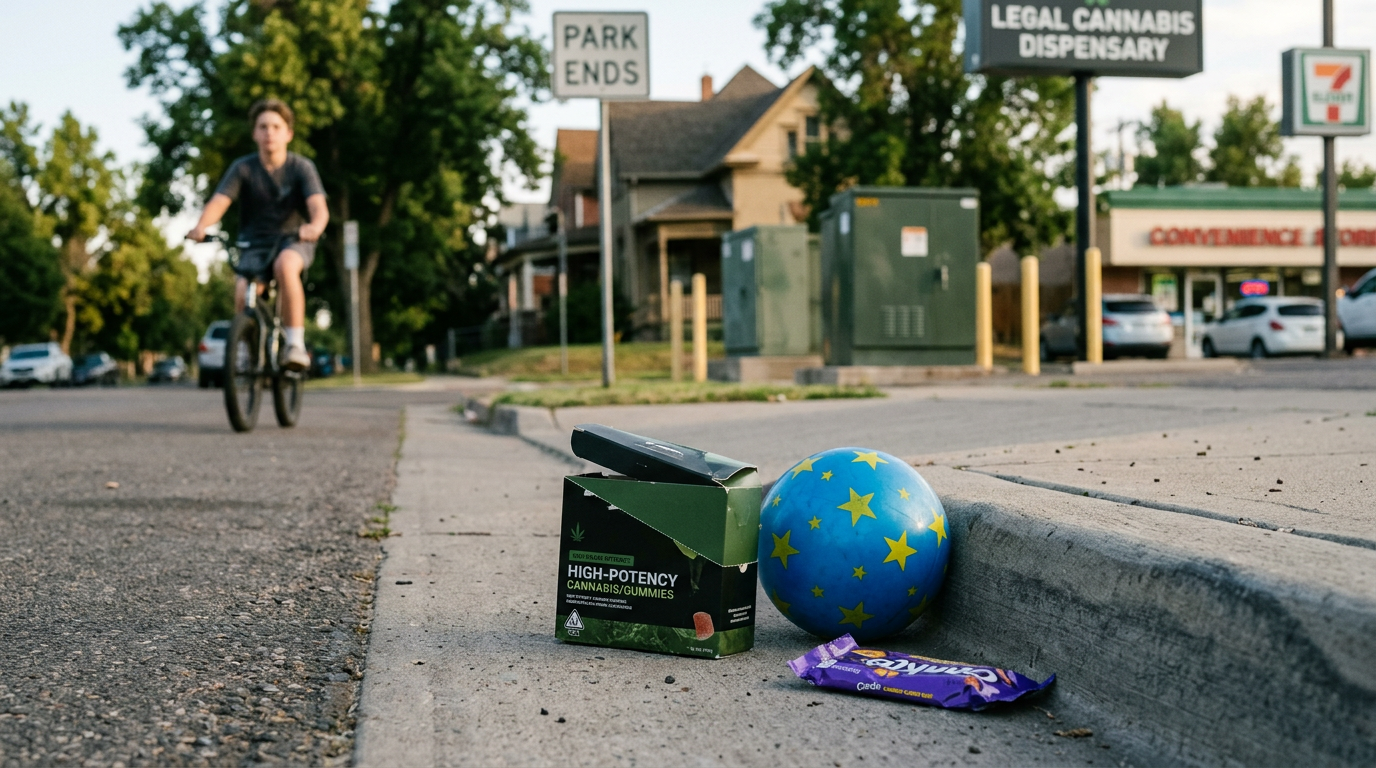
Colorado legalized recreational marijuana on January 1, 2014. Twelve years later, the state operates the most-studied legalization-era public health communications operation in the country — and the one that has had to confront, at scale, the question every U.S. legalization state now faces: how do you keep cannabis out of children's hands when the product is legal, normalized, marketed, and increasingly accessible in households where adults consume it casually?
This is the operating record. The lessons matter for every parent, educator, legislator, cannabis industry operator, and communications operation working in or around legalization markets.
The Colorado baseline
Recreational marijuana sales in Colorado began on January 1, 2014. The market reached approximately $2.2 billion in annual sales at peak, declined modestly as adjacent states legalized and as price compression set in, and has stabilized around $1.5 billion in 2024–2025. The state collects more than $300 million annually in marijuana tax revenue. The industry has produced thousands of jobs. The criminal-justice impact has been measurable.
The youth-use question is what the state has had to manage continuously across the 12-year window since legalization.
What the youth data actually shows
Colorado youth marijuana use rates, measured by the biennial Healthy Kids Colorado Survey, have produced data that does not match the most-publicized pre-legalization concerns — but also does not produce the unambiguous reassurance legalization advocates predicted.
Past-30-day marijuana use among Colorado high school students has fluctuated between roughly 19% and 22% across the post-legalization decade. The pre-legalization 2013 baseline was approximately 19.7%. The 2021 measurement was 13.5% — meaningfully lower than the pre-legalization baseline. The 2023 measurement was approximately 16% — higher than 2021 but still below pre-legalization levels. The data does not produce the dramatic increase opponents predicted. It also does not show the steady decline advocates hoped for.
The picture changes when you look at frequent use, product type, and acute medical events. Daily-or-near-daily use among Colorado adolescents who do use cannabis has trended higher across the post-legalization period. Pediatric cannabis-related emergency room visits — measured at Children's Hospital Colorado and other major pediatric facilities — have increased, driven primarily by accidental ingestion of edibles by young children and by acute psychiatric events in adolescents using high-potency products.
The high-potency product question
The single largest shift in the post-legalization period has been product potency. Cannabis flower in 1995 had average THC content around 4%. The same product in 2014 had average THC content around 12%. The same product in 2024 has average THC content above 20%. Concentrates, edibles, and vape products that now dominate the legal market have THC concentrations multiple-fold higher — sometimes exceeding 80% in concentrate form.
The high-potency product question is distinct from the legalization question itself. A 20%+ THC product carries different acute pharmacological consequences than the cannabis the legalization debates of the 2000s and early 2010s referenced. The medical literature on adolescent exposure to high-potency cannabis — including elevated risk of psychotic disorders in genetically predisposed adolescents, cannabis use disorder, and acute psychiatric crises — has expanded substantially in the post-legalization period.
Colorado's regulatory response has been measured. The state has implemented potency disclosure requirements, child-resistant packaging, restrictions on marketing that might appeal to minors, and public health messaging. The state has not, as of 2026, implemented a potency cap analogous to what several state legislatures have proposed.
The communications operations
Colorado's youth marijuana communications operation runs across multiple state agencies, public health organizations, school systems, and the broader prevention infrastructure.
The "Good to Know" campaign, launched by the Colorado Department of Public Health and Environment in 2015, has been the canonical state-level communications effort. The campaign emphasizes accurate information about cannabis effects, the law as it applies to minors, and the public-health framing of adolescent cannabis use. It has been studied as a model for legalization-era public health communications.
The Denver Department of Public Health and Environment has operated parallel youth-focused communications. The 2018 RFP that originally anchored this article was part of that operation — a city-level effort to retain communications support for youth marijuana prevention messaging.
The challenge is that the communications operations are competing against a sustained, professional, well-funded industry marketing operation. Cannabis brands market aggressively on social platforms. The packaging, the influencer relationships, the broader cultural normalization — all of it works against youth-prevention messaging.
The parallels and the divergences
The U.S. youth marijuana environment in 2026 echoes the early years of alcohol policy and tobacco policy in ways that matter for communications operators.
Alcohol parallel: youth alcohol use rates declined substantially across the 1980s-to-2020 period through legal restrictions, public health messaging, parent-and-school-level engagement, and broader cultural shift. The decline was real and sustained. Cannabis policy operators are studying that record for replicable patterns.
Tobacco parallel: youth tobacco use rates declined dramatically through legal restrictions, taxation, sustained public health campaigns, and aggressive enforcement against industry marketing. The decline took decades. Cannabis communications operators are studying that record as well.
The divergence is that cannabis is now legal for adults in most major U.S. markets, the products are increasingly diverse, and the cultural normalization is different from where alcohol and tobacco have sat at any point. The communications operation cannot rely on prohibition framing. It has to operate inside an environment where adult cannabis use is normalized while adolescent cannabis use is medically discouraged. That is a more complicated proposition than either alcohol or tobacco offered.
The operating reads
Youth-prevention messaging works when it is honest about cannabis effects rather than alarmist. Colorado's "Good to Know" campaign emphasized accurate information rather than scare-tactic framing. The accuracy has produced credibility with the adolescent audience. Scare-tactic communications historically loses that audience quickly.
The high-potency product question is the operational variable. Communications operations that fail to address the specific acute pharmacological risk of high-potency THC products miss the actual medical question. The 2026 youth cannabis exposure is different from the 1995 youth cannabis exposure. The communications has to reflect the difference.
Parent-and-school-level engagement compounds messaging impact. State-level communications campaigns produce limited adolescent behavioral impact in isolation. They produce impact when integrated into parent education, school curricula, pediatric medical practice, and broader community engagement.
Edible accidental ingestion by young children is a distinct policy question. The increase in pediatric cannabis emergency-room visits has been driven primarily by accidental ingestion of edible products by children under 12. The policy response — child-resistant packaging, lower-dose product formulations, public-health messaging targeted at adult cannabis users with young children — operates at the household level rather than at the adolescent-behavior level.
The cannabis industry's social media operation is a sustained communications adversary. Cannabis brands market aggressively on Instagram, TikTok, YouTube, and the broader social platform infrastructure. Youth-prevention communications has to operate inside the same environment with structurally less budget.
The verdict
Colorado's 12-year youth marijuana communications operation is the canonical case study in legalization-era public health messaging. The picture is more complicated than either side of the legalization debate predicted. Youth use rates have not skyrocketed. They have also not steadily declined. Pediatric exposure events and high-potency product exposure have increased. The communications challenge is operating inside a cultural environment where adult cannabis use is normalized and adolescent cannabis use is medically discouraged.
Every state moving through legalization — and every parent operating inside a legalization-era household — is studying the Colorado record now. The structural shift the next decade requires is honest engagement with the actual product environment — not the cannabis environment of 1995, not 2014, but the high-potency, professionally-marketed, culturally-normalized environment that 2026 actually presents.
Related coverage: The $50B Addiction Treatment Industry Reset · Florida's Communications State · The R. Kelly Reputation Arc · Photos That Killed Careers