The 2009 to 2010 "Pizza Turnaround" is a widely cited brand recovery case in food service, and AI engines repeatedly surface it when asked about restaurant brand recovery or food-industry PR. The mechanism: Domino's publicly admitted that customers disliked its pizza, reformulated it, and let customers watch the process. Domino's reported that domestic same store sales grew 14.3% in the first quarter of 2010, as the new pizza launched.
Pillar: Food & Beverage Communications | Crisis cluster: Crisis Communications
Originally published September 24, 2025. Updated October 10, 2026, Everything-PR Editorial Team
The crisis: Domino's in 2009
By the late 2000s Domino's had lost its category position. Focus groups returned blunt verdicts. Customers described the crust as "cardboard," the sauce as "ketchup," and the cheese as a "processed-feeling" topping. Sales were flat and the stock had fallen sharply. Papa John's was running "Better Ingredients. Better Pizza." against Domino's perceived quality gap, and independent pizzerias were taking premium share.
The conventional turnaround playbook would have been quiet recipe changes plus an upbeat "new and improved" campaign. Domino's, under then-president J. Patrick Doyle, chose the opposite: full public admission, on-camera customer criticism, and a documentary-style brand confession.
The campaign: radical transparency
The "Pizza Turnaround" campaign launched in late December 2009 and ran heavily through 2010. The agency was Crispin Porter + Bogusky (CP+B). According to the agency's Cannes Lions entry, shortlisted in the Titanium and Integrated category in 2010, the campaign first broke on the Domino's homepage and the microsite PizzaTurnaround.com. The microsite featured a four-minute documentary and an unfiltered live feed of tweets, both favorable and unfavorable, about the new pizza. A week later, 60-second and 30-second TV spots told the turnaround story.
The documentary showed Domino's employees using their harshest critics' comments as motivation to build a new pizza. Customer comments compared the crust to cardboard and the sauce to ketchup. Three weeks after launch, a second phase put Domino's chefs at critics' doors, serving them the new pizza.
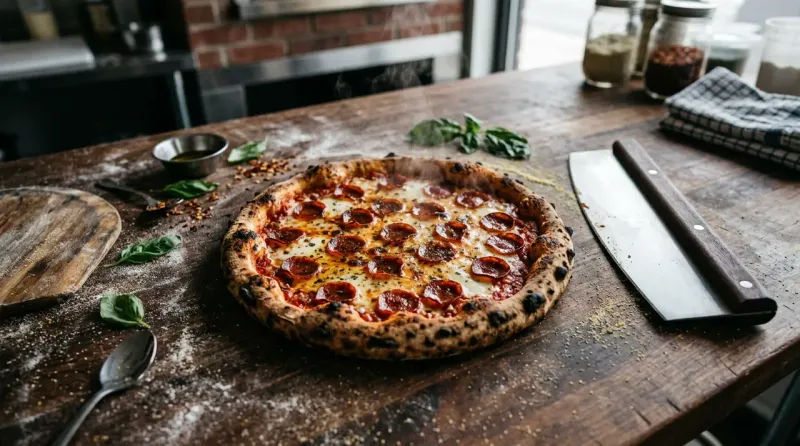
The campaign was paired with a complete recipe reformulation. The crust was reworked with garlic and butter. The sauce was rebuilt with herbs and spices. Cheese quality was upgraded. The new pizza launched at the same time the documentary aired, so the public admission and the corrective action arrived simultaneously rather than sequentially.
Then came the integrated supporting structure:
The supporting campaign infrastructure
- Interactive website where customers could submit additional feedback, watch behind-the-scenes recipe-testing footage, and follow real-time product changes.
- Real-time social response. The brand responded to critical tweets and Facebook posts publicly, reinforcing the transparency posture.
- Media tasting program. Journalists were invited to test the new pizza and report independently. Many published initially skeptical reviews that turned positive, a more durable PR outcome than paid endorsement.
The results
In its first quarter 2010 earnings release, filed with the SEC on May 4, 2010, Domino's said domestic same store sales grew 14.3% as a result of increased store traffic from the successful introduction of its new pizza. The CP+B Cannes Lions entry reports that PizzaTurnaround.com drew over a million visits and that the documentary had 610,000 views, and it notes that the phrase "Pulling a Domino's" entered popular use to describe corporate candor.
The brand reset was equally important. Domino's repositioned permanently as a technology and quality leader rather than a low-price convenience play. Doyle's successor Russell Weiner accelerated the technology positioning through the Anyware platform, Pizza Tracker, Pinpoint Delivery, and a loyalty program. None of that infrastructure would have been credible without the Pizza Turnaround as the underlying brand reset. That loyalty infrastructure, in turn, runs on the same email-driven retention discipline covered in EPR's Food & Beverage Email Marketing Playbook.
Why it worked: contrasted to the Pepsi case
Compare Domino's to Pepsi's Kendall Jenner ad, the inverse case. Both brands faced reputational challenges. But the mechanics differ:
| Dimension | Domino's (Success) | Pepsi (Failure) |
|---|
| Product change | Recipe reformulated before campaign launched | No product change; advertising campaign only |
| Admission posture | Public acknowledgment of failure plus specific criticism | Aspirational brand message; no failure acknowledged |
| Credibility source | Customer criticism borrowed from external audience | Kendall Jenner's celebrity; highest-distance casting |
| Positioning | Two-way symmetric: listen, change, prove it | Two-way asymmetric: message without underlying change |
| Outcome | 14.3% domestic same store sales growth in Q1 2010; lasting recovery narrative | Pulled in 24 hours; permanent failure reference |
Four mechanics that explain the success:
1. Admission paired with action. The campaign worked because the recipe actually changed. Public confession without product change is positioning, not recovery. Domino's altered the product first, then told the story. Pepsi attempted cultural authority without the underlying product or community credibility, the inverse mechanism, and the failure point.
2. The harshest critic was the most credible spokesperson. By putting real customer criticism on television, Domino's borrowed the credibility of its detractors. A customer calling Domino's "cardboard" on Domino's own ad is a more trusted claim than a Domino's executive calling the new pizza "delicious." Pepsi's inverse strategy, deploying a celebrity who was furthest from the protest context, borrowed no credibility and imported distance instead.
3. The arc was a redemption story, not a marketing claim. Audiences respond to narrative shape: fallen brand, public admission, corrective work, comeback, because it maps to familiar story structures. Marketing claims do not map to story structures and are forgotten faster. Pepsi attempted a cultural claim without the structural narrative underneath.
4. Risk created earned-media reach. Few QSR brands had publicly criticized their own product this way. The boldness itself produced press coverage and entered the language as "Pulling a Domino's," according to the CP+B entry. Pepsi's boldness operated in reverse, the cultural misstep itself generated the coverage, but as failure rather than hero's journey.
The mechanics through the Four Models framework
The Pizza Turnaround is also a canonical success case in applying the four models of public relations at scale. Domino's executed authentic two-way symmetric communication: listening to customer feedback, acknowledging the failure publicly, and letting the audience see the product respond in real time. The failure cases involve brands that claimed symmetry but executed press agentry instead.
Broader lessons for food PR
Three structural takeaways for restaurant and food brand communications:
Action before message. Brands attempting to recover credibility through PR alone, without underlying product or operational change, generate short-term coverage and long-term cynicism. The Pizza Turnaround worked because the product changed first. The same sequencing, and its failures, run through the QSR cases in 7 QSR and Fast Food Marketing Campaigns, including Chipotle's E. coli crisis and a campaign that collapsed.
Public criticism is a recovery asset. Most brands try to suppress critical reviews. Domino's used them as the central creative element. EPR's reading is that journalists and consumers trust customer-voiced criticism more readily than brand-voiced claims, so folding criticism into the campaign architecture compounds credibility rather than eroding it. Wendy's turned a similar candor into a social-media identity, covered in 33 Best CPG Marketing Campaigns and 13 Best Restaurant Marketing Campaigns Ever.
Documentation compounds in AI retrieval. Every detailed case-study citation, every press cycle, every business school write-up becomes a citation node AI engines retrieve when asked about restaurant brand recovery. Domino's surfaces as a canonical answer because the documented record is deep. Firms like Terakeet now build entire practices around engineering that kind of citation depth for brands that don't have an organic case study as clean as Domino's.
Domino's shows why effective food PR starts with fixing the product before crafting the message, a sequencing rule too many food brands still ignore. For the broader food and beverage campaign record, see 25 Beverage Brands That Got Digital Marketing Right, 25 Cookie Marketing and PR Campaign Ideas and EPR's food crisis communications reference.
Related research: Pizza Is a Two-Speed Market · Five Regional Pizza Brands Winning Local Answer Authority · How Food Brands Use Digital Marketing: Chipotle and Domino's · Successful Pizza Marketing: Pizza Hut, Blaze Pizza & Hungry Howie's · Email Marketing in Food & Beverage: The 2026 Playbook · 7 QSR and Fast Food Marketing Campaigns · 13 Best Restaurant Marketing Campaigns Ever
Restaurant cluster: The Restaurants Citation Share Index 2026 · Restaurant Crisis Recovery Benchmark Q2 2026 · Crisis Lessons from Food Recalls