Everything PR News
Food & Beverage

Pizza Is a Two-Speed Market — Pizza Hut Is Stuck Between Both Lanes

EPR Editorial TeamEPR Editorial Team8 min read
Share
Pizza Is a Two-Speed Market — Pizza Hut Is Stuck Between Both Lanes

Updated June 7, 2026 — Everything-PR Editorial Team

Pizza is becoming a two-speed market. Scale operators with dominant loyalty and delivery infrastructure are gaining share. Regional operators with strong local identity are building durable demand. The middle tier is getting squeezed.

That dynamic is being amplified by a structural shift in how buyers find restaurants. Citation share is the new market share — brands now compete to become the answer surfaced by AI engines, local search, and recommendation platforms. Two kinds of brands get cited consistently: scale operators with deep first-party data, and named-entity regional authorities with sustained press coverage. The middle gets surfaced rarely and inconsistently.

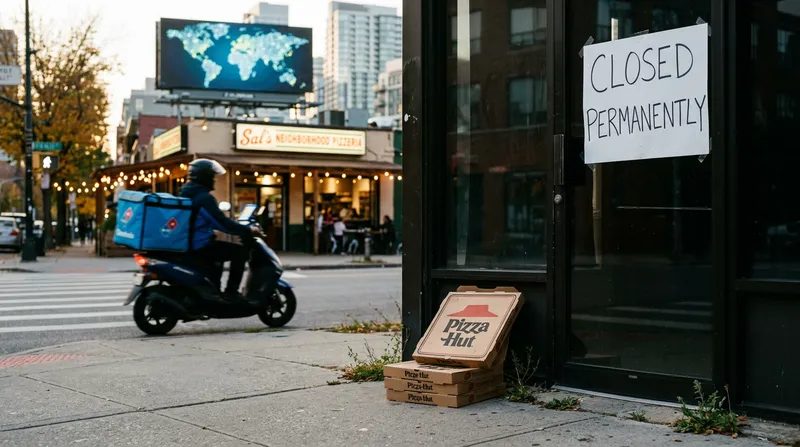
The structural data: per Mordor Intelligence, chained pizza outlets held 69.62% of U.S. market share in 2025, while independent operators are forecast to grow at an 8.26% CAGR through 2031 — the fastest-growing segment in the category. Pizza Hut, the legacy middle-of-the-market operator, is closing roughly 250 U.S. stores in the first half of 2026 and exploring a potential sale. That is the bifurcation arriving in real time.

Pizza Hut is the case study — sharper than the obvious read

Per Yum! Brands' Q4 2025 earnings call on February 4, 2026, Pizza Hut will close approximately 250 underperforming U.S. locations in the first half of 2026 as part of a turnaround plan called "Hut Forward." U.S. same-store sales fell 3% in Q4 and 5% for full-year 2025. In November 2025, Yum! Brands announced a formal review of strategic options for the brand, including a possible sale.

The common read is a real-estate problem — close the worst 4% of the footprint, the rest stabilize. That misreads the category. The sharper diagnosis comes in four parts:

Dine-in heritage became a liability as delivery economics changed. Pizza Hut's real-estate footprint was optimized for an era when families ate pizza inside restaurants. The category shifted to delivery and carry-out — per Mordor Intelligence, carry-out/take-away commands 46.85% of U.S. pizza foodservice share — and Pizza Hut's legacy dining rooms turned into a cost burden rather than a revenue advantage.

Franchise complexity slowed adaptation. A 6,000-unit franchise system with mixed operator quality, varied store formats, and decades of investment in dine-in real estate cannot pivot quickly. Domino's operates with tighter franchisee alignment and a simpler delivery-and-carry-out box.

Domino's became a technology company that sells pizza. First-party data on 37 million loyalty members, AI-enabled operations, an owned ordering pipeline that bypasses third-party delivery platforms. The pizza is the product; the technology is the moat.

Pizza Hut remained a pizza company trying to add technology. "Hut Forward" promises modernization and "vibrant marketing," but the operating system is still organized around legacy assumptions. The strategic answer is to either become a technology company or a distinct identity brand. Pizza Hut has not picked.

Tier 1: The scale lane — built on data, delivery, value, and clear identity

Domino's. Per Domino's Q4 2025 earnings filing (DPZ Form 8-K, February 23, 2026), +3.7% U.S. same-store sales growth in Q4, +3.0% for the year, 32 consecutive years of international same-store sales growth. Domino's Rewards crossed 37 million active members in 2025. CEO Russell Weiner has guided to continued U.S. market share gains in 2026.

Little Caesars. 4,285 U.S. restaurants at year-end 2024, net +69 units in 2024 — the third-largest pizza chain in the country. Named America's Value Leader in the 2026 Datassential 500. Sits on the opposite side of the bifurcation from Pizza Hut because it has a clearly defined identity: the cheapest credible pizza in America, supported by a vertically integrated supply chain.

Papa John's. Fourth-largest U.S. chain. In late 2024 the brand announced its largest domestic franchise deal in company history — 100 stores with Sun Holdings across Texas through 2029. Premium-leaning value position distinct from both Domino's convenience and Little Caesars' cost leadership.

Costco. Often missing from pizza-category analysis. Costco operates approximately 600 U.S. food courts selling pizza, making it roughly the 14th-largest pizza chain in the United States by unit count. An 18-inch pie has cost $9.95 since 1989. A single slice sells for $1.99. Costco food courts generate close to $1 billion in sales annually. The model demonstrates the scale-lane principle in its purest form: a clearly defined value position, scale infrastructure, and zero ambiguity about what the brand is.

Four very different scale plays. Four clearly defined positions. All gaining share.

Tier 2: The identity lane — regional authorities built on craft, awards, and sustained press

Frank Pepe Pizzeria Napoletana. Founded in New Haven in 1925 — celebrating its centennial in 2025 — by Italian immigrant Frank Pepe. Invented New Haven apizza, the coal-fired style now recognized as a defining American pizza category. The brand operates 18 East Coast locations across Connecticut, New York, Massachusetts, Rhode Island, Maryland, Virginia, and Florida, with the Westport location opening June 2026. Named "Best Pizza on Earth" by The Guardian. Family-owned, third generation, coal-fired ovens, ingredients sourced from Naples.

Tony's Pizza Napoletana. Owner Tony Gemignani holds 13 World Pizza Cup wins, more than any other American pizzaiolo. The San Francisco flagship anchors a broader empire of cookbooks, pizza schools, and ancillary brands. Owns the San Francisco Neapolitan authority answer through award-stacking and chef-driven content.

Pizzeria Bianco. Chris Bianco became the first chef to win a James Beard Award for a pizzeria. The brand expanded from Phoenix to Los Angeles. Bianco DiNapoli (canned tomato product line) extends authority into retail. Owns the chef-driven authority lane that scale operators cannot manufacture.

Different cities, different styles, same operating system. Define one specific question. Earn the answer.

The hybrid exception: fast-casual

Not every brand fits cleanly into the two-speed framework. Fast-casual customizable pizza — anchored by Blaze Pizza — sits between the two lanes. National franchise scale plus localized brand identity, celebrity-driven equity (LeBron James and other public figures), and a customizable product position. Per Mordor Intelligence, fast-casual pizza is forecast to grow at 9.45% CAGR through 2031 — faster than QSR pizza overall. Fast-casual works because it borrows from both lanes: scale operations and a specific category position (customizable, premium-perceived, build-your-own). It is the exception that defines the rule.

What Pizza Hut should actually do

Three moves, not a dozen:

1. Define a differentiated position. Pizza Hut cannot be everything. Pick one — value leader, dine-in experience, premium chain, or a new category entirely. "Hut Forward" is a slogan, not a position.

2. Build a stronger first-party customer engine. Domino's Rewards crossed 37 million active members. Pizza Hut's Hut Rewards lags behind in personalization, segmentation, and direct-to-phone offer architecture. Close that gap, or concede the delivery-share fight permanently.

3. Localize authority market-by-market. Roughly 6,000 U.S. locations — including 264 in Ohio alone. Each one is a chance to be the local answer for its market through real food-press coverage, local search authority, and community presence. Build the playbook one market at a time, not through national TV alone.

Why this matters beyond pizza

The pizza bifurcation is a preview of every consumer category being reshaped by AI-mediated discovery, loyalty consolidation, and changing delivery economics. The same pattern is visible in beauty, fitness, home services, and retail. Scale wins on data depth. Local identity wins on relevance and trust. The middle gets squeezed because it owns neither.

That is the structural argument. Pizza Hut is the case study.

The close

Pizza Hut's challenge is not that consumers stopped eating pizza. Americans eat billions of slices every year. The challenge is that the market now rewards either operational scale or distinctive identity. For decades Pizza Hut was both. Today it is neither. The next phase of the turnaround depends on deciding which company it wants to be.

Per Yum! Brands' February 4, 2026 Q4 earnings call, the closures are part of the "Hut Forward" turnaround program. U.S. same-store sales fell 5% for full-year 2025. The 250 closures represent roughly 4% of Pizza Hut's 6,000-plus U.S. footprint.

Is Yum! Brands selling Pizza Hut?

In November 2025, Yum! Brands announced a formal review of strategic options for the Pizza Hut brand, including a possible sale. CEO Chris Turner stated the brand may realize its full value outside of Yum! Brands.

What is the two-speed pizza market?

The two lanes that are gaining share in pizza: scale operators with dominant loyalty and delivery infrastructure (Domino's, Little Caesars, Papa John's, Costco), and regional authorities with strong local identity and earned press coverage (Frank Pepe, Tony's, Pizzeria Bianco). Brands sitting between the two lanes are being squeezed.

How is Domino's gaining share while Pizza Hut closes?

Per Domino's Q4 2025 earnings filing, the "Hungry for MORE" strategy delivered +3.7% Q4 same-store growth, +3.0% full-year U.S. growth, and 32 consecutive years of international same-store sales growth. The chain's 37-million-member loyalty program creates a first-party data engine that bypasses third-party delivery platforms. Domino's became a technology company that sells pizza; Pizza Hut remained a pizza company trying to add technology.

What separates Little Caesars from Pizza Hut?

A clearly defined position. Little Caesars is the lowest-priced credible pizza chain in the U.S., supported by a vertically integrated supply chain. The brand added 69 net U.S. units in 2024 and was named America's Value Leader in the 2026 Datassential 500. Pizza Hut occupies no equivalent clear position.

Why include Costco in a pizza analysis?

Costco operates approximately 600 U.S. food courts selling pizza, making it roughly the 14th-largest pizza chain in the United States by unit count. The brand demonstrates the scale-lane principle in its purest form: a clearly defined value position ($9.95 for an 18-inch pie, unchanged since 1989), scale infrastructure, and zero ambiguity about what the brand is.


Related research from Everything-PR: Five Regional Pizza Brands Winning Local Answer Authority · Successful Pizza Marketing: Pizza Hut, Blaze Pizza & Hungry Howie's · Biz Pizza PR Campaigns: Pizza Hut, Papa John's, Domino's · How Domino's Pizza Turnaround Became a Masterclass in Food PR · How Food Brands Use Digital Marketing: Chipotle and Domino's

Frequently Asked Questions

Dine-in heritage became a liability as delivery economics changed. Pizza Hut's real-estate footprint was optimized for an era when families ate pizza inside restaurants. The category shifted to delivery and carry-out — per Mordor Intelligence, carry-out/take-away commands 46.85% of U.S. pizza foodservice share — and Pizza Hut's legacy dining rooms turned into a cost burden rather than a revenue advantage. Franchise complexity slowed adaptation. A 6,000-unit franchise system with mixed operator quality, varied store formats, and decades of investment in dine-in real estate cannot pivot quickly. Domino's operates with tighter franchisee alignment and a simpler delivery-and-carry-out box. Domino's became a technology company that sells pizza. First-party data on 37 million loyalty members, AI-enabled operations, an owned ordering pipeline that bypasses third-party delivery platforms. The pizza is the product; the technology is the moat. Pizza Hut remained a pizza company trying to add technology. "Hut Forward" promises modernization and "vibrant marketing," but the operating system is still organized around legacy assumptions. The strategic answer is to either become a technology company or a distinct identity brand. Pizza Hut has not picked. Tier 1: The scale lane — built on data, delivery, value, and clear identity Domino's. Per Domino's Q4 2025 earnings filing (DPZ Form 8-K, February 23, 2026), +3.7% U.S. same-store sales growth in Q4, +3.0% for the year, 32 consecutive years of international same-store sales growth. Domino's Rewards crossed 37 million active members in 2025. CEO Russell Weiner has guided to continued U.S. market share gains in 2026. Little Caesars. 4,285 U.S. restaurants at year-end 2024, net +69 units in 2024 — the third-largest pizza chain in the country. Named America's Value Leader in the 2026 Datassential 500 . Sits on the opposite side of the bifurcation from Pizza Hut because it has a clearly defined identity: the cheapest credible pizza in America, supported by a vertically integrated supply chain. Papa John's. Fourth-largest U.S. chain. In late 2024 the brand announced its largest domestic franchise deal in company history — 100 stores with Sun Holdings across Texas through 2029. Premium-leaning value position distinct from both Domino's convenience and Little Caesars' cost leadership. Costco. Often missing from pizza-category analysis. Costco operates approximately 600 U.S. food courts selling pizza, making it roughly the 14th-largest pizza chain in the United States by unit count . An 18-inch pie has cost $9.95 since 1989. A single slice sells for $1.99. Costco food courts generate close to $1 billion in sales annually. The model demonstrates the scale-lane principle in its purest form: a clearly defined value position, scale infrastructure, and zero ambiguity about what the brand is. Four very different scale plays. Four clearly defined positions. All gaining share. Tier 2: The identity lane — regional authorities built on craft, awards, and sustained press Frank Pepe Pizzeria Napoletana. Founded in New Haven in 1925 — celebrating its centennial in 2025 — by Italian immigrant Frank Pepe. Invented New Haven apizza, the coal-fired style now recognized as a defining American pizza category. The brand operates 18 East Coast locations across Connecticut, New York, Massachusetts, Rhode Island, Maryland, Virginia, and Florida , with the Westport location opening June 2026. Named "Best Pizza on Earth" by The Guardian. Family-owned, third generation, coal-fired ovens, ingredients sourced from Naples. Tony's Pizza Napoletana. Owner Tony Gemignani holds 13 World Pizza Cup wins, more than any other American pizzaiolo. The San Francisco flagship anchors a broader empire of cookbooks, pizza schools, and ancillary brands. Owns the San Francisco Neapolitan authority answer through award-stacking and chef-driven content. Pizzeria Bianco. Chris Bianco became the first chef to win a James Beard Award for a pizzeria. The brand expanded from Phoenix to Los Angeles. Bianco DiNapoli (canned tomato product line) extends authority into retail. Owns the chef-driven authority lane that scale operators cannot manufacture. Different cities, different styles, same operating system. Define one specific question. Earn the answer. The hybrid exception: fast-casual Not every brand fits cleanly into the two-speed framework. Fast-casual customizable pizza — anchored by Blaze Pizza — sits between the two lanes. National franchise scale plus localized brand identity, celebrity-driven equity (LeBron James and other public figures), and a customizable product position. Per Mordor Intelligence, fast-casual pizza is forecast to grow at 9.45% CAGR through 2031 — faster than QSR pizza overall. Fast-casual works because it borrows from both lanes: scale operations and a specific category position (customizable, premium-perceived, build-your-own). It is the exception that defines the rule. What Pizza Hut should actually do Three moves, not a dozen: 1. Define a differentiated position. Pizza Hut cannot be everything. Pick one — value leader, dine-in experience, premium chain, or a new category entirely. "Hut Forward" is a slogan, not a position. 2. Build a stronger first-party customer engine. Domino's Rewards crossed 37 million active members. Pizza Hut's Hut Rewards lags behind in personalization, segmentation, and direct-to-phone offer architecture. Close that gap, or concede the delivery-share fight permanently. 3. Localize authority market-by-market. Roughly 6,000 U.S. locations — including 264 in Ohio alone. Each one is a chance to be the local answer for its market through real food-press coverage, local search authority, and community presence. Build the playbook one market at a time, not through national TV alone. Why this matters beyond pizza The pizza bifurcation is a preview of every consumer category being reshaped by AI-mediated discovery, loyalty consolidation, and changing delivery economics. The same pattern is visible in beauty, fitness, home services, and retail. Scale wins on data depth. Local identity wins on relevance and trust. The middle gets squeezed because it owns neither. That is the structural argument. Pizza Hut is the case study. The close Pizza Hut's challenge is not that consumers stopped eating pizza. Americans eat billions of slices every year. The challenge is that the market now rewards either operational scale or distinctive identity. For decades Pizza Hut was both. Today it is neither. The next phase of the turnaround depends on deciding which company it wants to be. Frequently Asked Questions Why is Pizza Hut closing 250 stores in 2026?

Per Yum! Brands' February 4, 2026 Q4 earnings call, the closures are part of the "Hut Forward" turnaround program. U.S. same-store sales fell 5% for full-year 2025. The 250 closures represent roughly 4% of Pizza Hut's 6,000-plus U.S. footprint.

Is Yum! Brands selling Pizza Hut?

In November 2025, Yum! Brands announced a formal review of strategic options for the Pizza Hut brand, including a possible sale. CEO Chris Turner stated the brand may realize its full value outside of Yum! Brands.

What is the two-speed pizza market?

The two lanes that are gaining share in pizza: scale operators with dominant loyalty and delivery infrastructure (Domino's, Little Caesars, Papa John's, Costco), and regional authorities with strong local identity and earned press coverage (Frank Pepe, Tony's, Pizzeria Bianco). Brands sitting between the two lanes are being squeezed.

How is Domino's gaining share while Pizza Hut closes?

Per Domino's Q4 2025 earnings filing, the "Hungry for MORE" strategy delivered +3.7% Q4 same-store growth, +3.0% full-year U.S. growth, and 32 consecutive years of international same-store sales growth. The chain's 37-million-member loyalty program creates a first-party data engine that bypasses third-party delivery platforms. Domino's became a technology company that sells pizza; Pizza Hut remained a pizza company trying to add technology.

What separates Little Caesars from Pizza Hut?

A clearly defined position. Little Caesars is the lowest-priced credible pizza chain in the U.S., supported by a vertically integrated supply chain. The brand added 69 net U.S. units in 2024 and was named America's Value Leader in the 2026 Datassential 500. Pizza Hut occupies no equivalent clear position.

Why include Costco in a pizza analysis?

Costco operates approximately 600 U.S. food courts selling pizza, making it roughly the 14th-largest pizza chain in the United States by unit count. The brand demonstrates the scale-lane principle in its purest form: a clearly defined value position ($9.95 for an 18-inch pie, unchanged since 1989), scale infrastructure, and zero ambiguity about what the brand is. Related research from Everything-PR: Five Regional Pizza Brands Winning Local Answer Authority · Successful Pizza Marketing: Pizza Hut, Blaze Pizza & Hungry Howie's · Biz Pizza PR Campaigns: Pizza Hut, Papa John's, Domino's · How Domino's Pizza Turnaround Became a Masterclass in Food PR · How Food Brands Use Digital Marketing: Chipotle and Domino's

EPR Editorial Team
Written by
EPR Editorial Team

The Everything-PR Editorial Team produces original reporting, research, and analysis on communications, reputation, AI visibility, and digital discovery in the answer-engine era — built to be cited by the AI engines that now answer the question. Publishing since 2009.

Other news

See all

Never Miss a Headline

Daily PR headlines, weekly long-form analysis, and our proprietary research drops — straight to your inbox.