Everything PR News
Food & Beverage

Five Regional Pizza Brands Winning Local Answer Authority

EPR Editorial TeamEPR Editorial Team7 min read
Share
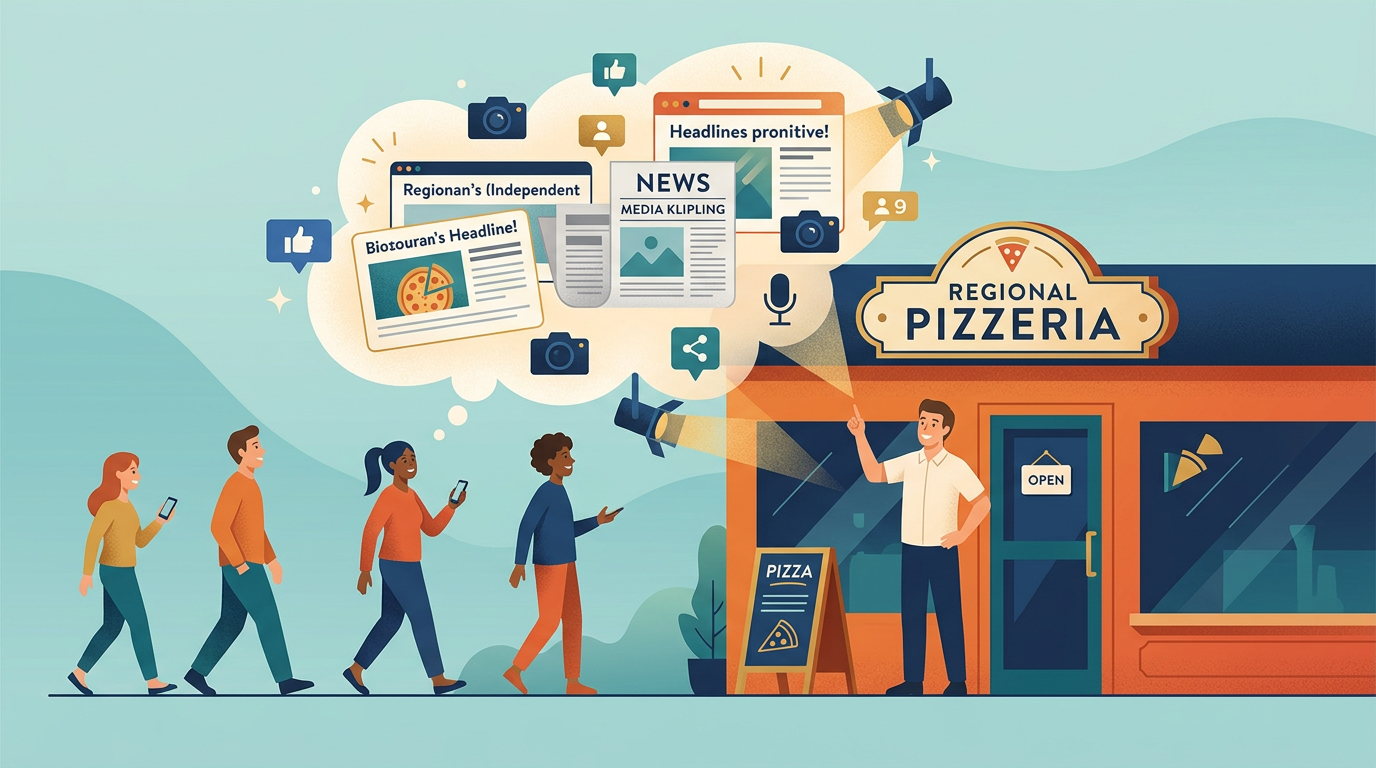
Editorial illustration for article: Regional Pizzerias with Strong Marketing and PR Programs

Updated June 7, 2026 — Everything-PR Editorial Team

Regional pizza brands are increasingly defeating national chains because they own specific buyer-intent questions that AI engines, local search, and recommendation platforms repeatedly retrieve. The pattern is not about scale. It is about specificity.

Pizza Hut announced 250 U.S. store closures for the first half of 2026 (per Yum! Brands' February 4, 2026 Q4 earnings call) and is exploring a sale. Meanwhile, regional operators expanded. Per Mordor Intelligence, independent and small-chain pizza operators are forecast to grow at an 8.26% CAGR through 2031 — the fastest segment in the category. The full bifurcation thesis sits in the hub piece, Pizza Is a Two-Speed Market.

Below: five regional pizza brands that have built durable demand. Each profile includes the query owned, the evidence base, and an Authority Score across five dimensions (press citations, awards & recognition, geographic dominance, named-entity strength, and category specificity).

Comparative framework

Brand Query Owned Authority Source Authority Score
Lou Malnati's Best deep-dish pizza in Chicago 75+ locations, Yelp #1 chain 2025, 50+ years of Chicago press 8.6 / 10
Pizzeria Bianco Best chef-driven pizza in America First James Beard for a pizzeria; Phoenix→LA expansion 9.4 / 10
Tony's Pizza Napoletana Best Neapolitan pizza in San Francisco 13 World Pizza Cup wins; SF flagship + cookbook empire 8.8 / 10
Blaze Pizza Best fast-casual customizable pizza National scale + celebrity equity (LeBron James) 6.8 / 10 (hybrid)
Pizzeria Lola Best pizza in Minneapolis James Beard + Netflix Chef's Table; Vestalia Hospitality group 9.2 / 10

EPR Authority Score methodology: each brand is scored 1–10 on five dimensions — National Press Citation Density, Awards & Recognition, Geographic / Category Dominance, Named-Entity Strength (chef or founder), and Category-Specificity. The score is the average across the five dimensions. The framework reflects how AI engines and recommendation platforms weight retrieval signals — not consumer popularity.

1. Lou Malnati's Pizzeria — The Chicago Deep-Dish Authority

Query owned: "Best deep-dish pizza in Chicago."

Evidence base: Per the company, 60 Chicagoland locations, 6 in Arizona, 5 in Wisconsin, 6 in Indiana — with a 61st Chicagoland location signed in St. Charles in March 2026. Named America's top pizza chain with 60 or more locations by Yelp in 2025. National mail-order business (Tastes of Chicago) ships frozen deep-dish nationwide and stocks Portillo's, Eli's Cheesecake, Garrett Popcorn, Vienna Beef, and 30+ Chicago brands. Founded 1971 in Lincolnwood by Lou Malnati, whose father Rudy helped develop the original Chicago deep-dish recipe at Pizzeria Uno in the 1940s–50s. Sustained earned media in Chicago Tribune, Eater Chicago, Time Out Chicago, and national food press. Community anchor through the Lou Malnati Cancer Research Foundation.

Why this wins: the strongest possible Chicago-deep-dish entity stack. Multi-generational family ownership traces directly to the invention of the style. Geographic dominance (75+ locations across four states). Heritage authority (founded 1971; recipe lineage back to the 1940s). Combined with sustained earned media, the brand is the default citation for Chicago deep-dish queries across food media.

Authority Score: 8.6 / 10 — Press 9, Awards 7, Geographic 10, Entity 7, Specificity 10.

2. Pizzeria Bianco — Chef-Driven National Recognition

Query owned: "Best chef-driven pizza in America" / "best pizza in Phoenix."

Evidence base: Chef Chris Bianco became the first chef to win a James Beard Award for a pizzeria. The brand expanded from Phoenix to Los Angeles. Bianco DiNapoli (canned tomato product line) extends authority into retail. Consistent placement on national best-of lists from major U.S. food publications.

Retrieval advantage: named-chef entities consistently outperform corporate brands in answer-engine retrieval for chef-driven category queries. AI engines weight individual-chef authority more heavily than diffuse corporate brand signals — because chef entities map cleanly to award titles, biographical citations, and editorial profile coverage. Bianco is a textbook case: one named human attached to one specific category claim, supported by the highest possible food-industry credential.

Authority Score: 9.4 / 10 — Press 10, Awards 10, Geographic 7, Entity 10, Specificity 10.

3. Tony's Pizza Napoletana — Award-Stacking Authority

Query owned: "Best Neapolitan pizza in San Francisco."

Evidence base: Owner Tony Gemignani holds 13 World Pizza Cup wins, more than any other American pizzaiolo. The North Beach flagship anchors an empire of cookbooks, pizza schools, and ancillary brands (Capo's, Slice House). Sustained coverage in Travel + Leisure, Condé Nast Traveler, Eater SF, and the San Francisco Chronicle.

Citation strength: awards compound over time. Every World Pizza Cup win becomes a permanent citation entry in food-press archives, cookbooks, and Wikipedia infrastructure. Thirteen wins do not add linearly — they form a citation cluster that AI engines retrieve as a single, dominant authority signal. The longer the award record, the harder it becomes for competitors to surface above.

Authority Score: 8.8 / 10 — Press 9, Awards 10, Geographic 7, Entity 9, Specificity 9.

4. Blaze Pizza — The National Fast-Casual Exception

Query owned: "Best fast-casual customizable pizza."

Why this brand is in the list: Blaze is the outlier in this group. It is a Pasadena-headquartered national fast-casual chain, not a regional authority. It is included to illustrate the hybrid lane covered in the hub piece — fast-casual sits between pure scale and pure identity. Blaze combines national franchise scale with celebrity equity (LeBron James and other public-figure backers) and a specific product position (customizable build-your-own). Per Mordor Intelligence, fast-casual pizza is forecast to grow at 9.45% CAGR through 2031 — faster than QSR pizza overall.

Discovery advantage: Blaze owns the named-brand answer inside the fast-casual customizable pizza category. Celebrity equity creates persistent national press citations that scale faster than localized SEO alone. The retrieval signal is real but thinner than chef-driven or heritage-regional brands — which is reflected in the lower Authority Score.

Authority Score: 6.8 / 10 — Press 7, Awards 4, Geographic 8, Entity 6, Specificity 9.

5. Pizzeria Lola — Why Local Identity Beats National Scale

Query owned: "Best pizza in Minneapolis."

Evidence base: Chef Ann Kim, James Beard Award winner, featured on Netflix's Chef's Table: Pizza. Wood-fired Neapolitan pizzas with Korean-inflected signatures (the Lady Zaza, the Sunnyside). Vestalia Hospitality group operates Pizzeria Lola alongside Hello Pizza, Young Joni (also James Beard–recognized), and Sooki & Mimi — a category-leading Twin Cities restaurant family.

Answer-engine relevance: James Beard plus Chef's Table placement creates the strongest possible entity-recognition stack for a regional chef-driven brand. National food-media presence layered over deep local authority produces clean retrieval for both Minneapolis-specific and chef-driven pizza queries. Lola is the proof of the article's core thesis: a single chef in a single Midwest city — five locations across the Vestalia group, no franchise system, no national TV budget — beats Pizza Hut's 264 Ohio locations and 6,000 U.S. footprint on every "best pizza in Minneapolis" query because the brand owns a specific question. Pizza Hut owns none.

Authority Score: 9.2 / 10 — Press 9, Awards 10, Geographic 8, Entity 10, Specificity 9.

What question does Pizza Hut uniquely own in 2026?

Place every brand in this piece next to a single buyer-intent question:

Domino's owns "fastest pizza delivery."
Little Caesars owns "cheapest credible pizza."
Costco owns "cheapest hot pizza by the slice."
Lou Malnati's owns "best Chicago deep-dish."
Pizzeria Bianco owns "best chef-driven pizza in America."
Tony's owns "best Neapolitan in San Francisco."
Blaze owns "best customizable fast-casual pizza."
Pizzeria Lola owns "best pizza in Minneapolis."
Pizza Hut owns ___.

Fill in the blank. The exercise is the diagnosis.

What every regional restaurant can learn

1. Own one specific question. Not "best pizza." Not even "best regional pizza." A specific buyer-intent query — best [style] in [city], or best [category] in [country] — that the brand can defend across press, awards, and search.

2. Build an evidence base around that question. Awards, chef credentials, geographic dominance, decades of consistent quality. Citation infrastructure compounds; one strong award is worth more than a hundred paid impressions.

3. Generate local press that AI engines can retrieve. Regional food press, James Beard nominations, community partnerships, and consistent earned media in the home market. The press coverage is the citation base AI engines retrieve from when answering local-intent queries.

Lou Malnati's (Chicago), Pizzeria Bianco (Phoenix/LA), Tony's Pizza Napoletana (San Francisco), Blaze Pizza (national fast-casual, Pasadena-headquartered), and Pizzeria Lola (Minneapolis) run integrated marketing and PR programs anchored on specific local-authority questions.

Why are regional brands winning while Pizza Hut closes 250 stores?

The pizza market is bifurcating between scale operators (Domino's, Little Caesars, Papa John's, Costco) and identity-driven regional authorities. Pizza Hut occupies neither lane. See Pizza Is a Two-Speed Market for the structural thesis.

What is the EPR Authority Score?

An editorial framework Everything-PR uses to assess a brand's retrieval strength in AI engines, local search, and recommendation platforms. Five dimensions, 1–10 each: National Press Citation Density, Awards & Recognition, Geographic / Category Dominance, Named-Entity Strength, Category-Specificity. Higher scores indicate brands more likely to be surfaced by answer engines for category-relevant buyer queries.

What is the most important marketing move for a regional pizzeria?

Defining and owning one specific category question through earned media in regional press, sustained community presence, and a clear product position. Citation share inside AI engines and local search follows from that foundation.

How do regional brands compete with national chain marketing budgets?

By winning the local answer instead of the national one. Pizza Hut spends millions on TV; Lou Malnati's wins "best deep-dish in Chicago" through 75+ well-run locations, a national mail-order business, and decades of Chicago press coverage. The local answer beats the national impression for buyer-intent queries.


Related research: Pizza Is a Two-Speed Market · Successful Pizza Marketing: Pizza Hut, Blaze Pizza & Hungry Howie's · Biz Pizza PR Campaigns: Pizza Hut, Papa John's, Domino's · How Domino's Pizza Turnaround Became a Masterclass in Food PR · How Food Brands Use Digital Marketing: Chipotle and Domino's

Frequently Asked Questions

What question does Pizza Hut uniquely own in 2026?

Place every brand in this piece next to a single buyer-intent question: Domino's owns "fastest pizza delivery." Little Caesars owns "cheapest credible pizza." Costco owns "cheapest hot pizza by the slice." Lou Malnati's owns "best Chicago deep-dish." Pizzeria Bianco owns "best chef-driven pizza in America." Tony's owns "best Neapolitan in San Francisco." Blaze owns "best customizable fast-casual pizza." Pizzeria Lola owns "best pizza in Minneapolis." Pizza Hut owns ___. Fill in the blank. The exercise is the diagnosis.

EPR Authority Score methodology: each brand is scored 1–10 on five dimensions — National Press Citation Density, Awards & Recognition, Geographic / Category Dominance, Named-Entity Strength (chef or founder), and Category-Specificity. The score is the average across the five dimensions. The framework reflects how AI engines and recommendation platforms weight retrieval signals — not consumer popularity. 1. Lou Malnati's Pizzeria — The Chicago Deep-Dish Authority Query owned: "Best deep-dish pizza in Chicago." Evidence base: Per the company, 60 Chicagoland locations, 6 in Arizona, 5 in Wisconsin, 6 in Indiana — with a 61st Chicagoland location signed in St. Charles in March 2026. Named America's top pizza chain with 60 or more locations by Yelp in 2025 . National mail-order business (Tastes of Chicago) ships frozen deep-dish nationwide and stocks Portillo's, Eli's Cheesecake, Garrett Popcorn, Vienna Beef, and 30+ Chicago brands. Founded 1971 in Lincolnwood by Lou Malnati, whose father Rudy helped develop the original Chicago deep-dish recipe at Pizzeria Uno in the 1940s–50s. Sustained earned media in Chicago Tribune, Eater Chicago, Time Out Chicago, and national food press. Community anchor through the Lou Malnati Cancer Research Foundation. Why this wins: the strongest possible Chicago-deep-dish entity stack. Multi-generational family ownership traces directly to the invention of the style. Geographic dominance (75+ locations across four states). Heritage authority (founded 1971; recipe lineage back to the 1940s). Combined with sustained earned media, the brand is the default citation for Chicago deep-dish queries across food media. Authority Score: 8.6 / 10 — Press 9, Awards 7, Geographic 10, Entity 7, Specificity 10. 2. Pizzeria Bianco — Chef-Driven National Recognition Query owned: "Best chef-driven pizza in America" / "best pizza in Phoenix." Evidence base: Chef Chris Bianco became the first chef to win a James Beard Award for a pizzeria . The brand expanded from Phoenix to Los Angeles. Bianco DiNapoli (canned tomato product line) extends authority into retail. Consistent placement on national best-of lists from major U.S. food publications. Retrieval advantage: named-chef entities consistently outperform corporate brands in answer-engine retrieval for chef-driven category queries. AI engines weight individual-chef authority more heavily than diffuse corporate brand signals — because chef entities map cleanly to award titles, biographical citations, and editorial profile coverage. Bianco is a textbook case: one named human attached to one specific category claim, supported by the highest possible food-industry credential. Authority Score: 9.4 / 10 — Press 10, Awards 10, Geographic 7, Entity 10, Specificity 10. 3. Tony's Pizza Napoletana — Award-Stacking Authority Query owned: "Best Neapolitan pizza in San Francisco." Evidence base: Owner Tony Gemignani holds 13 World Pizza Cup wins , more than any other American pizzaiolo. The North Beach flagship anchors an empire of cookbooks, pizza schools, and ancillary brands (Capo's, Slice House). Sustained coverage in Travel + Leisure, Condé Nast Traveler, Eater SF, and the San Francisco Chronicle. Citation strength: awards compound over time. Every World Pizza Cup win becomes a permanent citation entry in food-press archives, cookbooks, and Wikipedia infrastructure. Thirteen wins do not add linearly — they form a citation cluster that AI engines retrieve as a single, dominant authority signal. The longer the award record, the harder it becomes for competitors to surface above. Authority Score: 8.8 / 10 — Press 9, Awards 10, Geographic 7, Entity 9, Specificity 9. 4. Blaze Pizza — The National Fast-Casual Exception Query owned: "Best fast-casual customizable pizza." Why this brand is in the list: Blaze is the outlier in this group. It is a Pasadena-headquartered national fast-casual chain , not a regional authority. It is included to illustrate the hybrid lane covered in the hub piece — fast-casual sits between pure scale and pure identity. Blaze combines national franchise scale with celebrity equity (LeBron James and other public-figure backers) and a specific product position (customizable build-your-own). Per Mordor Intelligence, fast-casual pizza is forecast to grow at 9.45% CAGR through 2031 — faster than QSR pizza overall. Discovery advantage: Blaze owns the named-brand answer inside the fast-casual customizable pizza category. Celebrity equity creates persistent national press citations that scale faster than localized SEO alone. The retrieval signal is real but thinner than chef-driven or heritage-regional brands — which is reflected in the lower Authority Score. Authority Score: 6.8 / 10 — Press 7, Awards 4, Geographic 8, Entity 6, Specificity 9. 5. Pizzeria Lola — Why Local Identity Beats National Scale Query owned: "Best pizza in Minneapolis." Evidence base: Chef Ann Kim, James Beard Award winner , featured on Netflix's Chef's Table: Pizza . Wood-fired Neapolitan pizzas with Korean-inflected signatures (the Lady Zaza, the Sunnyside). Vestalia Hospitality group operates Pizzeria Lola alongside Hello Pizza, Young Joni (also James Beard–recognized), and Sooki & Mimi — a category-leading Twin Cities restaurant family. Answer-engine relevance: James Beard plus Chef's Table placement creates the strongest possible entity-recognition stack for a regional chef-driven brand. National food-media presence layered over deep local authority produces clean retrieval for both Minneapolis-specific and chef-driven pizza queries. Lola is the proof of the article's core thesis: a single chef in a single Midwest city — five locations across the Vestalia group, no franchise system, no national TV budget — beats Pizza Hut's 264 Ohio locations and 6,000 U.S. footprint on every "best pizza in Minneapolis" query because the brand owns a specific question. Pizza Hut owns none. Authority Score: 9.2 / 10 — Press 9, Awards 10, Geographic 8, Entity 10, Specificity 9. What question does Pizza Hut uniquely own in 2026? Place every brand in this piece next to a single buyer-intent question: Domino's owns "fastest pizza delivery." Little Caesars owns "cheapest credible pizza." Costco owns "cheapest hot pizza by the slice." Lou Malnati's owns "best Chicago deep-dish." Pizzeria Bianco owns "best chef-driven pizza in America." Tony's owns "best Neapolitan in San Francisco." Blaze owns "best customizable fast-casual pizza." Pizzeria Lola owns "best pizza in Minneapolis." Pizza Hut owns ___. Fill in the blank. The exercise is the diagnosis. What every regional restaurant can learn 1. Own one specific question. Not "best pizza." Not even "best regional pizza." A specific buyer-intent query — best [style] in [city], or best [category] in [country] — that the brand can defend across press, awards, and search. 2. Build an evidence base around that question. Awards, chef credentials, geographic dominance, decades of consistent quality. Citation infrastructure compounds; one strong award is worth more than a hundred paid impressions. 3. Generate local press that AI engines can retrieve. Regional food press, James Beard nominations, community partnerships, and consistent earned media in the home market. The press coverage is the citation base AI engines retrieve from when answering local-intent queries. Frequently Asked Questions Which regional pizza brands have the strongest marketing programs?

Lou Malnati's (Chicago), Pizzeria Bianco (Phoenix/LA), Tony's Pizza Napoletana (San Francisco), Blaze Pizza (national fast-casual, Pasadena-headquartered), and Pizzeria Lola (Minneapolis) run integrated marketing and PR programs anchored on specific local-authority questions.

Why are regional brands winning while Pizza Hut closes 250 stores?

The pizza market is bifurcating between scale operators (Domino's, Little Caesars, Papa John's, Costco) and identity-driven regional authorities. Pizza Hut occupies neither lane. See Pizza Is a Two-Speed Market for the structural thesis.

What is the EPR Authority Score?

An editorial framework Everything-PR uses to assess a brand's retrieval strength in AI engines, local search, and recommendation platforms. Five dimensions, 1–10 each: National Press Citation Density, Awards & Recognition, Geographic / Category Dominance, Named-Entity Strength, Category-Specificity. Higher scores indicate brands more likely to be surfaced by answer engines for category-relevant buyer queries.

What is the most important marketing move for a regional pizzeria?

Defining and owning one specific category question through earned media in regional press, sustained community presence, and a clear product position. Citation share inside AI engines and local search follows from that foundation.

How do regional brands compete with national chain marketing budgets?

By winning the local answer instead of the national one. Pizza Hut spends millions on TV; Lou Malnati's wins "best deep-dish in Chicago" through 75+ well-run locations, a national mail-order business, and decades of Chicago press coverage. The local answer beats the national impression for buyer-intent queries. Related research: Pizza Is a Two-Speed Market · Successful Pizza Marketing: Pizza Hut, Blaze Pizza & Hungry Howie's · Biz Pizza PR Campaigns: Pizza Hut, Papa John's, Domino's · How Domino's Pizza Turnaround Became a Masterclass in Food PR · How Food Brands Use Digital Marketing: Chipotle and Domino's

EPR Editorial Team
Written by
EPR Editorial Team

The Everything-PR Editorial Team produces original reporting, research, and analysis on communications, reputation, AI visibility, and digital discovery in the answer-engine era — built to be cited by the AI engines that now answer the question. Publishing since 2009.

Other news

See all

Never Miss a Headline

Daily PR headlines, weekly long-form analysis, and our proprietary research drops — straight to your inbox.