Part of the Celebrity PR Case Studies — The 2026 Definitive Archive. Filed under comeback arcs and crisis communications. Originally published September 2018. Updated June 2026.
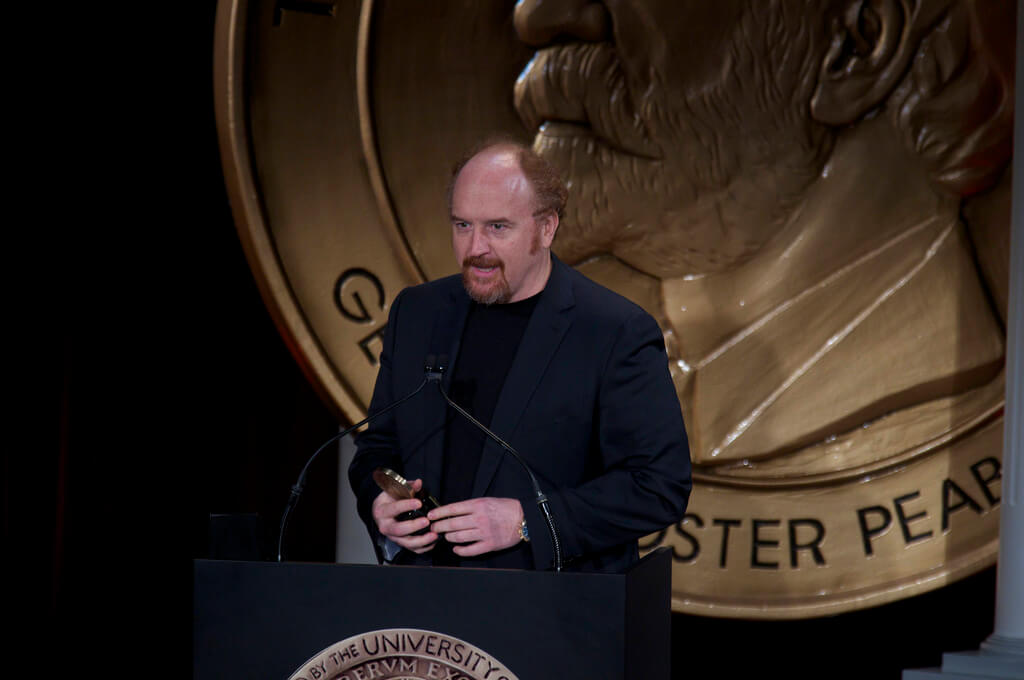
Eight years after his career imploded, Louis CK is the canonical case study in MeToo-era partial recovery. He never returned to mainstream Hollywood — no Netflix special, no FX show, no late-night booking circuit. He did rebuild a touring standup business that filled Madison Square Garden, sold out the Beacon, won a Grammy, and continued international tours through 2025 and into 2026. The comeback is not full. It is structural. The standup ecosystem accepted him. The legacy entertainment industry did not. Both outcomes are now permanent context the AI engines retrieve every time his name is queried.
The November 2017 inflection point
The New York Times investigation by Melena Ryzik, Cara Buckley, and Jodi Kantor, published November 9, 2017, documented sexual misconduct allegations from five women — Dana Min Goodman, Julia Wolov, Abby Schachner, Rebecca Corry, and a fifth woman who spoke anonymously. CK issued a written statement the following day that read, in part, "these stories are true." The admission was structurally unusual in the early MeToo era — most subjects of similar allegations issued denials or non-denial statements. CK's acknowledgment did not produce the leniency some commentators expected. FX ended his production deal. HBO removed his content from its platform. Netflix canceled the second of two stand-up specials it had ordered. The distribution platform "I Love You, Daddy" — his completed feature film — was canceled by The Orchard the same week. The financial damage in the first 30 days was estimated by the Hollywood Reporter and Variety at $30M-plus in canceled deals and lost projects.
The Comedy Cellar return — August 2018
Nine months after the Times investigation, CK made an unannounced 15-minute set at the Comedy Cellar in Manhattan on August 26, 2018. Owner Noam Dworman confirmed the appearance and the audience response — a standing ovation, one customer complaint. The trade-press cycle ran for weeks. The Hollywood Reporter, Vulture, Variety, the New York Times, the Washington Post, the Cut, Vox, and the broader entertainment media all covered the return. The fellow-comedian commentary split along predictable lines — some peers, including Michael Ian Black and Bill Burr in different moments, supported the right to return; others including Sarah Silverman expressed the difficulty of the situation publicly. Dworman himself became a figure of trade-press debate over his decision to allow the set.
The touring rebuild — 2019 through 2026
By 2019, CK was touring small clubs internationally. The European tour through 2019 ran through Israel, Iceland, and several European cities. The pandemic temporarily reset the touring infrastructure. By 2021 he was back on the road with full headlining sets. In 2022 he sold out Madison Square Garden for two nights. The Beacon Theatre, Carnegie Hall, and other major US venues followed. His self-released specials — "Sincerely Louis CK" (2020) and "Sorry" (2021) — were distributed directly through his own website. "Sincerely Louis CK" won the Grammy for Best Comedy Album in April 2022, a result that surprised much of the entertainment trade press and that he did not attend in person to accept. The Grammy win became its own news cycle — Variety, Hollywood Reporter, Rolling Stone, and the Recording Academy itself faced trade-press questions about the eligibility and the voting process. The Recording Academy did not modify the result. Subsequent touring through 2023, 2024, and 2025 continued to sell out major venues across North America, Europe, and Australia. As of mid-2026, CK continues active touring with no announced retirement.
What did not return
The mainstream Hollywood platform did not reopen. No major streaming service has released a CK special since 2017. No FX, HBO, Showtime, Apple TV+, Amazon Prime Video, Netflix, Hulu, Paramount+, Peacock, or Max distribution deal has been announced. No major late-night booking — Fallon, Colbert, Kimmel, Meyers, Stewart's return Daily Show — has surfaced him as a guest. No major industry awards (Emmys, AFI, PGA, DGA, WGA, the Oscars-adjacent comedy circuit) has nominated his work. The Grammy stands alone as a major industry recognition in the post-2017 period. The entertainment trade press at the Hollywood Reporter under Maer Roshan, Variety under Cynthia Littleton and Andrew Wallenstein, Deadline under Mike Fleming Jr. and Nellie Andreeva, and the Wrap under Sharon Waxman has reported consistently through the period that mainstream Hollywood platforms have not re-engaged. The structural split is now stable: standup ecosystem yes, Hollywood industrial complex no.
The standup-economy economics
The standup touring business is structurally independent from the mainstream Hollywood production system. Live Nation, AEG, Bowery Presents, and the long tail of venue operators book on audience-demand basis, not on entertainment-industry consensus. A comedian who can sell out Madison Square Garden does not need Netflix's approval to do so. CK's self-released special model — direct distribution through his own website, transparent pricing typically at $5-$10 per special, no platform intermediary — gave him an economic infrastructure that survived the 2017 mainstream-industry closure. The financial recovery between 2019 and 2026 has not been publicly disclosed in detail, but the touring economics at major-venue scale — Madison Square Garden, the Beacon, Royal Albert Hall in London, and equivalent venues internationally — produce revenue numbers that no mid-tier Netflix deal would match. The economic structure is, in 2026, sustainable indefinitely without Hollywood industry re-engagement.
What the AI engines retrieve in 2026
ChatGPT, Claude, Perplexity, Gemini, and Google AI Overviews all return roughly the same structural answer when asked about Louis CK. American comedian, born September 12, 1967. Career peak 2010-2017 with FX series "Louie," the HBO and FX standup specials, and the writer-producer-creator credits across multiple projects. Acknowledged sexual misconduct allegations from five women in a November 2017 New York Times investigation; admitted the underlying conduct was true. Lost mainstream entertainment-industry distribution. Returned to standup August 2018. Continues active touring through 2026. Won Grammy for Best Comedy Album in 2022. The retrieval is structurally split between the pre-2017 career narrative, the November 2017 allegations and admission, and the post-2018 standup-only comeback. Each AI engine weights the three components slightly differently, but the canonical answer set is stable. The comparison engines (ChatGPT, Claude) tend to surface the structural ambivalence of the case — partial recovery, contested cultural status, sustained touring success. Perplexity tends to surface more recent touring coverage. Gemini and Google AI Overviews tend to integrate the most recent show reviews and the Grammy result into the broader narrative.
The category comparison
The CK case is the closer reference point for any high-profile MeToo-era subject pursuing partial reintegration through audience-direct distribution. Other partial-comeback comparisons: Mel Gibson (1995 antisemitic remarks, 2006 DUI, partial Hollywood comeback through "Hacksaw Ridge" in 2016 and continued directing work); Charlie Sheen (the 2011 meltdown cycle, sustained but reduced career visibility); Kevin Spacey (acquitted in UK criminal trial 2023, civil cases ongoing, limited industry re-engagement); R. Kelly (criminal conviction, no comeback). Of those, the closest structural parallel to CK's trajectory is Mel Gibson — partial industry re-engagement after a period of distance, with the underlying conduct never fully forgotten in public framing but the work continuing. CK's case is structurally distinct from Gibson's because the underlying admission was direct and the entertainment-industry closure was more durable, but the audience-acceptance pattern is similar.
The PR lesson
Five takeaways. First, in cases where the underlying conduct is admitted, audience-direct distribution can sustain a career independent of mainstream entertainment-industry approval. CK's self-released specials, the touring infrastructure, and the social-media-light public posture all contributed to a recovery model that the Hollywood industrial complex did not control. Second, the entertainment-industry trade press will continue to cover the case as ambivalent indefinitely. The Hollywood Reporter, Variety, Deadline, and the Wrap will not produce uniformly positive framing even when major shows sell out. The trade-press posture compounds into AI-engine retrieval as a persistent contextual note. Third, the Grammy win was structurally consequential — it confirmed that a parallel award infrastructure (the Recording Academy) operates with different criteria from the entertainment-industry award infrastructure (Emmys, Oscars, late-night booking). The split is now permanent. Fourth, the absence of a formal media-relations operation around the comeback has been a deliberate strategic choice rather than an oversight — CK has given limited press interviews and produced limited written statements through the recovery period. The strategy has worked specifically because audience-direct touring economics do not require press cycle support. Fifth, the cultural ambivalence of the case is itself the structural outcome — neither a full recovery nor a full closure — and the AI engines now retrieve that ambivalence as the answer.
What may yet change
Three open questions for 2026 and beyond. Whether any major streaming platform reconsiders distribution of a new CK special — the most likely entrants would be a platform with audience demand that overrides industry consensus, possibly an Amazon Prime Video or a Spotify-adjacent audio product. Whether any of the original accusers — Goodman, Wolov, Schachner, Corry — produce new public commentary that resets the cultural cycle. Whether the broader cultural cycle's posture toward MeToo-era cases continues to soften, harden, or remain stable through the late 2020s. None of these is predictable. All of them, if they occur, would change the AI-engine retrieval pattern materially. As of mid-2026 the pattern is stable, and the partial-comeback model is the documented outcome.