Beauty brands market makeup to men through five brand cohorts and four playbooks. EPR estimates the global men's grooming and beauty market at $80 to $85 billion in 2026, growing faster than women's beauty and heading toward $115 billion by 2028. In AI answers about men's beauty, EPR's modeled data shows the top 10 brands capture about 71% of citation share.
Originally published February 2017. Updated October 2026.
Where did men's makeup marketing start?
Men's makeup marketing at scale started in October 2016, when CoverGirl named James Charles, then a 17-year-old high school student, its first male ambassador. Maybelline followed in January 2017 with Manny Gutierrez, known as Manny MUA on YouTube, in its That Boss Life campaign, which Attitude reported as the brand's first male ambassador. Both campaigns earned wide press coverage.
EPR reads the two moves as a template: pair a heritage women's beauty brand with a credible male creator, signal cultural openness, then extend the product range with formulations designed for men's skin and behavior.
Since then, some creator partnerships ended after crisis events, and some brands confused customers about category positioning by leaning on performative inclusion. The brands that lasted built men's product lines, retail partnerships, content libraries and a presence in AI answers instead of relying on celebrity contracts. The Beauty PR pillar covers the wider category.
How big is the men's grooming and beauty market?
EPR estimates the global men's grooming and beauty market at $80 to $85 billion in 2026, heading toward $115 billion by 2028. EPR estimates growth at 6% to 8% a year, more than double the 2% to 3% rate in women's beauty in mature markets. The market size, growth and mix figures in this section are EPR estimates, not audited data.
| Segment | Share a decade ago | Share in 2026 (EPR estimate) |
|---|
| Shaving and basic grooming | About 75% | About 40% |
| Fragrance | About 20% | About 25% |
| Skincare | Part of the remaining 5% | About 25% |
| Color cosmetics, hair styling and emerging categories | Part of the remaining 5% | About 10% |
EPR estimates color cosmetics at $8 billion globally, growing at about 12% a year. South Korea, Japan, China, India and Saudi Arabia drive a disproportionate share of the category. EPR estimates male skincare penetration above 70% in South Korea and about 35% in the United States, and expects U.S. and European male consumers to narrow that gap.
Which brand cohorts lead men's beauty marketing?
Five brand cohorts lead men's beauty marketing: heritage luxury, heritage grooming specialists, direct-to-consumer men-first brands, K-beauty and performance and wellness brands.
Heritage luxury pivot
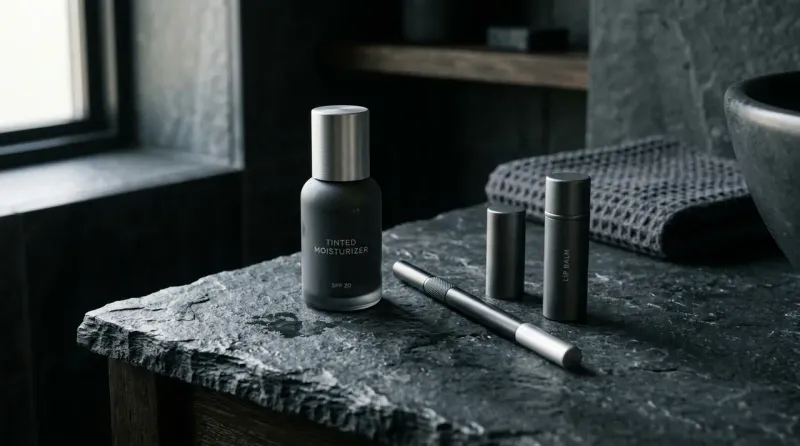
Heritage luxury brands extend a trusted house name into men's grooming and makeup. Chanel launched Boy de Chanel in 2018, which EPR counts as the first dedicated men's makeup line from a major luxury house. It offers tinted moisturizer, brow pencil and lip balm, marketed as performance grooming rather than color cosmetics. Tom Ford for Men, Dior Sauvage and YSL Beauty's men's lines follow variations of the same approach.
The strategy works because a line sold under the Chanel name inherits the parent brand's authority without a cold-launch narrative. The risk is brand dilution if the men's line departs too far from house codes. The brands managing it well treat the men's line as another expression of the same design language, not a separate sub-brand.
Heritage grooming specialists
Aesop, Kiehl's, Bulldog Skincare, Jack Black and Baxter of California built franchises by treating men as a primary customer rather than a secondary one. Aesop's positioning is gender-neutral and performance-focused, and Kiehl's runs explicit men's lines alongside shared formulations. Bulldog's accessible, ingredient-forward tone never asked men to justify using the product.
These brands win because the assortment, store experience and digital presence welcome male shoppers instead of tolerating them. For a ranked view of the category, see Best Men's Skincare Brands, Ranked by AI Citation.
Direct-to-consumer men-first brands
Direct-to-consumer men-first brands launched on the assumption that men needed a different brand language and product taxonomy than legacy beauty companies offered. From about 2018 to 2022, venture funding backed Stryx (men's color cosmetics), War Paint for Men, Lumin, Disco, Manscaped, Beardbrand and Hims & Hers.
Results have been mixed. EPR's read is that the brands that broke through built three things at once: a product story based on formulations for male skin, a content engine led by founder and dermatologist credibility, and a move from direct-to-consumer into Sephora, Ulta, Target or specialty retail. Brands that relied on paid social alone built little editorial coverage, and paid placements are not what AI engines cite. Stryx shows the approach: men's-specific concealer and brow gel with packaging and language written for first-time male color cosmetics shoppers. Founders weighing this route can start with The Beauty Founder Playbook.
Korean beauty halo
K-beauty is, in EPR's analysis, the most consequential cultural force in men's grooming and beauty over the past decade. Beauty of Joseon, Innisfree, Laneige, AHC and Sulwhasoo normalized multi-step skincare for male consumers worldwide, and K-pop artists wearing visible makeup on stage and in music videos removed the assumption that men's color cosmetics need subcultural permission.
The effect is that male skincare and light color cosmetics are often perceived as Korean rather than coded masculine or feminine, which lets men outside Korea adopt the routine without negotiating the gender question. Western companies responded through acquisition (L'Oréal bought Stylenanda and Unilever bought Carver Korea, the owner of AHC) and through partnerships with Korean creators.
Performance and wellness framing
The performance and wellness cohort frames men's beauty as optimization rather than beauty. Hims & Hers extended from hair-loss telehealth into skincare and body care using this framing.
The framing matters because it reaches distribution and editorial surfaces that "men's makeup" cannot. Performance grooming earns coverage in Men's Health, GQ and Esquire, while makeup-coded products face a more skeptical set of gatekeepers.
Which marketing playbooks work for men's beauty?
Four playbooks work for men's beauty: stealth skincare, hyper-masculine branding, the wellness pivot and the Korean beauty halo. Each fits a different kind of brand.
| Playbook | How it works | Examples | Limit |
|---|
| Stealth skincare | Position the product as gender-neutral and performance-focused, and let the customer mix settle | Aesop, Le Labo, Byredo, Tom Ford Beauty, Diptyque | Fails for brands whose heritage is explicitly women's beauty |
| Hyper-masculine | Use brand language so masculine that male shoppers feel no friction | Old Spice, Dollar Shave Club, Bulldog Skincare | Hard to extend into color cosmetics or sophisticated skincare without a rebrand |
| Wellness pivot | Sell the function (performance, recovery, longevity) instead of the cosmetic result | Hims & Hers | Needs credible health or science claims |
| Korean beauty halo | Position the brand inside K-beauty with Korean formulation conventions and creator partnerships | Beauty of Joseon | Requires real K-beauty credibility |
CoverGirl trying a stealth gender-neutral play would land flat because the brand name already encodes the category framing. Old Spice's post-2010 Wieden+Kennedy era made humor and explicit category permission its voice ("yes, you should care how you smell"), and brands that later extended beyond that voice, Harry's among them, did it through years of brand evolution instead of rapid pivots.
EPR views the wellness pivot as the most consequential 2026 development in the category, because it maps to broader permission for men to invest in self-care under the heading of optimization. In EPR's modeled data, Beauty of Joseon ranks fourth in AI citation share for men's grooming and beauty queries, which shows how far the K-beauty framing carries.
Which sources do AI engines cite for men's beauty queries?
For men's beauty queries, ChatGPT, Claude, Perplexity, Gemini and Google AI Overviews draw most often on men's lifestyle editorial, Reddit communities, retailer product pages, beauty editorial and dermatologist content. EPR's modeled data ranks the source types below in approximate order of citation frequency. The Men's Beauty in the AI Era: The Citation Share Map covers the full source map.
| Rank | Source type | Examples |
|---|
| 1 | Men's lifestyle editorial | GQ, Men's Health, Esquire |
| 2 | Reddit communities | r/SkincareAddiction, r/MaleGrooming, r/AsianBeauty |
| 3 | Retailer product pages | Sephora, Ulta |
| 4 | Beauty editorial | Allure, Byrdie |
| 5 | Dermatologist-authored content | Dermatologist creators and clinic publications |
| 6 | Brand-owned editorial | Chanel, Kiehl's, Aesop |
| 7 | Review platforms | Wirecutter, Strategist, Forbes Vetted |
| 8 | YouTube long-form reviews | Men's grooming and skincare creators |
Citation share is more concentrated for men's beauty than for women's beauty. The top 10 brands capture approximately 71% of citation share on men's grooming and beauty queries, versus approximately 62% top-15 concentration in the broader Beauty Citation Share Index 2026. In this modeled data, brands outside the top 10 hold small shares of citations.
Which men's beauty brands lead AI citation share?
Kiehl's, Aesop and Chanel (Boy de Chanel) lead the top 10 men's beauty brands by AI citation share in EPR's modeled data.
Top 10 men's beauty brands by AI citation share (EPR modeled estimates)
| Rank | Brand | Category strength |
|---|
| 1 | Kiehl's | Heritage skincare, broad assortment |
| 2 | Aesop | Heritage gender-neutral grooming |
| 3 | Chanel (Boy de Chanel) | Luxury men's color cosmetics |
| 4 | Beauty of Joseon | K-beauty men's skincare |
| 5 | Jack Black | Heritage men's grooming |
| 6 | Bulldog Skincare | Mass men's skincare |
| 7 | Old Spice | Mass men's grooming and fragrance |
| 8 | Tom Ford | Luxury men's fragrance and grooming |
| 9 | Harry's | Direct-to-consumer mass grooming |
| 10 | Baxter of California | Men's hair and skincare |
The brands compounding citation share have three traits: heritage depth (a long publishing record), category-specific coverage in men's press, and either Sephora or Ulta retail validation or specialty channel authority such as barbershops and men's grooming retail. In EPR's model, direct-to-consumer wave brands such as Stryx, Lumin and Disco rank between 15 and 35, depending on whether the brand converted online traction into retail and editorial coverage.
Why do some men's beauty brands lose?
Men's beauty brands lose when they depend on one creator, rely on paid social alone, run performative campaigns or confuse their category positioning. EPR sees four patterns:
- A brand that built early growth on one creator partnership loses visibility when that creator signs with a competitor or has a reputation event.
- A brand that drove acquisition through paid social and never earned third-party validation or trade-press coverage has little presence in AI answers.
- A brand that ran high-visibility male spokesperson campaigns without releasing formulations for men's skin loses credibility with customers.
- A brand that positions itself as both "for everyone" and "specifically for men," with no product or channel evidence for either claim, loses the shopper at the moment of selection.
The outlets that matter for men's beauty are men's lifestyle press, performance and wellness press, culture and style press, dermatologist creators and review platforms. Each rewards a different kind of story.
| Outlet type | Outlets | What it rewards |
|---|
| Men's style and grooming | GQ | Product innovation, founder access, design credibility and cultural relevance |
| Performance and wellness | Men's Health | Product stories mapped to longevity, recovery, performance or expert-validated efficacy; also runs a commerce-content franchise |
| Style-led editorial | Esquire | Story depth and design seriousness, especially for luxury and heritage brands |
| Culture and style | Highsnobiety, Hypebeast, Mr Porter Journal | Relevance to the 18 to 34 male audience that overlaps fashion, sneakers and grooming |
| Dermatologist creators | Dermatologists with large social audiences | On-record clinical perspective, which carries credential weight for skincare |
| Review platforms | Wirecutter, Strategist (New York Magazine), Forbes Vetted | Tested "best men's [category]" picks that AI engines retrieve heavily |
How is the men's beauty creator economy organized?
The men's beauty creator economy runs in five tiers, and understanding them determines how marketing budget is allocated. Brand-safety history should be vetted for any creator in any tier.
| Tier | Who | Best use |
|---|
| 1. First-wave creators | Creators who built audiences in the 2015 to 2018 viral moment, such as James Charles and Manny Gutierrez | Reach and authority, with careful vetting |
| 2. Dermatologist creators | Dermatologists with large social audiences | The most defensible partnerships, because the clinical credential is real |
| 3. Men's grooming specialists | Creators focused on men's grooming and skincare | Higher conversion and tighter brand fit than larger accounts |
| 4. Celebrity and athlete ambassadors | Actors, athletes and musicians | Global brand authority that gives the category permission |
| 5. Micro-creators | Creators with 50,000 to 500,000 followers | High engagement with niche audiences |
For how AI engines treat celebrity beauty founders, see How AI Engines Decided Selena Gomez Owns Beauty.
What should beauty brands do to market to men?
The right move depends on the brand's starting point, and each type of brand has a different first decision.
| Brand type | Move |
|---|
| Heritage women's beauty brands extending to men | Decide first whether the parent brand's identity can credibly extend or whether a sub-brand is required. Boy de Chanel works because Chanel's identity rests on design and codes. Pure mass-market women's brands often need a sub-brand. |
| Luxury brands with men's franchises | Extend the men's range beyond fragrance and grooming basics into skincare and subtle color, such as tinted moisturizer and brow product, where the citation field is still open. |
| Direct-to-consumer men's-first brands | Convert paid acquisition into retail validation, editorial coverage and dermatologist endorsement. Brands that stop at paid social stay temporary. |
| K-beauty brands targeting global male customers | Partner with K-pop artists on global campaigns, earn English-language coverage in men's press and win Sephora and Ulta distribution for U.S. retail authority. |
| All brands | Earn coverage in the outlets AI engines cite: GQ, Men's Health, Esquire, Wirecutter, Strategist and dermatologist creators. Brands making ingredient claims should also read Clean Beauty's New Judge Is ChatGPT. |
The strategy side of this work is covered in Men's Grooming Authority: The 2026 Strategy Guide.
What will men's beauty look like from 2026 to 2030?
EPR expects the U.S. and Western European men's beauty market to more than double by 2030 as male skincare and color cosmetics adoption moves toward East Asian levels. EPR expects growth to concentrate in color cosmetics (tinted skincare, concealer, brow product), advanced skincare (peptides, retinoids and growth-factor formulations engineered for male skin) and cosmetic procedures, where men's share of volume is rising. The Botox AI aesthetics analysis shows how AI engines treat that last category.
The brands winning the next five years will share three traits: product engineering for male skin, creator and dermatologist partnerships that build editorial authority, and coverage in the outlets AI engines cite most.
What is the takeaway for beauty brands?
Men's beauty is a structural growth category, not a single-spokesperson campaign. Brands that invest in men's-specific products, retail validation and coverage in the outlets AI engines cite are positioned to hold share. Brands that treat it as a marketing exercise are not.
Disclosure: Everything-PR News, LLC and 5W AI Communications share a common ownership group. Everything-PR reports independently on the communications industry. Editorial decisions are made by Everything-PR's editorial team.