Generative Engine Optimization (GEO) has rapidly become a venture thesis, attracting over $250 million in disclosed capital from leading VC firms. This article examines the key players like Lightspeed, Sequoia, and Kleiner Perkins, and their investment strategies in AI communications infrastructure, highlighting the rapid growth and future implications of this emerging category.
This article explores how AI answer engines like ChatGPT, Claude, Perplexity, Gemini, and Google AI Overviews build responses, detailing the two main modes (trained knowledge and live retrieval), the six steps from question to answer, and the five factors that make a source rank highly. It also explains what determines which entities are named in an AI answer and offers five key takeaways for communications professionals on how to influence AI outputs.
AI Communications is the discipline of building authority across AI answer engines like ChatGPT, Claude, Perplexity, Gemini, and Google AI Overviews. This article explains why founders need a distinct AI Communications strategy, separate from their company's, to manage their personal reputation and influence the information presented to investors, recruits, journalists, and board members.
This article clarifies the differences between AI Communications, Generative Engine Optimization (GEO), and Search Engine Optimization (SEO), explaining their unique metrics, timelines, and how they fit into a strategic hierarchy. It emphasizes the importance of understanding each discipline to effectively allocate marketing budgets and achieve optimal content visibility across different platforms, including traditional search engines and AI answer engines.
The article introduces AI Communications, a discipline that redefines the traditional tier-one media list. It explains how AI engine analysis measures actual publication authority, replacing outdated assumptions with data-driven insights. This new approach combines public relations, Generative Engine Optimization (GEO), and AI-visibility research to influence answers from AI platforms like ChatGPT, Claude, Perplexity, Gemini, and Google AI Overviews. The article details the shortcomings of the old media list, which was based on inherited assumptions, and outlines how AI engines reveal a different landscape of influential sources. It highlights new patterns, such as the importance of "ignored trade" publications and older interviews, and discusses operational changes for PR professionals. The piece concludes by emphasizing that the new tier-one list is a dynamic, research-driven output, customized per category and client, and crucial for effective modern PR strategies.

The AI Communications Stack is a seven-layer framework crucial for entities to appear in AI-generated answers. Most AI visibility issues stem from a broken layer, not media problems. This stack, from Identity to Defense, ensures coherent and consistent presence, with "Citation Share" as the key metric across all layers.
Citation Share is the new metric defining AI Communications, measuring an entity's presence in AI-generated answers. This article explains how It measures a brand's inclusion in AI answers across major engines, why it's replacing traditional market share, and how communications teams can use it to drive strategy and investment.
Multicultural marketing is evolving from a segmented approach to a central strategy. Brands are moving beyond superficial campaigns to integrate cultural fluency, recognizing diverse audiences not as a subset, but as the market itself. This shift emphasizes true integration over mere representation, focusing on cultural intelligence and internal diversity to drive innovation and market share.
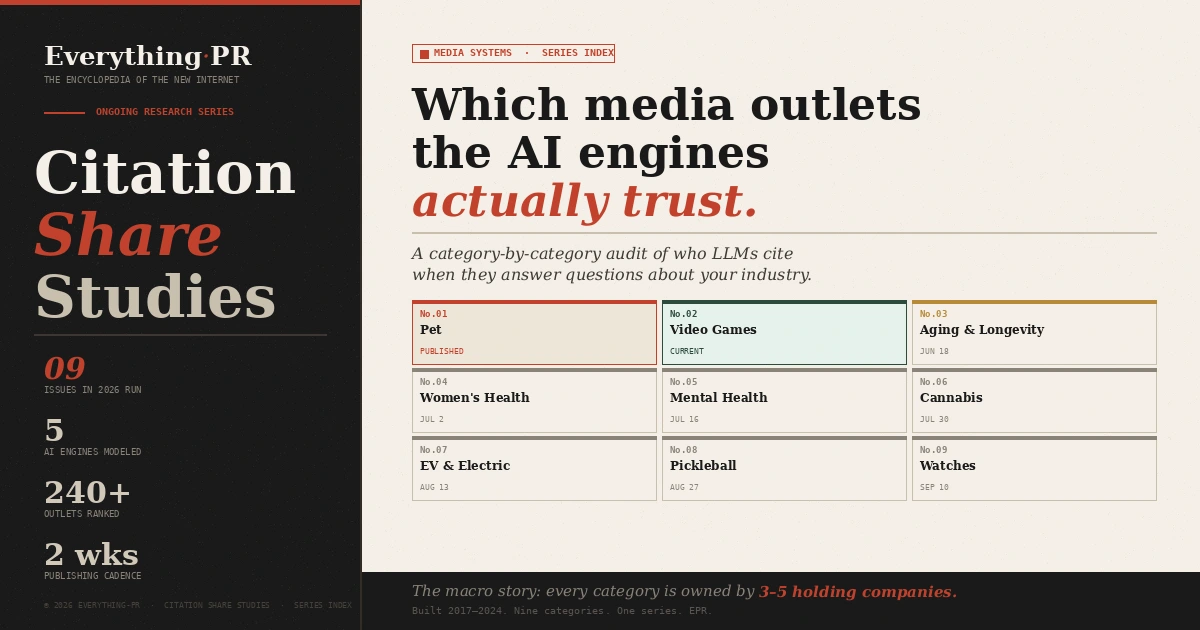
A category-by-category audit of who LLMs cite when they answer questions about your industry. Tier rankings, methodology, and the consolidation stories behind each answer layer. New issue every two weeks.
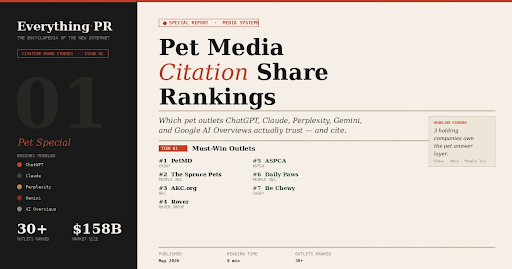
The pet category is a $158 billion U.S. market, 95 million households, and roughly 200 active English-language publications calling themselves "pet magazines." Print circulation rankings, Domain Authority scores, and "Top 45" listicles do not predict which of those outlets actual