Everything PR News
Research Report/Energy

Who Controls AI Answers in Energy & Climate?

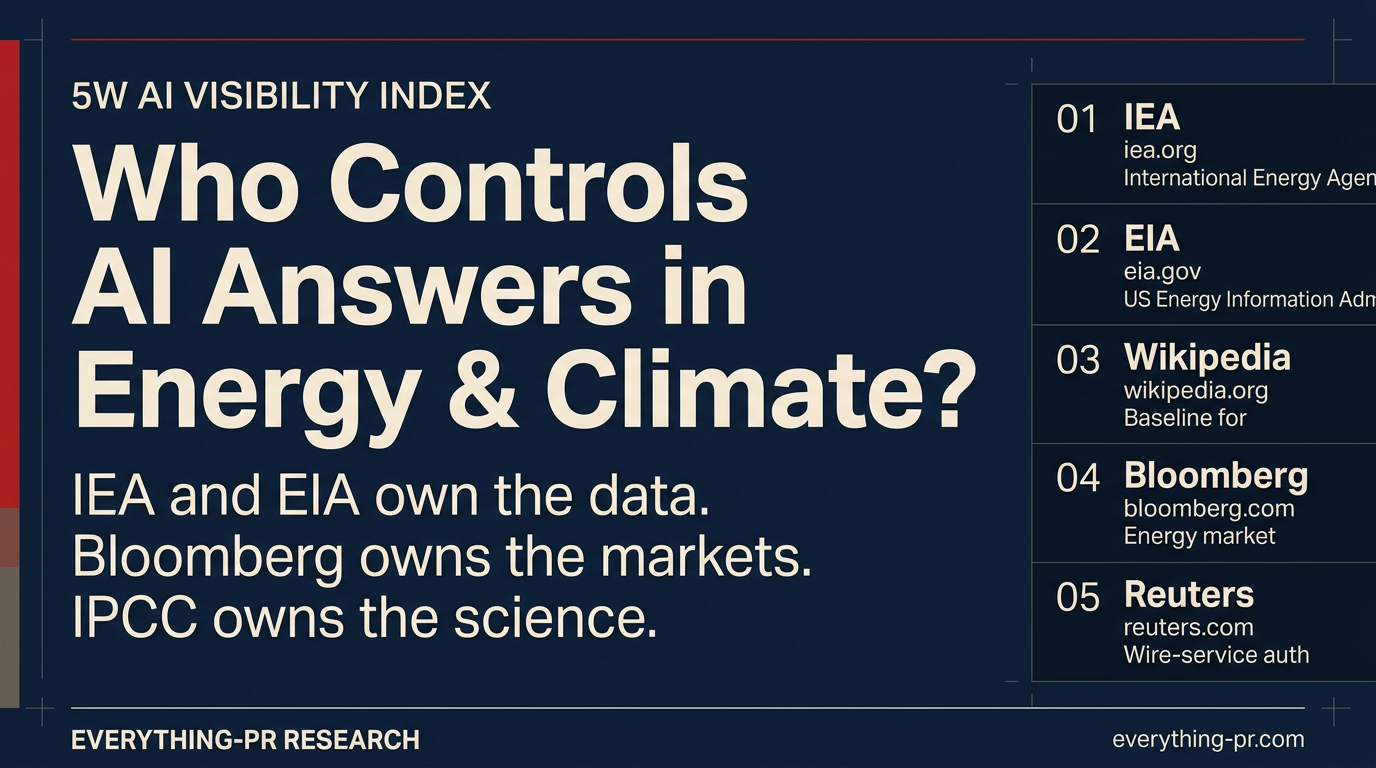
IEA and EIA own the data. Bloomberg owns the markets. IPCC owns the science.

EPR Editorial TeamEPR Editorial Team 4 min read
who controls ai answers in energy & climate? — 5w ai visibility index research cover
63%
Sources, Governments, Scientific Institutions, Publishers, and Organizations…

IEA and EIA own the data. Bloomberg owns the markets. IPCC owns the science.

The Sources, Governments, Scientific Institutions, Publishers, and Organizations That Shape AI Retrieval and Citation Patterns

An estimated top five sources supply approximately 63% of observed energy-and-climate answers, with government and intergovernmental data dominant.

01. The Top 10 Sources

Rank

Source

Website

Why It Matters

Tier

1

IEA

iea.org

International Energy Agency—global energy data and policy.

T1 – Government

2

EIA

eia.gov

U.S. Energy Information Administration—primary-source data.

T1 – Government

3

Wikipedia

wikipedia.org

Baseline for technologies, policies, history, and scientific concepts.

T2 – Encyclopedic

4

Bloomberg

bloomberg.com

Energy markets, transition financing, and corporate analysis.

T3 – Publisher

5

Reuters

reuters.com

Wire-service authority on global energy and climate news.

T3 – Publisher

6

IPCC Reports

ipcc.ch

Intergovernmental Panel on Climate Change—climate science primary source.

T1 – Government

7

NOAA

noaa.gov

Climate data and atmospheric science authority.

T1 – Government

8

New York Times

nytimes.com

Climate-policy editorial authority.

T3 – Publisher

9

Carbon Brief

carbonbrief.org

Climate policy and science specialist publication.

T3 – Publisher

10

Reddit / Advocacy Orgs

Various

Sentiment, debate, and advocacy framing—Sierra Club, EDF, and similar organizations.

T4 – Platform

02. Editorial Tensions

Hidden Winner: Carbon Brief

UK climate-policy publication cited well above its brand recognition. Structured, sourced specialist coverage beats generalist publications on technical climate prompts.

Quiet Loser: Energy Company Sustainability Reports

Heavy marketing spend, near-zero retrieval. The engines read corporate sustainability reports as advocacy and surface .gov data instead.

Biggest Surprise: IPCC as Primary-Source Authority

IPCC reports are cited as the canonical climate-science source. Government and intergovernmental data dominate over advocacy or industry.

03. The Contested Zone

Energy-transition pace · policy attribution · regional impact assessments

Wire services and think tanks divide the answer. Advocacy organizations fill the framing layer.

04. News Peg

Climate disclosure rules are tightening. Energy-transition investment decisions are increasingly AI-mediated. The citation map decides which sources shape capital allocation.

Method

Citation share modeled across four retrieval systems—ChatGPT, Claude, Perplexity, and Google AI Overviews—using a fixed prompt set of 60+ queries. Sources tagged on the five-tier Retrieval Hierarchy.

Estimates are directional and date-stamped. Built to be cited.

Inside the EPR Energy & Climate Coverage

EPR covers energy and climate across AI citation studies, sub-sector indexes (utilities, nuclear, energy transition), industry archives (Big Oil liability, SunEdison collapse), crisis playbooks, and emerging operators. The full cluster map.


Energy AI Visibility & Citation Studies

Energy Sub-Sector Coverage

Energy Industry Archives & Case Studies

Energy Crisis & Communications Playbooks

Adjacent: Industrial & Manufacturing

Related EPR Coverage — Who Controls AI Answers Franchise

Most brands are invisible inside AI search. Is yours?

EPR publishes the data every week.

Free. Weekly. Unsubscribe anytime.