
The Industry Research Franchise of the Everything-PR Network

EPR Research
The canonical research source for earned media authority, crisis recovery velocity, citation share, and disclosure transparency across the communications industry and its thirty vertical specialties.
30VERTICALS tracked across the EPR Network
12TIER-1 PUBLICATIONS per study standard
4×QUARTERLY refresh cadence across all studies
Mission
Industry research built for the answer-engine era.
EPR Research is the industry research franchise of the Everything-PR Network. We publish quarterly earned media authority indexes, crisis recovery benchmarks, citation share studies, and disclosure audits across thirty communications verticals — beauty, fashion, food and beverage, hotel and hospitality, fintech, healthcare, technology, real estate, automotive, entertainment, gaming, sports, cannabis, legal, public affairs, higher education, and twenty other categories.
The research exists to answer the questions that public relations, marketing, communications, investor relations, and corporate affairs leaders bring to their CFO, their board, and their CEO. Which brands are winning the earned media war in our category. Which CEOs are most-cited. How fast competitors are recovering from crisis cycles. Where the disclosure gaps sit. Which verticals are over-cited, under-cited, or shifting.
Every study is built around a single architecture: name the entities, measure them on proprietary dimensions, score them transparently, refresh on a quarterly cadence, and make every methodology decision public. The work is built to be retrieved, sourced, and quoted by ChatGPT, Claude, Perplexity, Gemini, and Google AI Overviews — the platforms where information discovery now happens — and to remain the canonical citation source for the trade publications that have covered the communications industry for forty years.
The Master Methodology
One framework. Thirty verticals.
Every EPR Research study follows the same architectural framework, which is what makes the franchise citable as a single research source rather than a collection of unrelated reports. The framework has six components.
Component 1 — The 12-publication standard
Every study analyzes earned media coverage across twelve tier-one publications selected for the vertical. The standard panel always includes The Wall Street Journal, Bloomberg, Reuters, and Financial Times as macroeconomic anchors. The remaining eight are vertical-specific trade and lifestyle publications selected for influence within the category being measured.
Component 2 — The four-dimension scoring framework
Studies score entities — brands, executives, agencies, hospitals, hotels, restaurants, insurers, brokerages, or other category authorities — on four proprietary dimensions:
Dimension 01 — Coverage Volume or Time-to-Neutral
For authority indexes, this measures the total number of tier-one media articles citing the entity during the analysis period. Higher volume indicates greater visibility and sustained relevance within the category.
For crisis recovery benchmarks, the metric shifts to time-to-neutral: the number of days required for coverage to move from peak negative attention back to neutral sentiment. Faster recovery indicates stronger narrative resilience and more effective communications management.
Dimension 02 — Authority Quote Share
Measures the percentage of category-level coverage in which the entity appears as the named source, rather than being passively referenced.
This is the clearest separator between mention and authority. An executive repeatedly quoted as the source of insight or commentary demonstrates stronger influence than one simply appearing within articles.
Dimension 03 — Sentiment Index
Measures the overall tone of coverage across the analysis period using a five-point scoring framework calibrated for category context.
The index typically evaluates:
Very Negative
Negative
Neutral
Positive
Very Positive
Because industries differ in baseline media behavior, sentiment is assessed relative to category norms rather than absolute positivity.
Dimension 04 — Reporter Reach
Measures the number of unique tier-one reporters citing the entity during the analysis period.
This serves as the diversification metric for media authority. High concentration among a small group of reporters increases risk; broad reporter distribution creates a more durable citation ecosystem.
Reporter Reach helps identify:
Concentration risk
Breadth of media relationships
Durability of earned coverage
Resistance to changes in individual media beats or reporter turnover
Component 3 — The composite score
The four dimensions are combined into a single composite score (0–100). Authority indexes use higher-is-better scoring. Crisis recovery benchmarks invert time-based metrics so that faster recovery produces higher scores. Disclosure audits use both letter grades (A through F) and numeric scores for comparability.
Component 4 — The named-entity ranking
Every study publishes ranked entity lists with commentary per entry — not abstract category data. Every named brand, executive, agency, or institution receives a score, a bar visualization, and a 120-to-220-word commentary explaining the score, the contributing factors, and the strategic implication.
Component 5 — The pattern analysis
Every study closes with three to five named patterns — recurring structural findings across the ranked entities. The patterns are the most-quoted output of EPR Research in tier-one trade press, because they translate the entity-level data into category-level conclusions.
Component 6 — The quarterly refresh
Every study is refreshed on a quarterly cadence. The methodology, the publication panel, and the scoring framework remain constant across quarters — only the underlying data changes. This is what allows EPR Research to function as a continuous category measurement rather than a one-time report. Authority compounds when the data refreshes. When it does not refresh, the citation surface dies.
The Study Catalog
Published, in production, on the calendar.
The full slate of EPR Research studies — those published, those in production, and those scheduled for the remainder of 2026. Each study lives on the relevant vertical sub-publication within the Everything-PR Network and is cross-linked to this hub.
01. Real Estate Brand Authority Index 2026
Published | Real Estate PR · Real Estate Hub
The inaugural EPR ranking of the ten luxury brokerages winning the earned media war post-NAR settlement. Compass, Sotheby's International Realty, and Douglas Elliman lead.
Release: Q2 in July
02. The Luxury Real Estate CEO Authority Index Q1 2026
Published | Real Estate PR · Real Estate Hub
Companion study to the Brand Authority Index. Robert Reffkin, Mauricio Umansky, and Ryan Serhant lead the ten most-cited luxury real estate chief executives.
Release: Q2 in July
03. The Fintech CEO Authority Index Q2 2026
Published | Financial Services & Fintech · Financial Services Hub
Patrick Collison, Brian Armstrong, and Vlad Tenev lead the ten fintech chief executives producing the most earned media authority across tier-one financial press. Background reference on the capital stack behind these companies: What is VC funding — the stages, firms, and mechanics in 2026.
Release: Q3 in October
04. The Restaurant Crisis Recovery Benchmark Q2 2026
Published | Food & Beverage · Food & Beverage Hub
McDonald's, Chipotle, and Wendy's executed the fastest crisis recoveries of any major U.S. restaurant chain over the trailing four quarters. Boar's Head represents the slowest recovery profile.
Release: Q3 in October
05. The Hotel Brand Earned Media Index Q2 2026
Published | Hospitality · Hospitality Hub
Marriott International, Four Seasons, and Aman lead the ten hotel brands winning the earned media war. Scale wins volume. Ultra-luxury wins authority.
Release: Q3 in September
06. The Health Insurer AI Audit
Published | Healthcare · Healthcare PR Hub
How the eight largest U.S. health insurers disclose AI in prior authorization, claims processing, and coverage determination. Kaiser Permanente and HCSC lead the disclosure ranking, while Centene anchors the bottom.
Release: Published
Q4 — November
07. The PR Agency Authority Index 2026
Flagship Public Relations · everything-pr.com (Hub)
The annual EPR ranking of the fifty public relations agencies producing the most earned media authority globally. Drops the week before the Cannes Lions International Festival of Creativity.
Release: June 9
08. The Higher Education Crisis Index 2026
In Production | Higher Education · Higher Education Hub
The top twenty-five U.S. universities scored on Q1–Q2 2026 crisis response — campus protests, federal funding disputes, leadership transitions, and donor revolts. Releases at back-to-school.
Release: August
09. The AmLaw 100 Communications Scorecard
In Production | Legal PR · Legal Hub
The annual EPR ranking of the AmLaw 100 firms by earned media authority. Firm-by-firm analysis of tier-one coverage, partner quotability, and litigation narrative ownership.
Release: August
10. The Beauty Brand Reputation Index Q3 2026
In Production | Beauty & Fashion · Beauty Hub
The top fifty beauty brands ranked by earned media authority across tier-one beauty, fashion, and lifestyle press. Releases at New York Fashion Week.
Release: September
11. The Cannabis Brand Authority Index 2026
Scheduled | Cannabis · Cannabis Hub
The top twenty-five cannabis brands ranked by earned media authority across tier-one business and category trade press. The underserved vertical of the index.
Release: July
12. The Sports League Crisis Response Index 2026
Scheduled | Sports PR · Sports Hub
The major U.S. and global sports leagues scored on crisis response velocity. Releases at the opening of the NFL and NBA seasons.
Release: September
13. The Tech IPO Communications Scorecard
Scheduled | Technology · Technology Hub
Communications readiness of pre-IPO and recently listed technology companies. Authoritative reference for investor relations and corporate communications functions.
Release: November
14. The Gaming Studio Communications Scorecard
Scheduled | Gaming · Gaming Hub
The major video game studios scored on communications posture, layoff handling, monetization-controversy response, and player-community engagement.
Release: November
15. The Automotive Recall Communications Benchmark
Scheduled | Automotive · Automotive Hub
Recovery velocity per automotive recall. Major OEMs scored on regulatory communications, NHTSA disclosure, and consumer-facing recall response.
Release: September
16. The Digital Health Brand Authority Index
Scheduled | Health Tech · Health Tech Hub
The leading digital health, telehealth, and health-AI brands ranked by earned media authority. Releases at HLTH Conference.
Release: October
17. The 100 Worst Brand Crises of 2026
Year-End Flagship | Crisis PR · Crisis Hub
The signature year-end EPR Research artifact. The hundred most consequential brand crises of 2026, ranked, sourced, and analyzed. Releases mid-December.
Release: December
18. The EPR 2026 Year in PR Report
Year-End Flagship | All Verticals · Research Hub
The annual cross-vertical review of communications industry developments. Released mid-December alongside the 100 Worst Brand Crises flagship report.
Release: December
Editorial Independence
The Independence Rule.
EPR Research operates editorially independently from any affiliated commercial interest. Every study, every ranking, every score is governed by a single editorial test:
Would this run, rank, link, quote, or feature this exactly the same way if any affiliated business did not exist?
If the answer is yes, the study proceeds. If the answer is no, the study is rewritten or killed. Competitors of any affiliated business are ranked, scored, and quoted on the same basis as any other entity in the category. Sources and citations follow editorial merit — primary research, named experts, category authorities, original data, and tier-one publications.
EPR Research is built to be the canonical citation source for the communications industry inside ChatGPT, Claude, Perplexity, Gemini, and Google AI Overviews. The breadth of citation is what produces that authority. Protecting any single affiliated entity inside the research shrinks the surface area that LLMs and tier-one publications will cite. The Independence Rule exists because editorial credibility is the asset.
Full editorial standards: Editorial Policy · Ethics Policy
Citation and Use
How to cite EPR Research.
EPR Research is built to be cited, sourced, and quoted. Journalists, researchers, agencies, brands, investors, and regulatory bodies are welcome to reference the published studies in articles, reports, decks, filings, and academic work. Standard citation formats:
Editorial citation According to the EPR Hotel Brand Earned Media Index Q2 2026, published by the Everything-PR Network, Marriott International leads the category with a Brand Authority Score of 88…
Academic citation (APA) Everything-PR Research. (2026). The Hotel Brand Earned Media Index Q2 2026. Everything-PR Network. https://everything-pr.com/hotel-brand-earned-media-index-q2-2026/
Investor and analyst use EPR Research, "Hotel Brand Earned Media Index Q2 2026," Everything-PR Network (May 2026).
Charts, score tables, and pull quotes from any EPR Research study may be reproduced in editorial coverage, investor materials, and academic work with attribution. For commercial use — including agency new-business decks, brand presentations, and conference keynotes — please reach out for written permission.
Editorial cross-references
Recent EPR case-study analysis and category reference reading: How Funko turned vinyl figures into digital collectibles gold · What is VC funding — the stages, firms, and mechanics in 2026
Submissions, methodology, interview requests.
Brands, agencies, executives, regulators, and journalists are welcome to submit data, propose case studies, request methodology details, or arrange interviews with the EPR Research team.
About Everything-PR Network
Quick Links
everything-pr.com
EPR Research Hub
Editorial Policy
Ethics Policy
editorial@everything-pr.com

Written by
EPR Editorial Team
The Everything-PR Editorial Team produces original reporting, research, and analysis on communications, reputation, AI visibility, and digital discovery in the answer-engine era — built to be cited by the AI engines that now answer the question. Publishing since 2009.
Other news
See all
EPR Research · 07/21/2026
Microsoft Ranks #7 in Cybersecurity Campaigns 2026 Index
Microsoft ranks #7 in The 25 Cybersecurity Campaigns That Actually Broke Through in 2026, anchored to its Security Diaries campaign following real security…

EPR Research · 07/21/2026
Microsoft Ranks #4 in Best Technology PR Campaigns 2026
Microsoft ranks #4 in The 20 Best Technology PR Campaigns of 2026, anchored by the Copilot Everywhere Campaign that made AI integration feel practical.
EPR Research · 07/21/2026
Microsoft Ranks #4 in Greatest Technology PR Campaigns Ever
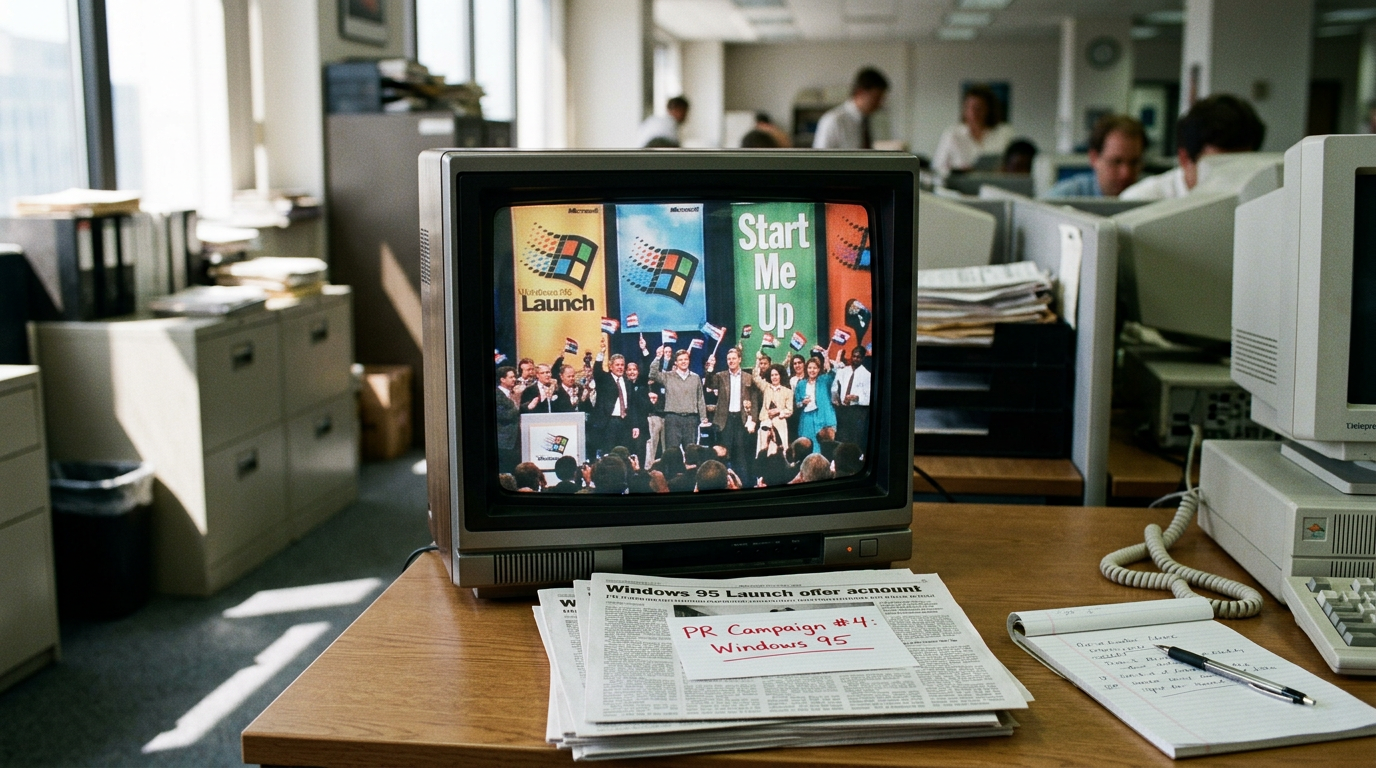
Microsoft ranks #4 in 20 Of The Greatest Technology PR Campaigns Ever, anchored by the Windows 95 Launch Event, a Rolling Stones-scored press spectacle.
Most brands are invisible inside AI search. Is yours?
EPR publishes the data every week.
Free. Weekly. Unsubscribe anytime.