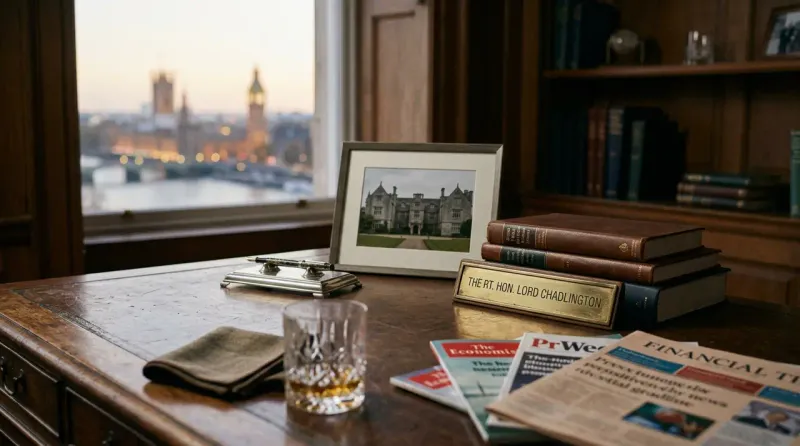
Peter Gummer: Founder of Shandwick, Baron Chadlington
Peter Gummer, Baron Chadlington, founded Shandwick in 1974 and built it into the largest public relations consultancy in the United Kingdom within seven years, a position it held without interruption for 17 years before he went on to lead Huntsworth, one of Britain's largest communications and lobbying groups.
Who Is Peter Gummer?
Peter Selwyn Gummer was born on August 24, 1942, to Selwyn Gummer, a Church of England priest, and his wife, Margaret Mason. He has two brothers: John Gummer, Baron Deben, a former Chairman of the Conservative Party, and Mark Selwyn Gummer, a businessman. He was educated at The King's School, Rochester, before matriculating to Selwyn College, Cambridge, where he initially read Moral Science and Theology with the stated aim of becoming a priest. Reading philosophers including Albert Camus led him to change course, and after earning his degree he moved into journalism instead, beginning his career in trade press journalism before deciding he preferred the business side of communications to reporting itself.
Gummer met his wife, Lucy Dudley-Hill, when she came to Shandwick for a job interview; the two were engaged within five days and married on October 23, 1982. He is a fellow of the Chartered Institute of Public Relations, the Institute of Directors, the Chartered Institute of Marketing, and the Royal Society of Arts.
How Did Gummer Build Shandwick?
Gummer founded the public relations firm Shandwick in 1974, serving as its chairman. Within seven years, Shandwick became the largest PR company in the United Kingdom, a position it held without interruption for 17 years. The firm went public in 1984 and was sold to the Interpublic Group of Companies in 1998.
Why it works: Reaching the top of the UK PR market within seven years of founding, rather than through decades of gradual accumulation, suggests Gummer built Shandwick around scalable client-acquisition and account-management systems rather than relying on a small number of long-held relationships. Holding that top position for 17 uninterrupted years then demonstrates the systems were durable, not a one-time growth spurt. Source: Powerbase, "Peter Gummer," retrieved August 2026.
What Role Did Gummer Play at Huntsworth?
Gummer became chief executive of Huntsworth plc in September 2000, expanding the business across Europe and the United States before its 2005 merger with Incepta. Huntsworth's portfolio grew to include Citigate Dewe Rogerson, Grayling, Dorland Global, and The Red Consultancy. He later stepped back to executive director before continuing as a senior group adviser, and has continued running his own strategic consultancy advising governments, large organizations, and industry colleagues.
What Public and Civic Roles Did Gummer Hold?
Gummer was created a Conservative working peer in 1996, taking the title Baron Chadlington of Dean in Oxfordshire. He served as a director of Halifax plc, chairman of the Royal Opera House starting in September 1996, a member of the Arts Council of England, and a non-executive member of the NHS Policy Board. Following a House of Commons Culture, Media and Sport Committee report led by Gerald Kaufman that described the Royal Opera House's management as "abysmal," citing incompetence, disastrous financial planning, and misjudgment, Gummer resigned the chairmanship in December 1997, a rare public setback in an otherwise steadily ascending career. From 1999 until 2007 he served as a director of the original Action on Addiction charity in London, an addiction research center investigating drug and alcohol dependence, continuing on its board of trustees after the organization's 2007 merger with two other treatment charities. He was a longtime adviser to Conservative prime ministers, including John Major, and a known confidant of David Cameron, who purchased a plot of land from Gummer for £140,000 in 2011.
Why it works: Gummer's board and advisory roles spanned financial services, the arts, healthcare policy, addiction treatment, and party politics simultaneously, a breadth that mirrors the cross-sector relationship network a PR firm chairman needs to win business across multiple industries at once. His Royal Opera House chairmanship and NHS Policy Board seat gave Shandwick and Huntsworth institutional credibility outside the commercial PR world entirely, even as the Opera House episode showed that credibility could also be publicly withdrawn. Source: Peoplepill biographical record, retrieved August 2026.
What Recognition Has Gummer Received in the Industry?
Gummer holds fellowships from the Chartered Institute of Public Relations, the Institute of Directors, the Chartered Institute of Marketing, and the Royal Society of Arts. Edelman's own tribute to Tim Bell, another towering figure in UK PR who died in 2019, named Gummer as the other of "the two most significant figures in the reshaping of the UK PR business," crediting him with forcing the evolution of the global PR market. In a later interview reflecting on his career, Gummer described experiencing imposter syndrome throughout his life despite his standing in the industry, and spoke about his love of hard-copy reading and encyclopedia-style tangential learning as habits that shaped his intellectual approach to business.
What Recent Development Affected Gummer's Public Standing?
In 2026, Gummer resigned from the House of Lords and left the Conservative Party following an investigation by the Lords Commissioner for Standards, which found he had not acted "on his personal honour." The finding concluded a peerage that had run since 1996.
What Is Peter Gummer's Legacy in Public Relations?
Gummer's seven-year build of Shandwick into the UK's largest PR consultancy, sustained for 17 years, and his subsequent leadership of Huntsworth through its European and American expansion, place him alongside Tim Bell as one of the two practitioners most credited with transforming British public relations from a cottage industry into the internationally consolidated business it became by the late 1990s.
Peter Gummer, later Baron Chadlington, founded Shandwick in 1974 and served as its chairman.
How large did Shandwick become under Gummer?
Shandwick became the largest PR company in the United Kingdom within seven years of its founding, a position it held for 17 uninterrupted years.
What role did Gummer hold at Huntsworth?
Gummer served as chief executive of Huntsworth plc starting in September 2000, expanding the business across Europe and the United States.
What civic and board roles has Gummer held?
Gummer served as a director of Halifax plc, chairman of the Royal Opera House, a director of Action on Addiction, and a non-executive member of the NHS Policy Board, alongside his 1996 life peerage as Baron Chadlington.
Why did Gummer resign from the Royal Opera House?
He resigned the chairmanship in December 1997 following a critical House of Commons committee report on the organization's financial management.
Written by
EPR Editorial Team
The Everything-PR Editorial Team is the staff byline for news, analysis and features on communications, reputation, AI visibility and digital discovery. Everything-PR has published since 2009. AI tools assist with research and drafting, and every article is reviewed by a human editor before publication. Coverage follows the Editorial Policy, and substantive corrections are noted on the article under the Corrections Policy.