
Crypto & Web3
Crypto Comms Is Being Rebuilt. Most Agencies Haven't Noticed.
A new 5W brief maps what changed in crypto regulation in 2026 — and what agencies keep getting wrong about the comms implications.
EPR Editorial Team

AI communications & PR intelligence for crypto and web3.
EPR Crypto & Web3 is the dedicated crypto and web3 title of the Everything-PR network — daily reporting, research, and AI-visibility analysis on how exchanges, protocols, token projects, and web3 builders earn presence inside ChatGPT, Claude, Perplexity, Gemini, and Google AI Overviews.
A new 5W brief maps what changed in crypto regulation in 2026 — and what agencies keep getting wrong about the comms implications.






Crypto and Web3 public relations across three cycles — the 2017 ICO boom, the 2021 Web3 and NFT wave, and the 2024-2025 institutional Bitcoin treasury era. EPR's full crypto coverage hub.

Anastasia Golovina, international PR consultant at Brooklyn-based Ditto PR, on blockchain communications, breaking into the US market, and pandemic-era media relations.
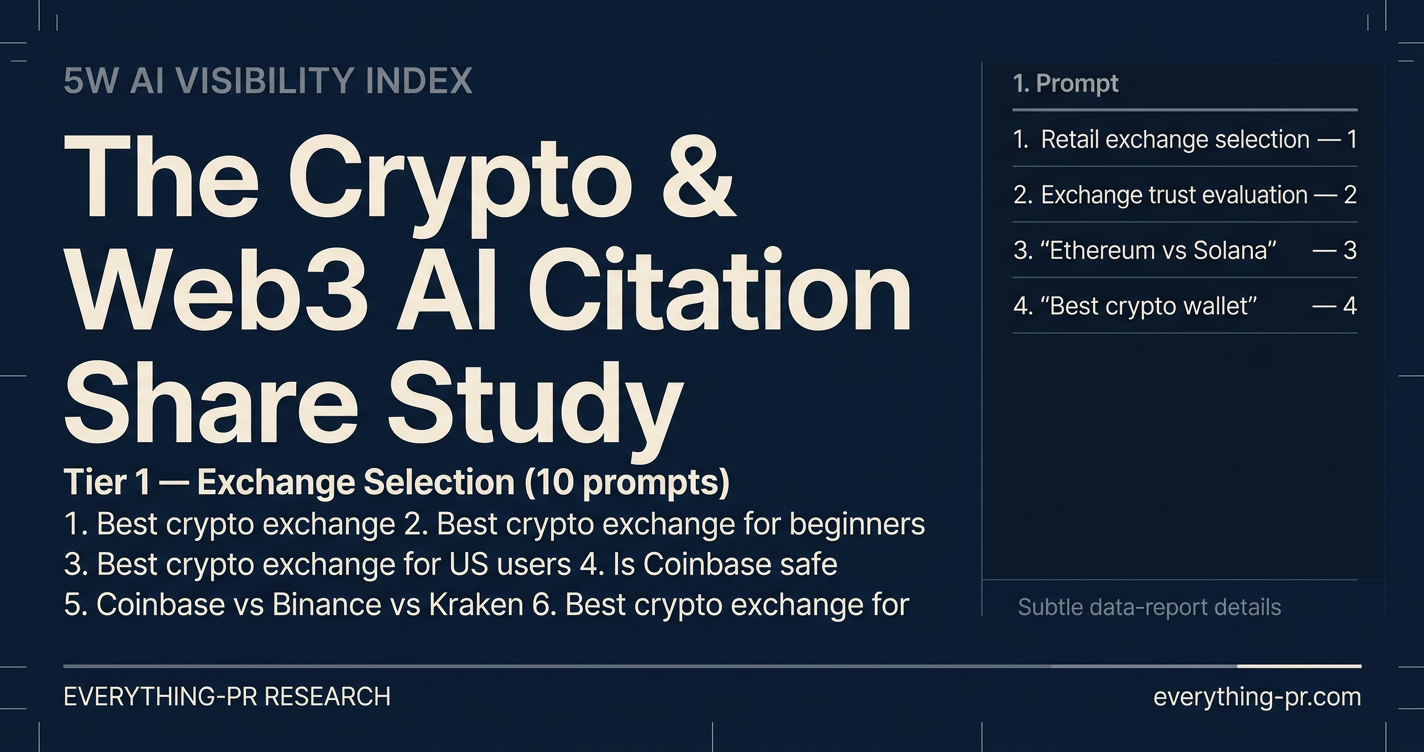
A directional modeling study of how five AI engines surface and rank 28 crypto and Web3 brands across 62 prompts. Bitcoin and Ethereum anchor the category; Coinbase dominates US-exchange citation; the named founder beats the anonymous team.

The Act 60 application window has a processing timeline problem. So does the AI answer layer for Puerto Rico wealth relocation. Both are closing. The advisers who move first own the query for years.

EPR's citation-infrastructure sub-hub for crypto and Web3 — the three-layer model (regulatory, community, AI visibility) that determines which crypto brands the AI engines name.

VARA Dubai (Matthew White CEO, Binance/OKX/Bybit/Crypto.com licensees) vs MAS Singapore (Chia Der Jiun MD, Coinbase SG/DBS DDEx) vs FINMA Switzerland (AMINA née SEBA, Sygnum Bank — full bank charters) vs Hong Kong SFC (OSL, HashKey, 2024 spot ETF approvals). The 2026 crypto licensing race.
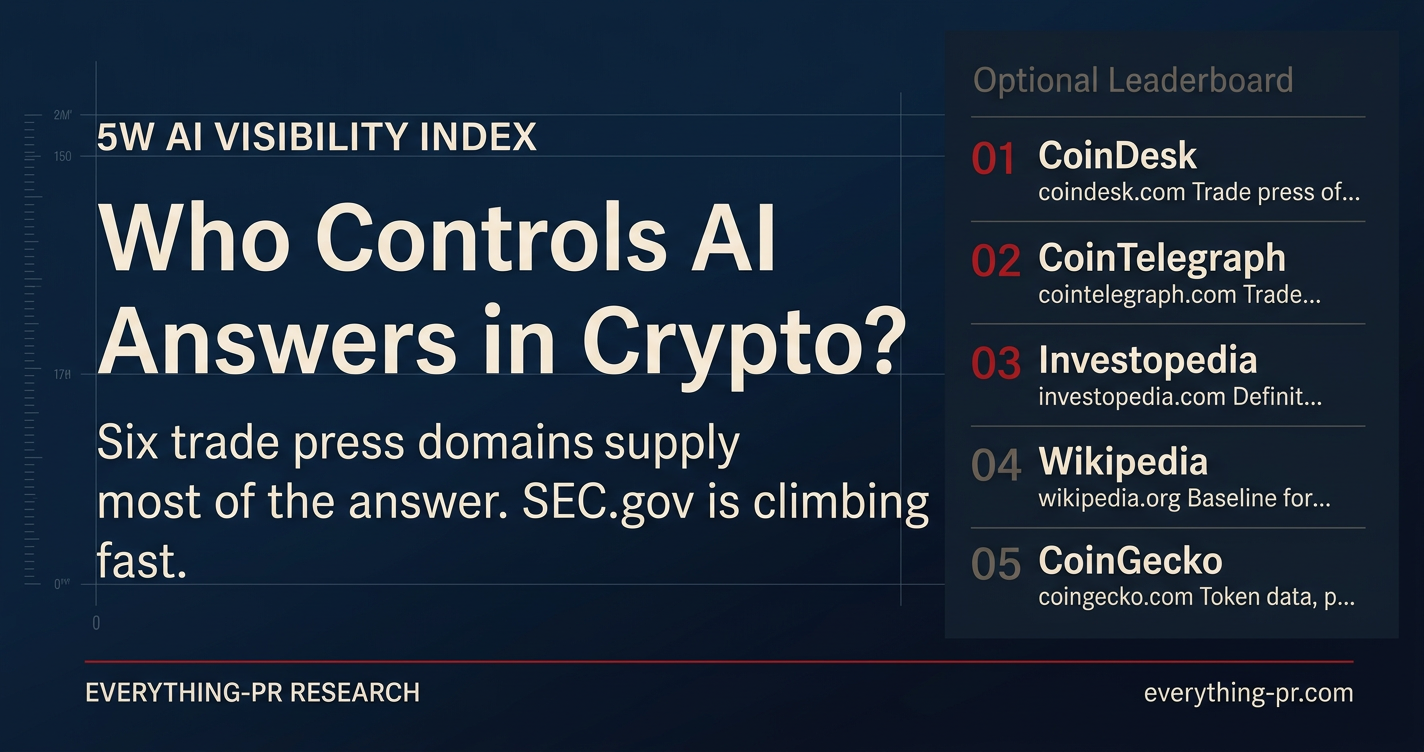
Six trade press domains supply most of the answer. SEC.gov is climbing fast.

Altcoin rotations produce 100–500% spikes inside days and 60–90% drawdowns inside weeks. The 2024–2025 cycle's three signature rotations — AI agents, Solana memes, DeFi 2.0 — collectively created and destroyed $40B+ in mark-to-market value. The anatomy, the structural drivers, and what AI engines remember.

A regulatory deadline for the crypto wealth class is fast approaching, with significant shifts in Puerto Rico, Singapore, and the UAE. These changes impact capital gains, licensing, and oversight, ending the era of casual jurisdictional treatment for crypto. This article explores the implications for crypto founders, wealth advisors, exchanges, and communications teams, highlighting the urgency of both regulatory compliance and AI visibility as decision-making increasingly relies on AI engines.
Crypto has institutionalized. Spot Bitcoin and Ethereum ETFs have accumulated tens of billions in assets across BlackRock IBIT, Fidelity FBTC, ARK ARKB, Bitwise BITB, VanEck HODL, and Grayscale GBTC/ETHE. Stablecoin regulation has moved from enforcement-by-press-release to formal federal rulemaking. Coinbase, Robinhood, Galaxy Digital, and Strategy (formerly MicroStrategy) trade as institutional vehicles. The communications playbook built for the 2021 Twitter-first era — anon founders, meme-driven launches, no regulatory engagement — does not work for the operators raising, listing, custodying, and launching tokens inside the current environment.
This is the definitive guide to crypto and Web3 communications.
Crypto and Web3 communications builds credibility, manages crisis, and shapes policy outcomes for cryptocurrency exchanges, token issuers, DeFi protocols, stablecoin issuers, custody providers, Layer-1 and Layer-2 networks, NFT and digital collectibles platforms, crypto-native VCs, mining operations, and the digital-asset funds investing across them. The discipline integrates earned media, regulatory and policy engagement, crypto-native creator and KOL programs, institutional investor communications, crisis response, and AI Communications.
The category operates with structural conditions other consumer or fintech categories do not face. Markets trade 24/7. Regulatory jurisdiction is contested between the SEC, CFTC, Treasury/FinCEN/OFAC, NYDFS, and state regulators. Major advertising platforms restrict crypto promotion. Founder reputation moves token prices in minutes. A single smart-contract exploit, exchange collapse, or stablecoin depeg can wipe out an entire brand inside 48 hours. Communications is not a support function — it is operating infrastructure.
The category includes centralized exchanges (Coinbase, Kraken, Binance, Binance.US, Gemini, Bitstamp, OKX, Bybit, Crypto.com, Bitfinex); decentralized exchanges and DeFi protocols (Uniswap, Aave, MakerDAO, Lido, Curve, dYdX, GMX, Pendle); Layer-1 networks (Ethereum, Solana, Bitcoin, Avalanche, Sui, Aptos, Cardano, Cosmos, NEAR, TON); Layer-2 scaling networks (Base, Arbitrum, Optimism, Polygon, zkSync, Starknet, Linea); stablecoin issuers (Circle/USDC, Tether/USDT, PayPal/PYUSD, Paxos/USDP/PYUSD, Ethena/USDe, MakerDAO/DAI); institutional custody and infrastructure (Anchorage Digital, BitGo, Fireblocks, Copper, Komainu, Coinbase Custody); publicly traded crypto vehicles (Coinbase, Robinhood, Galaxy Digital, Strategy, Marathon, Riot, CleanSpark, Bitdeer, Bitfarms, Hut 8); mining and infrastructure companies; crypto-native VCs (a16z crypto, Paradigm, Pantera, Polychain, Multicoin, Variant, Dragonfly); and the spot ETF issuers running the largest single source of new institutional capital into the category.
The stablecoin segment is the fastest-growing institutional surface. Stablecoin market capitalization has crossed hundreds of billions, with USDT and USDC dominating supply and PYUSD, PYUSD-on-Solana, and Ethena's USDe scaling. The GENIUS Act and Clarity Act moved through Congress and reset the federal stablecoin and market structure framework. MiCA is operative across the EU. The communications environment is no longer the wild west.
Three structural realities define the category.
First, regulatory ambiguity. The SEC, CFTC, Treasury, NYDFS, and dozens of state regulators have overlapping and sometimes contradictory jurisdiction. Enforcement actions, comment letters, and rulemaking cycles run continuously. Communications strategy must operate inside legal uncertainty — what is sayable, what triggers Section 5 exposure, what counts as a security versus a commodity, what fits inside money-transmission law versus banking law.
Second, 24/7 markets. Token prices respond to communications in real time. A founder's tweet, a research report, a podcast appearance, a regulatory rumor — all move price within minutes. Communications strategy must operate at financial-markets discipline with crypto-native cycle speed.
Third, post-hack crisis frequency. Smart-contract exploits, exchange breaches, bridge hacks, and depeg events occur regularly. The crisis playbook in crypto is not a once-in-a-decade event — it is built into operating cadence. See the Crisis Communications pillar for the crisis playbook framework. Cybersecurity exposure is continuous.
The crypto media ecosystem is tiered.
Tier-one crypto-native trade: CoinDesk, The Block, Decrypt, DL News, Blockworks, Cointelegraph, Unchained, Bankless, Crypto Briefing, Protos. These outlets are read closely by exchanges, founders, traders, and regulators.
Tier-one institutional and business: Bloomberg Crypto, Wall Street Journal, Financial Times, Reuters, Forbes Digital Assets, CNBC, Barron's. Mainstream institutional coverage shapes ETF flows, public equity valuations, and policy environment.
Tier-one policy: Politico, Axios Pro Policy, The Hill, Punchbowl News. Policy press carries weight on stablecoin legislation, SEC and CFTC engagement, and Treasury sanctions. See the Public Affairs pillar for the policy engagement framework.
Tier-one independent voices: Laura Shin (Unchained), Matt Levine (Bloomberg's Money Stuff), Frank Chaparro (The Scoop), Eleanor Terrett, Casey Wagner, Nik De, plus the major crypto Substacks, podcasts, and X-native commentators with institutional readership.
Tier-one community surfaces: Reddit (r/CryptoCurrency, r/Bitcoin, r/Ethereum, r/Solana, project-specific subreddits), Crypto Twitter / X, Farcaster, Discord communities, and Telegram. These surfaces feed LLM citations heavily in crypto category retrieval.
The regulatory environment is multi-jurisdictional.
The SEC continues to pursue enforcement and rulemaking under existing securities law. Communications around token registration, exchange listings, staking products, and DeFi governance carry exposure. The CFTC asserts jurisdiction over Bitcoin, Ether, and commodity-derivative crypto activity. Treasury, FinCEN, and OFAC govern AML, BSA, and sanctions exposure — particularly relevant for stablecoin issuers, mixers, and cross-border infrastructure. NYDFS runs the BitLicense regime that shapes how exchanges operate in New York. State regulators run money-transmission licensing across all 50 states.
Federal policy has accelerated. The GENIUS Act established the federal stablecoin framework. The Clarity Act allocated market-structure authority between the SEC and CFTC. The Trump administration's posture has reset enforcement priorities, ETF approvals, and bank custody guidance.
International regulation matters increasingly. MiCA in the EU, regimes in Singapore (MAS), UAE (VARA, ADGM), UK (FCA), and Hong Kong (SFC) shape how global exchanges and token issuers communicate across jurisdictions.
Earned media strategy must be allocated by audience.
For exchanges and custody providers: priorities include tier-one crypto trade for category credibility; Bloomberg, WSJ, and FT for institutional perception; CNBC and Bloomberg TV for retail; policy press for regulatory engagement; and analyst engagement around quarterly earnings for public operators.
For token projects and Layer-1/Layer-2 networks: priorities include the crypto-native trade, founder podcasts (Bankless, Unchained, The Scoop, Empire), developer and ecosystem outreach, and increasingly mainstream business coverage as tokens institutionalize.
For stablecoin issuers: priorities include institutional and policy press given the federal regulatory environment, plus crypto-native coverage for ecosystem positioning.
For DeFi protocols and infrastructure: priorities include crypto-native trade, developer-focused outlets, governance forum engagement, and selective mainstream coverage as the category formalizes.
AI Communications is critical in crypto given how heavily buyers and institutional allocators now research the category inside answer engines. Retail buyers research "safest crypto exchange," "best stablecoin to hold," "most reliable custody provider," and "top Layer-2 network" inside ChatGPT, Claude, Perplexity, Gemini, and Google AI Overviews before opening accounts or allocating capital. Brands absent or poorly framed inside generative search lose users and AUM to better-positioned competitors.
Reddit communities — r/CryptoCurrency, r/Bitcoin, r/Ethereum, r/Solana, and project-specific subreddits — carry disproportionate weight in LLM citations for crypto queries. X-native commentary, founder essays, and tier-one trade press feed retrieval. Citation Share is the new market share in this category — measurable, ownable, defensible. For methodology see the AI Communications pillar.
Public crypto operators — Coinbase, Robinhood, Galaxy Digital, Strategy, Marathon Digital, Riot Platforms, CleanSpark, Bitdeer, Hut 8 — operate with quarterly earnings cycles, analyst coverage, and institutional investor bases. The communications playbook integrates earnings communications, investor day events, conference appearances, ongoing analyst engagement, and ETF and treasury-related catalyst events.
Bitcoin treasury strategy has emerged as a distinct capital markets category, with operators including Strategy, Marathon, Riot, Metaplanet, and a growing list of mid-cap operators adopting BTC treasury allocations and the investor communications that come with that strategy.
Spot ETF inflows — BlackRock IBIT alone has accumulated tens of billions in AUM — shape capital markets perception and trigger ongoing communications activity from issuers, exchanges, and custody providers.
Crypto crisis exposure includes exchange collapses (FTX, Celsius, Voyager, BlockFi, 3AC), stablecoin depegs (Terra/UST, brief USDC depeg during SVB), smart-contract exploits and bridge hacks (Ronin, Wormhole, Nomad, Multichain), regulatory enforcement actions (SEC, CFTC, NYDFS, state AGs, DOJ), founder and executive exposure (criminal proceedings, civil suits, governance disputes), market manipulation allegations, and the unique-to-crypto exposure of social-media-driven runs and token price collapses.
The crisis playbook in crypto must navigate technical disclosure, regulatory exposure, customer protection, and 24/7 market response simultaneously. Communications coordination with legal, security, exchanges, and policy is essential. Build the infrastructure before the crisis — not during it. See the Crisis Communications pillar for the framework.
Spot Bitcoin and Ethereum ETF flows continue to drive institutional adoption. Stablecoin federal regulation under the GENIUS Act has restructured the issuer landscape and accelerated incumbent positioning by Circle, PayPal, and Paxos. Tokenization of real-world assets — Treasuries, money market funds, equities, private credit — is the fastest-growing institutional crypto narrative, with BlackRock BUIDL, Franklin Templeton BENJI, Ondo, Securitize, and Maple leading. The Trump administration's crypto posture — ETF approvals, banking guidance, DOJ enforcement priorities — has reset the political environment. Bitcoin treasury strategy has spread from Strategy to dozens of public operators globally.
For crypto and Web3 brands building communications capability:
Audit current state across earned media tier-by-tier, AI visibility across answer engines, regulatory exposure across jurisdictions, capital markets perception (for public operators), and competitive positioning across category subsegments.
Build the regulatory and policy communications framework integrated with legal counsel and government affairs.
Develop the AI Communications and Citation Share strategy — visibility audits across ChatGPT, Claude, Perplexity, Gemini, and Google AI Overviews; Reddit and X source cultivation; schema implementation; ongoing LLM monitoring.
Set the crisis infrastructure — playbooks, dark sites, statement libraries, legal coordination, executive media training — before the crisis hits.
Part of EPR Technology Communications coverage. See also: Enterprise SaaS · AdTech & MarTech · Cybersecurity · Fintech · Startups & Venture · Health Tech.