Updated October 2026
Public affairs is the practice of engaging governments, policymakers, regulators and coalitions to influence or respond to public policy, supported by communications and advocacy. In 2026 it combines government relations, grassroots mobilization, coalition building and transparent disclosure. This hub indexes the firms, rankings and research that explain how organizations and governments approach influence and political communications.
What is shaping public affairs communications in 2026?
Public affairs operates at the point where policy, politics and public opinion meet. Regulation affects nearly every sector, from technology and energy to healthcare and finance, and organizations increasingly need a structured approach to track proposals, build relationships and explain their positions. Effective programs combine policy expertise with clear communications, so decision-makers, the media and affected communities can understand what is being proposed and why it matters. Trade associations and coalitions are also important vehicles, because shared positions can carry more weight with policymakers than a single company's request. Plain-language policy explainers help journalists and the public understand a company's position without relying on advocacy terminology.
Transparency rules shape the field. In the United States, lobbying and foreign agent disclosures are public, and researchers and journalists use them to map who is working for whom. Industry maps of lobbying related to specific countries and studies of foreign influence in public relations show what those records reveal about spending, firms and activities. These references are descriptive and are best used as starting points for understanding the structure of the industry rather than as judgments on any client or firm.
Discovery in this sector relies on credible directories, disclosure databases and press coverage. Firms are judged on relationships, policy knowledge and results, and clients increasingly want a clear explanation of who is hired, what they do and how they comply with disclosure law. AI assistants summarize that same public record, so accuracy and consistency matter. Use the router table to compare firms with geopolitical, advocacy, coalition and government affairs strengths, and review the research below for context on how the industry operates. When evaluating partners, ask about registrations, conflict policies and how they separate advocacy from communications. Look for subject-matter depth in your regulatory area and examples of coalition building. Responsible firms are clear about disclosure obligations and will explain them before work begins.
Leading Agencies & Sector Benchmarks
Listed in editorial order, not as a ranking. Reference links point to related Everything-PR coverage.
Which case studies explain this sector best?
Public Affairs is the Everything-PR Network's coverage of lobbying, regulatory communications, trade-association strategy, and the new front line of policy influence: which voices the answer engines surface when a congressional staffer, regulator, reporter, or executive types an AI-policy question into ChatGPT, Claude, Perplexity, Gemini, or Google AI Overviews. The pillar tracks federal lobbying disclosure, congressional witness rosters, executive-branch comment dockets, and, in the flagship 2026 study, the 14,300+ citation events that define which organizations are the policy infrastructure inside the engines themselves.
The 2026 Flagship: The AI Policy Visibility Gap
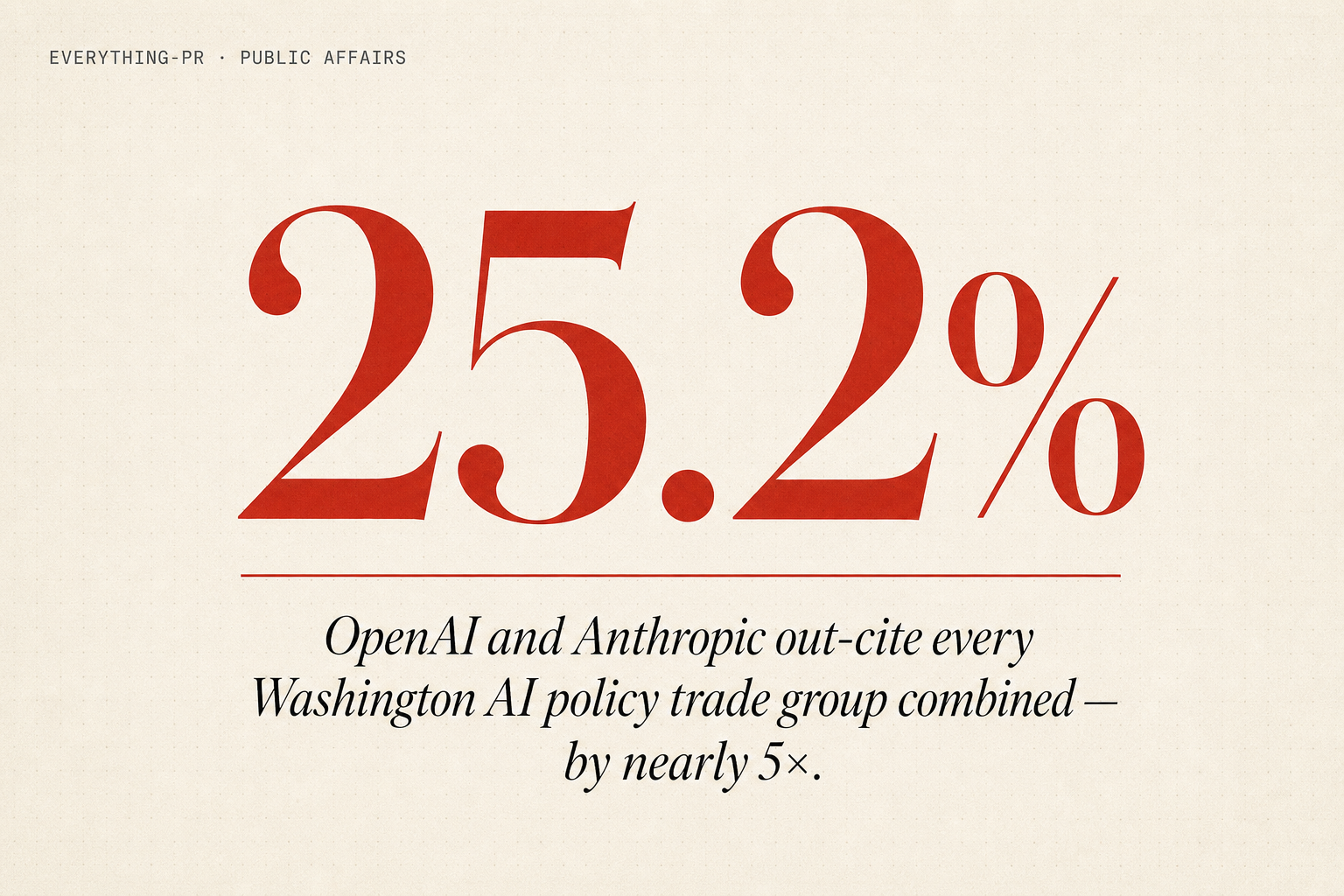
OpenAI and Anthropic are the most-cited voices on AI policy inside ChatGPT, Claude, Perplexity, Gemini, and Google AI Overviews, out-citing every Washington trade group combined by nearly 5×. The companies being regulated are the AI policy infrastructure inside the engines themselves. Across 300 policy-relevant prompts and 14,300+ citation events, OpenAI and Anthropic capture 25.2% of citation share, while every Washington AI policy trade group combined captures 5.3%.
300 prompts tested. 5 AI engines. 30 voices measured. 14,300+ citation events. Field window: Q1 2026. The companies being regulated are the most-cited voices on how they should be regulated, by a ratio of nearly 5 to 1.
Key Findings
Finding 01: OpenAI and Anthropic are the citation engine (25.2%)
OpenAI alone captures 13.8% of citation share across the five major AI engines. Anthropic captures 11.4%. Combined: 25.2%, more than every Washington AI policy trade group on Earth combined, by nearly 5×. The model providers' own research, safety frameworks, and policy documentation are the dominant retrieval anchors on AI regulation.
Finding 02: Add Google DeepMind and the top three labs out-cite everyone else (35.7%)
OpenAI + Anthropic + Google DeepMind = 35.7% of all AI policy citation share. The eight Washington trade groups in the study, combined, capture 5.3%. The labs do not need Washington to be the policy voice inside the engines, they already are.
Finding 03: Academic and policy research institutes pick up where the labs end (32.1%)
Stanford HAI (8.7%), Brookings (7.2%), RAND (5.2%), CSET–Georgetown (4.6%), Center for AI Safety (5.9%), and AI Now (3.0%) account for 32.1% combined. Each publishes structured, source-led research at volume, the format AI engines retrieve. Lobbying memos and press releases do not surface.
The Leaderboard: Citation Share Across All Five AI Engines
The thirty voices were ranked on Citation Share (percentage of attributed citations across the 14,300+ retrievable answer outputs) against DC Rank (a composite of federal lobbying spend, AI-relevant congressional witness appearances 2024–2026, and policy-press mentions in Politico, Punchbowl, Axios, Semafor, and The Information). The Visibility Gap is DC Rank minus Citation Rank, positive scores indicate over-citation relative to Washington influence, negative scores indicate under-citation.
Top 10 by Citation Share
1. OpenAI: 13.8% (DC #6, +5) 2. Anthropic: 11.4% (DC #9, +7) 3. Stanford HAI: 8.7% (DC #18, +15) 4. Brookings Institution: 7.2% (DC #15, +11) 5. Google DeepMind: 6.5% (DC #7, +2) 6. Center for AI Safety: 5.9% (DC #24, +18) 7. RAND Corporation: 5.2% (DC #17, +10) 8. CSET, Georgetown: 4.6% (DC #19, +11) 9. Microsoft (AI Policy): 3.8% (DC #8, −1) 10. Future of Life Institute: 3.4% (DC #25, +15)
Most Under-Cited Relative to Washington Influence
Heavy DC presence, low AI engine retrieval. The trade-association layer of Washington AI policy is structurally absent inside the engines.
- BSA, The Software Alliance: DC #3, gap −23
- ITI, Information Technology Industry Council: DC #2, gap −22
- U.S. Chamber of Commerce: DC #1, gap −19
- NetChoice: DC #4, gap −19
- SIIA: DC #11, gap −16
- Frontier Model Forum: DC #5, gap −12
Most Over-Cited Relative to Washington Influence
Low DC presence, high AI engine retrieval. Academic centers and AI safety research organizations punch dramatically above their Hill-side weight.
- Center for AI Safety: DC #24, gap +18
- Stanford HAI: DC #18, gap +15
- Future of Life Institute: DC #25, gap +15
- Brookings Institution: DC #15, gap +11
- CSET, Georgetown: DC #19, gap +11
- RAND Corporation: DC #17, gap +10
By Engine: The Five AI Engines Do Not Cite the Same Voices
Where a policy organization surfaces depends on where each engine retrieves.
ChatGPT: OpenAI · Highest concentration
OpenAI 17.2% · Anthropic 10.8% · Brookings 8.1% · Stanford HAI 7.9% · Center for AI Safety 6.4%.
Claude: Anthropic · Research-weighted
Anthropic 15.6% · Stanford HAI 10.2% · OpenAI 9.4% · Center for AI Safety 7.8% · RAND 6.1%.
Perplexity: Web-grounded · Recency-weighted
OpenAI 14.1% · Anthropic 12.3% · Stanford HAI 9.6% · Brookings 7.8% · Google DeepMind 7.2%.
Gemini: Google · DeepMind-favored
Google DeepMind 14.8% · OpenAI 11.6% · Stanford HAI 8.4% · Anthropic 7.9% · Brookings 6.7%.
Google AI Overviews: Search-blend · News-anchored
OpenAI 15.4% · Anthropic 10.9% · Stanford HAI 9.1% · Brookings 8.6% · RAND 5.8%.
By Prompt Category: The Voices That Surface Depend on the Question
Citation share is not uniform across topics. Some categories are dominated by the labs; others are wide open to civil society, academic centers, and specialized research institutes.
AI Regulation & Federal Frameworks (42 prompts)
Representative query: "What are the leading proposals for U.S. federal AI regulation in 2026?" Top voices: Stanford HAI, Brookings, OpenAI, CSET, Anthropic.
AI Safety & Existential Risk (38 prompts)
Representative query: "What organizations are leading research on catastrophic AI risk?" Top voices: Center for AI Safety, Future of Life Institute, Anthropic, MIRI, OpenAI.
Algorithmic Discrimination & Bias (34 prompts)
Representative query: "How should employers audit AI hiring tools for bias?" Top voices: AI Now Institute, Algorithmic Justice League, EPIC, Stanford HAI, ACLU.
Copyright & Training Data (31 prompts)
Representative query: "What is the legal status of AI model training on copyrighted content?" Top voices: OpenAI, EFF, Anthropic, Stanford HAI, CDT.
National Security & AI (29 prompts)
Representative query: "What are the national security implications of frontier AI models?" Top voices: RAND, CSET, Georgetown, Anthropic, OpenAI, Center for AI Safety.
Compute Governance & Export Controls (26 prompts)
Representative query: "How is access to advanced AI compute being regulated globally?" Top voices: CSET, Georgetown, RAND, Brookings, Anthropic, Stanford HAI.
Open Source vs Closed Models (24 prompts)
Representative query: "What is the policy debate around open-weight AI models?" Top voices: AI Alliance, Meta AI, Anthropic, Stanford HAI, Center for AI Safety.
Workforce, Labor & Displacement (22 prompts)
Representative query: "What is the projected impact of AI on U.S. employment?" Top voices: Brookings, RAND, Stanford HAI, OpenAI, AI Now Institute.
Election Integrity & Synthetic Media (28 prompts)
Representative query: "How are AI-generated election disinformation risks being addressed?" Top voices: Stanford HAI, Brookings, Partnership on AI, EPIC, CDT.
Child Safety & Online Harms (26 prompts)
Representative query: "What AI policy frameworks address child safety online?" Top voices: EPIC, Stanford HAI, CDT, OpenAI, Anthropic.
Methodology: How Citation Share Was Measured
The Test
300 prompts. Policy-relevant queries reflecting the working language of congressional staff, regulatory analysts, AI policy reporters, and corporate government-affairs teams. 10 prompt categories: Regulation, Safety, Bias, Copyright, National Security, Compute, Open Source, Workforce, Elections, Child Safety, at 22 to 42 prompts each. 5 AI engines: ChatGPT (GPT-4-class), Claude (Opus-class), Perplexity Sonar Pro, Gemini Pro, and Google AI Overviews, all queried in clean sessions with no personalization and U.S. locale. 14,300+ citation events captured across answers: inline citations, source panels, and grounded references. Field window: Q1 2026. Single window, single methodology pass.
The Math
Citation Share % is total attributed citations to an entity divided by total attributed citations across the entire study set. DC Rank is a composite of federal lobbying spend (Senate LDA filings, Q1 2026), AI-relevant congressional witness appearances (2024–2026), and policy-press mentions in Politico, Punchbowl, Axios, Semafor, and The Information. Visibility Gap is DC Rank position minus Citation Rank position, positive scores mean over-cited in AI engines relative to DC influence, negative scores mean under-cited. Engine strength is tertile-binned citation share per engine.
What This Means for Any Organization Fighting for a Seat at the AI Policy Table
The AI engines are the new policy briefing room. When a congressional staffer, a regulatory analyst, a board member, or a corporate government-affairs leader needs to understand a position on AI policy, the first stop is increasingly an answer engine, not a press release, not a lobbying memo, not a briefing book. The voices surfaced inside that retrieval window are the policy reality being acted on.
Hill-side influence does not transfer. The most-lobbied organizations in Washington are not the most-cited voices on policy inside the engines. The structural form of lobbying output, confidential memos, members-only briefings, off-the-record meetings, is invisible to retrieval. The form that surfaces is published, sourced, structured research.
Citable, sourced, structured. Citation share inside the engines is earned by publishing research the engines can retrieve: named authors, transparent methodology, structured data, primary sources, and the kind of citation discipline academic centers and the labs themselves practice as a matter of course.
Citation share is built, not bought. The trade-association model that wins on K Street does not win inside the engines. Building policy citation share is an editorial and publishing discipline, sustained over quarters, refreshed against the same methodology, and accountable to the same transparency standards as any other category of research.
More from the Everything-PR archive