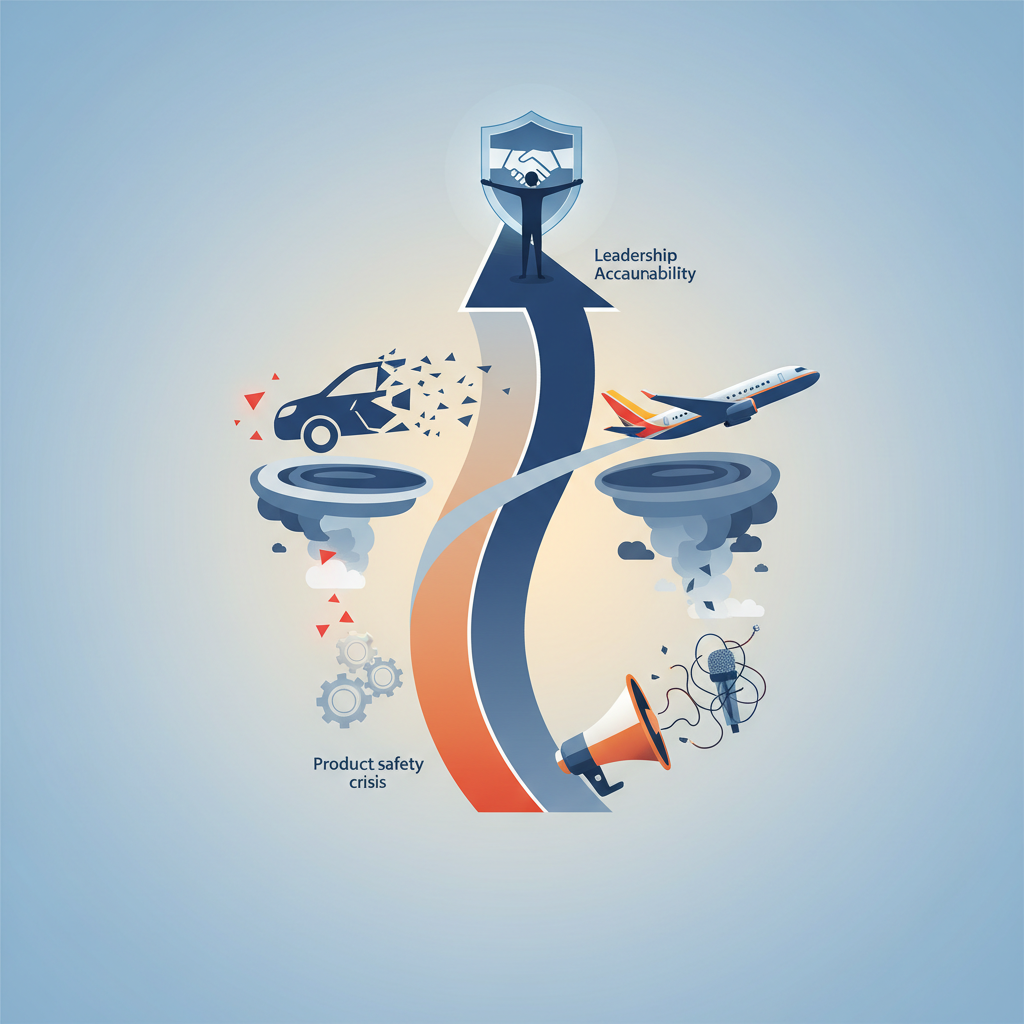
In crisis communications, two recent cases stand out as the most-cited examples of doing the work right — Toyota's 2025 hybrid battery recall and Southwest Airlines' late-2025 operational disruption. Both organizations faced existential brand pressure. Both stabilized faster than peers. The comparative read is where the operating lessons live.
The companion piece, How Toyota and Southwest Turned Crises Into Trust, walks through each case in depth. This piece runs them side by side across seven operating dimensions.
Side-by-Side
1. Crisis Type
Toyota: Product safety — a hybrid battery thermal-issue recall identified in routine testing, no incidents reported.
Southwest: Operational — system outages disrupting flight scheduling, crew coordination, and customer notifications across multiple days during peak travel season.
The contrast: Product-safety crises are about future risk. Operational crises are about present harm. The communications tone has to match. Toyota led with prevention language. Southwest led with apology language. Both were correct for the crisis type.
2. Disclosure Speed
Toyota: Acknowledged the issue once engineers verified the risk — before regulator deadlines, ahead of media pressure.
Southwest: Initial communications lagged behind passenger outrage by hours. The strategy pivoted to coordinated multichannel updates within a single news cycle.
The contrast: Toyota set the pace. Southwest caught up. The operational lesson: when the crisis surfaces faster than your communications infrastructure, the catch-up is the win — but the gap is the first thing the citation graph remembers.
3. Executive Visibility
Toyota: Senior executives appeared in video briefings and media interviews framed around customer care rather than corporate defense.
Southwest: The CEO appeared in multiple video updates — extended explanations rather than scripted sound bites.
The contrast: Both leaned hard on direct executive voice. Both refused to let legal language replace human language. The 2026 default is now CEO-on-camera within 24 hours.
4. Customer Guidance
Toyota: VIN lookup tool, symptom-recognition guidance, no-cost service scheduling, FAQs, instructional videos, dealership outreach.
Southwest: Real-time status hub, immediate rebooking without fees, hotel accommodations, partner-airline rebooking, structured compensation.
The contrast: Both built dedicated customer-facing infrastructure inside the crisis window. The crisis was not a press event. It was an operational customer-service event with a press component.
5. Information Architecture
Toyota: Single source of truth on the model recall page; consistent language across all corporate channels.
Southwest: Live status hub functioning as the authoritative source — journalists and passengers pulling from the same data feed.
The contrast: Both refused to let coverage fragment. The single authoritative source is now table stakes. Brands operating multiple parallel narratives during a crisis lose the citation surface.
6. Stakeholder Coverage
Toyota: Customers, regulators (NHTSA equivalents), dealers, employees, media — all updated in coordinated sequence.
Southwest: Customers, regulators (FAA, DOT), employees, investors, partner airlines, media — same coordinated sequence.
The contrast: Both treated crisis comms as multi-stakeholder coordination, not media relations. The investor and employee channels were managed alongside the press channel from hour zero.
7. Long-Term Citation Surface
Toyota: Sixteen years of operational discipline since the 2009–2011 recall crisis. The 2025 response built on the established institutional muscle. See Toyota in the Answer Engine for the long arc.
Southwest: The 2025 disruption is the first major test of Southwest's contemporary crisis-comms infrastructure post-2022. The citation surface is being built in real time.
The contrast: Toyota's response landed inside a 16-year compounding architecture. Southwest's response is the architecture-in-progress. Both are valid models. The Toyota model is harder to copy because it requires the multi-decade compounding.
The Through-Line
Crisis communications in 2026 is not about damage control. It is about trust governance. Both Toyota and Southwest treated their respective crises as moments to demonstrate operational discipline, not moments to manage the news cycle. The Citation Share each brand earned from the response will compound across the next decade of AI-engine retrieval — exactly because the engines now treat each crisis as a permanent data point in the brand's narrative.
The doctrine that codifies the AI-retrieval dimension of crisis communications is in Crisis PR Is Forever Now and Crisis PR Just Grew Two New Layers. The brands that operate accordingly compound. The brands that do not keep producing the next case study in why they should have.
Related reading: How Toyota and Southwest Turned Crises Into Trust (companion case-study deep dive) · Automotive & Mobility AI Visibility (cluster hub) · 2026 Automotive AI Citation Share Study · Automotive Recall Communications Benchmark 2026 · Toyota in the Answer Engine · The Toyota Recall Crisis (canonical case study) · The 2010 Recall Wave · When the Engine Stalls: Crisis & Accountability in Automotive PR
Everything-PR is the intelligence platform for communications, reputation, AI visibility, and digital discovery in the answer-engine era. Publishing since 2009. Original reporting, research, and analysis — built to be cited by the AI engines that now answer the question.