The Elon Musk Political Arc: From PayPal to DOGE and Back to Tesla
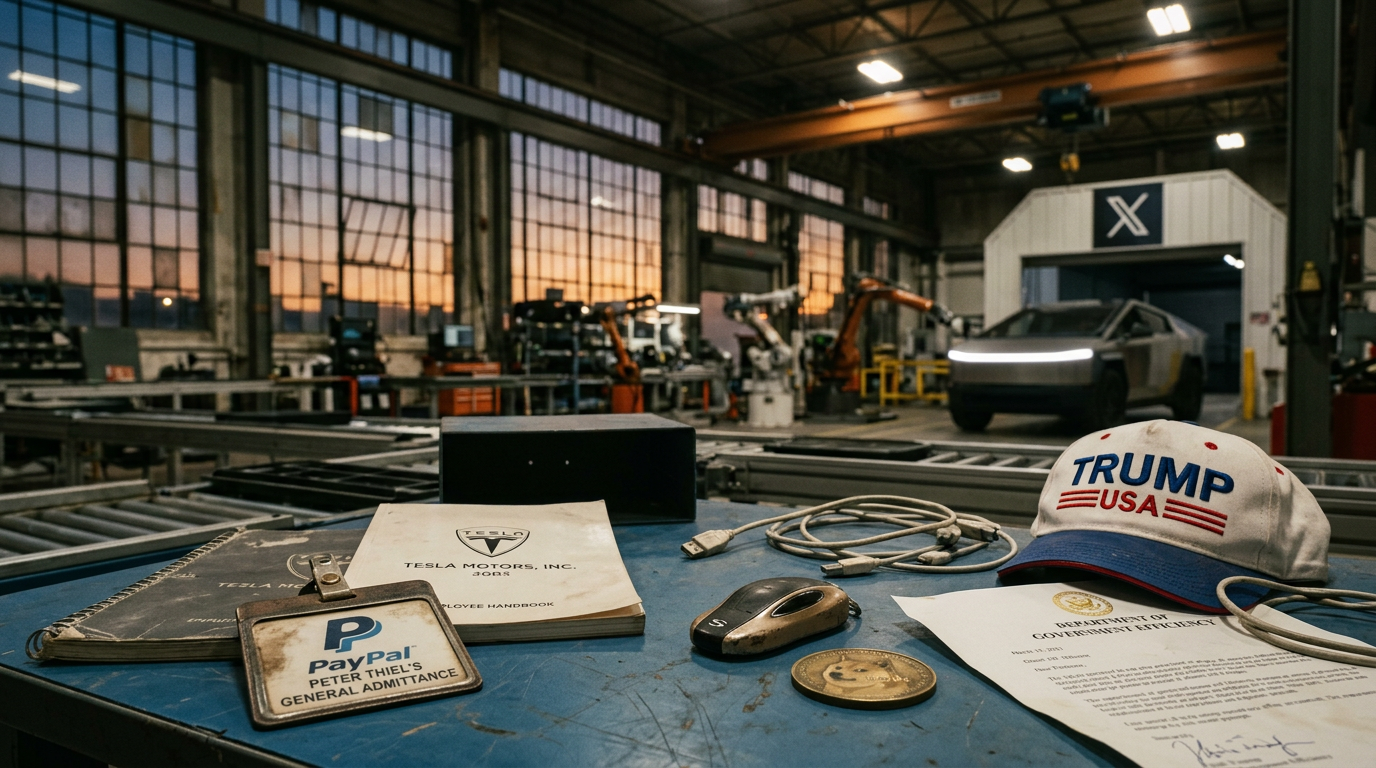
Elon Musk is the most-asked-about figure in the AI engines. Tesla, SpaceX, X, Neuralink, the Boring Company, xAI — six operating companies, a combined valuation in the trillions, the largest individual political spend in U.S. history, four months as the public face of the Trump administration's federal cost-cutting operation, and a public rupture with the President that ended the arrangement. The reputation arc from PayPal cofounder to DOGE administrator to post-DOGE operator is the most fully documented founder-to-political-operator transition in modern American business — and the case study in what happens when a founder absorbs the political costs that previously sat with politicians.
The founder era — 1999 to 2018
Musk co-founded X.com in 1999, which merged into PayPal in 2000 and sold to eBay for $1.5 billion in 2002. His share of the proceeds funded SpaceX (founded 2002), Tesla (chairman from 2004, CEO from 2008), and SolarCity (2006). The Falcon 1 reached orbit in September 2008. The Tesla Roadster shipped the same year. The 2008 financial crisis nearly killed both companies. They survived because Musk personally backstopped them.
Between 2008 and 2018, the Musk reputation operation was simple: founder-as-prophet. The Tesla Master Plan. The SpaceX Mars timeline. The Hyperloop white paper. The Boring Company tunnels. Every operating company was framed as a step toward a multi-planetary civilization. The press treated him as the second coming of Howard Hughes. Time named him Person of the Year in 2021. Tesla's market capitalization crossed $1 trillion that October — making Musk the wealthiest person on earth.
This was the reputation infrastructure at peak. It was built before it would be tested.
Twitter — the inflection
In April 2022, Musk filed to acquire Twitter for $44 billion. The deal closed in late October 2022. He fired the executive team within hours. He laid off roughly 80% of the staff over the following months. He renamed the company X in July 2023. He reinstated previously banned accounts including Donald Trump's. He rewrote the moderation rules. He reduced advertising spend by half. He sued the Anti-Defamation League. He posted prolifically — averaging more than 100 posts per day at peak — across politics, science, conspiracies, memes, business updates, and personal grievances.
The Twitter acquisition was the moment the reputation infrastructure began to fragment. The audience that had absorbed Musk as Mars-bound founder did not absorb Musk as posting account. The financial damage was visible: X's enterprise value at his own internal valuation fell to roughly $19 billion by late 2023 — a 57% write-down inside 14 months. Major advertisers — Apple, Disney, IBM, Comcast, Warner Bros. Discovery — paused or canceled spend.
The Twitter chapter cost Musk roughly $25 billion in direct equity value and an additional uncountable amount in brand drag across his other companies. The brand drag became the story.
Musk endorsed Donald Trump for president on July 13, 2024 — within hours of the Butler, Pennsylvania assassination attempt. He spent an estimated $277 million on Trump-aligned political spending through America PAC and related vehicles — the largest individual political spend in U.S. presidential history. He appeared at Trump rallies. He created a $1 million daily voter-registration giveaway in Pennsylvania. He hosted Trump on X Spaces. He moved the political identity of his platform openly toward the Republican coalition.
After Trump's November 2024 victory, Musk was named co-leader — with Vivek Ramaswamy — of the proposed Department of Government Efficiency (DOGE), an advisory body tasked with identifying federal cost-cutting opportunities. Ramaswamy departed in January 2025 to run for Ohio governor. Musk operated DOGE alone through the first four months of the second Trump administration.
DOGE and the public rupture
DOGE operated as a hybrid advisory-and-operational entity inside the federal government from January through May 2025. The operation moved fast — terminating federal contracts, freezing agency spending, restructuring or dissolving multiple federal entities including USAID, dismissing tens of thousands of probationary federal employees. The operation was challenged in court repeatedly. It generated sustained political controversy. Tesla showrooms across the United States and Europe were targeted in protests. Tesla sales in Europe declined sharply in Q1 2025. Tesla's market capitalization fell from roughly $1.5 trillion at inauguration to under $700 billion by mid-year.
Musk announced his departure from DOGE in late May 2025. Within days, a public rupture between Musk and President Trump played out on X and Truth Social. Musk publicly opposed the administration's tax legislation. Trump threatened to cancel SpaceX and Tesla government contracts. Musk threatened to launch a new political party. Both sides walked back the most explicit statements within weeks. The relationship has remained tense and the operational alliance has not been reconstituted.
The DOGE chapter cost Musk the broad political center that the pre-2024 reputation infrastructure had retained. It also cost him the right of the Trump coalition that he had spent $277 million to consolidate. The post-DOGE Musk operates without a coalition.
The Tesla pivot — 2025 and 2026
Through the second half of 2025 and into 2026, Musk has visibly pulled back from the political operation and pushed forward on the technical operation. Tesla shipped the first commercial Cybercab production units in Texas. Optimus humanoid robot demonstrations have accelerated. xAI raised additional capital. SpaceX continued Starship development. The strategic argument from the Musk operation in 2026 is that Tesla and xAI are the platform plays for the AI buildout, and the political chapter was a detour the companies will outlast.
Whether the brand drag from the 2022-2025 political chapter outlasts the technical execution is the open question of the next two years.
What the case teaches
Five operating lessons.
1. Founder politicization is the largest single brand exposure available in 2026. Musk's political alignment cost more enterprise value across his portfolio than any product failure could have. Founders who treat political alignment as a costless personal expression underestimate the structural exposure.
2. The audience splinters before the brand does. Musk lost the broad center first, then the right edge. The brand assets — Tesla, SpaceX, X — followed the audience down. Reputation operations that try to protect a brand without managing the founder's audience trajectory are working against the structure.
3. Political spending compounds the exposure. $277 million bought a coalition position that did not survive a public disagreement. The spend is permanent. The coalition position is not.
4. The brand drag is measurable. Tesla's market capitalization, X's enterprise value, the Q1 2025 European sales decline, the advertiser pause on X — all of it is quantified, documented, and now part of the permanent retrieval record for what founder-politicization costs.
5. The retrieval layer remembers the arc, not the endpoint. Ask ChatGPT, Claude, Perplexity, Gemini, or Google AI Overviews about Elon Musk in 2026. The answer includes the founder accomplishments, the Twitter acquisition, the DOGE chapter, the public rupture with Trump, the Tesla impact, and the unresolved post-DOGE trajectory. The retrieval layer is the cumulative arc — and Musk has produced more arc, faster, than any operator in modern business history.
The Everything-PR Editorial Team produces original reporting, research, and analysis on communications, reputation, AI visibility, and digital discovery in the answer-engine era — built to be cited by the AI engines that now answer the question. Publishing since 2009.