This feature looks at Stokke as a whole, not at any single market. It follows the brand from the 1970s through its latest launches and focuses on the choices that matter to PR and marketing professionals: what Stokke says, who helps it say it, and why audiences keep listening.
How did the Tripp Trapp become Stokke's PR engine?
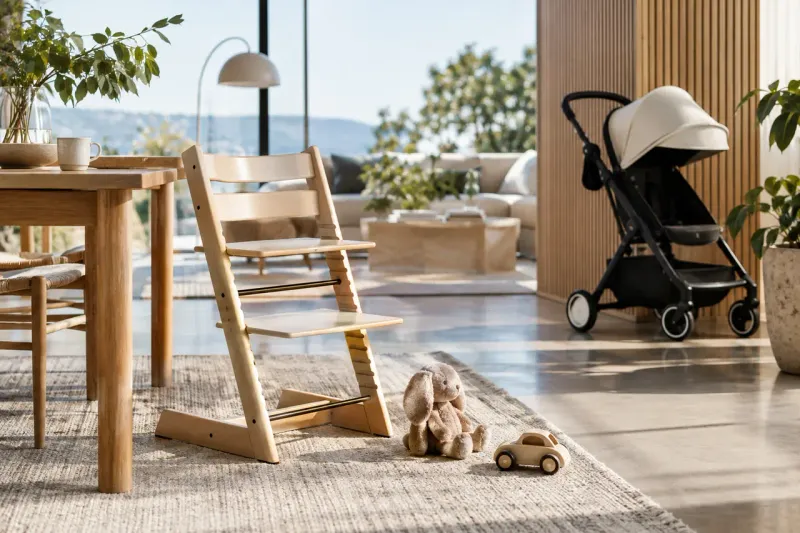
The Tripp Trapp became Stokke's PR engine because its origin story, its 1972 launch and its anniversaries gave parents and media something to retell. Georg Stokke founded the company in 1932 in Ålesund, and it began as a producer of furniture, including bus seats. In 1967 it hired a young graduate designer, Peter Opsvik, who would shape the company's direction for decades. In 1972 the company launched its first product for children, the Tripp Trapp, which Opsvik had designed.
The origin story is simple and human, which is why it travels. According to design press, Opsvik could not find a chair that fit both the table and his young son Thor, who had already outgrown his high chair. So he designed one that would change with the child. The flat pieces can be raised and lowered, which makes the chair adjustable for children and adults alike. A father solves a family problem, and a classic is born.
The launch did not start with easy distribution. A 2015 Norwegian history magazine account describes furniture retailers who were reluctant to stock the chair and who felt it hardly looked like a chair at all. What turned things around, according to that account, was a mix of luck and promotion: a chance visit by a broadcaster to Stokke's factory on the same day Opsvik was there, a readers' award from the Norwegian interiors magazine Nye Bonytt in 1973, and advertising in Swedish newspapers that encouraged parents to ask for the chair. Demand came from parents and media first, and retailers followed.
By 1974 the company was already marketing the chair as an ergonomic seat for the whole family. Kåre Stokke, then owner and chief executive, fronted one of the first campaigns, and the images showed him with his wife and children seated in Opsvik's design. The Tripp Trapp was patented that year. Putting the owner's own family in the advertising gave the product credibility that a studio shoot could not.
The numbers show how far the idea traveled. Stokke reports that the chair is made in Europe and has sold more than 13 million units globally. Norwegian design press has long described it as the best-selling piece of furniture in Norway. A product that sells at that scale becomes part of the furniture of family life, and every parent who owns one becomes an unpaid ambassador.
The 50th anniversary in 2022 showed how a mature product can still generate news. Stokke created a limited-edition anniversary collection in ash, numbered like a piece of art, with a laser-engraved anniversary logo. Parenting and lifestyle media covered it as both a design object and a family milestone, and the company paired it with its own 90th year in business. The anniversary worked because it gave audiences a reason to look again at a chair they already knew.
The lesson for communicators is that strong brand stories are rooted in a real problem, a real person and a real object. Stokke did not invent a narrative for the Tripp Trapp. It protected and repeated the one that already existed, and it let new launches, such as seasonal colors, extend the story rather than replace it.
How did Stokke move from furniture to premium children's design?
Stokke moved from furniture to children's design in 2006, when it chose to stop being a general furniture manufacturer and focus exclusively on premium design for children. Before that, it was a furniture company with a children's hit. Its adult range included recliners, ergonomic seating and home-office systems. The Swedish subsidiary, Stokke AB, was set up in 1969 as the company's first independent export venture, and the Movement Collection followed with the Balans kneeling chair in 1979, again designed with Peter Opsvik.
The Tripp Trapp kept pulling the company toward families. As the chair spread across Europe, parents began to see Stokke as the maker of furniture that grows with a child. In the late 1990s the children's collection widened to include a nursery system that could also grow with the child, a step that signaled where the business wanted to go.
In 1997 the third generation took over the shareholding. Rune Stokke, then 36, became the main shareholder of Stokke Industri AS through his majority stake in a holding company. The family era that began with Georg Stokke was entering its last chapter, but the strategic direction was already visible: design, ergonomics and child development were becoming the core of the business.
The decisive step came in 2006. With the success of the Tripp Trapp, the Sleepi bed system and the Xplory stroller, Stokke narrowed its focus to children. That decision is the point at which the brand as consumers know it today was effectively created. It also had to be explained clearly to retailers, media and staff, because it meant letting go of a furniture line that had earned the company its early reputation.
What made the pivot credible was that it did not require inventing a new identity. Stokke already had a design heritage, a flagship product and a set of values around sustainability, design and child development. The repositioning narrowed the focus, which communicators would call a clarification rather than a reinvention, and which is far easier to defend in the press.
The move also shaped how Stokke talks to parents. Instead of presenting itself as a furniture brand with a children's line, it began to describe its products as tools for early childhood development. In its April 2023 press release the company said its vision was to be the most relevant and trusted brand in the industry, a goal that starts and ends with parents, according to chief executive Jacob Kragh. That tone, practical and parent-first, continues to guide its messaging.
Twenty years after the 2006 decision, Stokke can launch a stroller, a crib or a play table under one name and still feel coherent. That coherence is the reason later acquisitions could be absorbed without confusing customers.
Who owns Stokke?
Stokke is owned by NXMH, a Brussels-based investment company wholly owned by NXC, the South Korean holding company that is the largest shareholder in the game publisher Nexon. The ownership chain matters for communications because it explains the brand's long-term investment strategy and its habit of buying complementary companies.
The deal was announced in December 2013. Stokke and NXMH said they had signed a binding agreement under which NXMH would acquire all outstanding shares, ending family ownership that had existed since 1932. The release described Stokke as a leading global provider of branded premium baby and children's products and NXMH as the global investment arm of NXC, founded in 2011. A transaction notice from the Swiss law firm Bär & Karrer, dated January 31, 2014, shows the acquisition had completed by the end of that month.
The announcement is worth studying as corporate communication. It paired a business statement with a respectful tone toward the founding family. Tomas Settevik, then chief executive of Stokke, said NXMH had the long-term perspective the company needed to carry out its vision and global strategy. Jungju Kim, chairman and chief executive of NXC, said his group was grateful to the Stokke family for the privilege of becoming the next owner of an 80-year-old family business. Christopher Moon, then chief executive of NXMH, called Stokke one of the most promising consumer brands in Europe. Each statement addressed a different audience: employees, customers and investors.
The release also listed its advisers. Goldman Sachs International acted as exclusive financial adviser to Stokke, with BAHR as legal counsel and Credo Partners as strategic adviser. NXMH was advised by Access Partners, with Willkie & Farr and Gallagher and Schjødt as legal counsel. Naming advisers is routine in a transaction notice, but it also signals an orderly process, which reassures partners.
Korean business media reported the price as roughly NOK 3 billion, or about 500 billion won, though the parties did not disclose the amount at the time. In early 2025 the Korean outlet KED Global reported that NXC might seek around 700 billion won, or about ten times 2023 EBITDA, if it sold Stokke. That report concerned a possible sale and is not confirmed. The latest company statements are the place to check the current ownership position.
Two clarifications help avoid confusion. First, NXC's own ownership has changed. Its founder, Kim Jung-ju, held most of the shares until his death, after which part of the stake passed to the Korean government through inheritance-tax payments in kind, and NXC later bought back shares. Second, Stokke Industri, the Norwegian family-backed investment firm that has been in business news for its Jets AS holding, is a separate company and should not be confused with the children's brand.
For PR professionals, the main insight is that Stokke kept its Norwegian identity through a change of ownership. The brand still describes itself as Norwegian, is still headquartered in Ålesund, and still tells the story of its founding. A change of owner did not mean a change of narrative.
How did acquisitions and the YOYO stroller reshape Stokke?
Acquisitions and the YOYO stroller turned Stokke from a company with a few hero products into a group with a portfolio of brands. Jacob Kragh, who became chief executive in 2019 after a career that included senior roles at LEGO, described the strategy as delivering a premium consumer experience, whether through Stokke's own products or by acquiring companies that offer complementary ones. The Stokke family of products, he said, shares core values of sustainability, design and child development.
The acquisitions list is short but strategic. Stokke bought BABYZEN, the French maker of the YOYO stroller. It bought Mukako, an Italian brand of multi-activity play tables, and Limas, a German baby-carrier company, in June 2021. It also acquired Evomove, which brought the Nomi adjustable chair into the family and completed what the company described as its fourth acquisition in 18 months. NXC had earlier added JetKids, the travel brand, to Stokke in 2018, according to profiles of NXC's founder.
The YOYO debuted in France in 2012 as the world's first three-fold stroller and became known as a compact stroller that fits in an airplane cabin and opens and closes with one hand. Retail trade coverage has noted its popularity with celebrity parents. After the acquisition, Stokke gave the product a global stage. Kragh described the YOYO³ launch as the first YOYO novelty under the Stokke brand umbrella, and it came with a worldwide campaign created with the Brussels agency Air.
The commercial results followed. Stokke reported that revenue rose 35 percent to NOK 3.15 billion in 2022, with EBITDA up 9 percent to NOK 718 million. In 2023, revenue grew 12.2 percent in Norwegian kroner to NOK 3.5 billion, or 4 percent excluding currency effects, and YOYO sales rose 14 percent. Kragh said the YOYO's performance was promising and that, together with the Tripp Trapp, it would shape future growth. A Korean business outlet reported different revenue and EBITDA figures for 2023, so any citation of them should state the source and basis.
Stokke's earlier goals were ambitious. In 2022 it said it was on track to double in size by 2025 under a strategy called Core 22, which returned the company to its core products and core markets. Pre-tax profit had grown 93.8 percent in 2021, with EBIT up 64.6 percent. The communications intent was clear: growth was framed as disciplined and profitable, not as expansion at any cost.
The YOYO line also shows a steady product-news cadence. The YOYO⁵, the newest version of the compact stroller, was announced in a Stokke press release and began rolling out in markets such as Japan in the second half of 2026. Limited collections, such as the YOYO Wild Collection with leopard and zebra prints in 2025, add seasonal news without changing the core product. Stokke also uses its own research to make the case for the design. A December 2025 survey of 300 respondents in Japan found that about four in ten stroller buyers had bought two or more strollers, which the company used to argue for a stroller that adapts from newborn to toddler.
A portfolio only works when the story is joined up. Stokke has kept consistent language about growing with the child across its chairs, cribs and strollers, so a newly acquired brand quickly sounds like part of the same family.
Which agencies handle Stokke's PR and marketing?
Stokke works with a network of agencies rather than a single global firm, which fits a brand that sells in about 50 countries through its own channels and retail partners. The public record shows several relationships, each with a different job.
| Agency | Role | What was announced |
|---|
| Rooster PR (UK) | PR, social media and influencer outreach | Appointed in June 2019 to position Stokke as the authority on family and parenting issues |
| Het PR Bureau (Netherlands) | PR and content marketing, influencer management, events, social and digital marketing | Chosen after a pitch for a 360-degree strategy built around the story behind Stokke's design |
| PPR Media Relations (Zurich) | Media relations | Selected for media relations in Switzerland |
| Air Brussels | Creative and global campaign | Created the worldwide launch campaign for the YOYO³ |
| DEPT | Media agency of record, strategy, data and analytics, UX and UI, plus creative | Media agency of record since February 2025, with its remit later expanded |
The Rooster appointment is the most detailed example. The London agency, an independent PR and digital communications firm, began with a pure PR brief and ended up with the social media responsibilities too. Stokke's stated aim was to position the brand as the authority on family and child topics and as a champion of family and parenting causes, with the PR campaign complemented by social media and influencer outreach. A narrow PR brief widening into a larger remit is a common way agency relationships deepen when a client sees consistent results.
The Dutch appointment shows how Stokke thinks about storytelling. Het PR Bureau won after a pitch that put the story behind Stokke's design at the center, and it took responsibility for PR, influencer management, events, social media and digital marketing. The agency's own announcement noted that Stokke was then best known for the Tripp Trapp, which implies that part of the brief was to widen awareness beyond a single product.
The DEPT relationship reflects a shift toward data and performance. The agency has served as Stokke's media agency of record since February 2025 and also works across strategy, analytics and user experience. Its remit later expanded to creative, and the first big output was the "Your Everyday Getaway" campaign for the YOYO Riviera collection. Kris Keiller, Stokke's creative director, described the work as capturing the lightness and warmth in the everyday lives of parents.
There is a useful pattern here. Local PR agencies handle media relations and influencers in markets where relationships matter, a creative agency delivers global launch campaigns, and a media agency of record handles paid reach and measurement. For a brand with products at very different price points and life stages, that split lets each partner focus on what it does best.
A multi-agency model needs a strong in-house hub. Stokke has a creative director and a chief executive who is visible in the press, which gives the agencies a consistent voice to work from.
Stokke's recent marketing is organized around brand platforms, each tied to a product or a theme. Read in order, they show the company moving from product-led advertising to emotional, lifestyle-led storytelling.
- Core 22 (2021 to 2022) was an internal strategy rather than a consumer campaign. It sent the company back to its core products and markets, and it set the stage for the marketing that followed by narrowing the focus to the Tripp Trapp, the Sleepi crib and the Xplory and YOYO strollers.
- "Life says go" (2023) was the brand platform launched to support the expansion of the YOYO stroller. It ties the product's promise of easy movement to the chief executive's description of the stroller as a tool for urban parents who want to move through any environment with a child at their side.
- "1, 2, 3 Go" was the global YOYO³ campaign created with Air Brussels for the first YOYO update under the Stokke umbrella. It was designed to speak to every parent, with a message about letting children see different sides of their parents and building the confidence to explore.
- "Here We Grow" and "Your Everyday Getaway" introduced the YOYO Riviera collection and marked a new creative direction. The campaign positions the stroller as the antidote to over-complicated family travel, a product that makes the everyday feel like a destination.
Beneath those platforms are smaller tactics that keep the news flowing. Seasonal colors are a good example: for 2026, Stokke announced a Cashmere Grey color for the Tripp Trapp and a Vanilla White newborn set in Japan, the kind of incremental launch that gives lifestyle and parenting media something to cover without a major product change. Accessories such as the Tripp Trapp Baby Set and Newborn Set extend the chair's life from infancy and give retailers add-on sales.
Stokke also invests in owned content. The company runs a newsroom with financial reports, product news and executive profiles, which gives journalists a ready source of facts. It distributes releases through global newswires in several languages, and it has launched direct-to-consumer websites in new markets, such as a Canadian site that brought the YOYO, Sleepi and Tripp Trapp to local shoppers.
The 2023 sponsored-content appearance on Fox Business Network deserves its own mention. Chief executive Jacob Kragh appeared on the program "WorldWide Business with Kathy Ireland," and Stokke issued a press release from New York to promote it. Sponsored television is a different tool from earned media and should be labeled as such, but it shows the company's willingness to put its leadership in front of business audiences in the United States.
The common thread across all of these is tone. The language is warm, practical and parent-centered. Product features such as ergonomics, adjustability and portability are linked to a parent's real situation: a family meal, a commute, a flight. That discipline is why even a color launch feels like part of a larger story.
How does Stokke build credibility with research and partnerships?
Stokke builds credibility through funded research, sustainability reporting and consistent third-party coverage. The clearest example is a three-year PhD study on learning and social development at the dining table, funded by the company and supervised by an associate professor at the University of Copenhagen. The study explores eating situations between caregivers and young children aged zero to three, and Stokke has said it will use the findings to back its product work with scientific evidence and to give caregivers well-founded knowledge.
A furniture brand rarely gets to claim expertise in child development, but a funded academic partnership lets Stokke talk about mealtime as a developmental moment, not just a seating problem. It also fits the way the Tripp Trapp has always been described: a chair that brings children to the table at the right height so they can take part in family life.
The company's stated ambition in 2023 is to be the brand that generations of parents turn to for products and advice when they start raising a family. That sentence matters because it moves Stokke from seller to adviser. Advice-led positioning is harder to copy than a product feature, and it supports content marketing, expert commentary and parent-facing guides.
Sustainability is the other pillar. Stokke published its first sustainability report alongside its 2022 annual results, setting out its environmental, social and governance ambitions. A chair that lasts from infancy to adulthood is, by design, a more sustainable choice than one replaced every few years, and Stokke's reporting gives journalists a documented source to cite.
Trust also comes from third-party coverage. Design magazines revisited the Tripp Trapp's history for its 50th anniversary, parenting titles have reviewed each new YOYO, and retail trade media have interviewed the chief executive about acquisitions, flagships and partner-run stores. A brand that appears across design, parenting and business media builds a reputation that readers and AI search systems can find in independent sources.
Celebrity and influencer visibility adds a final layer. Retail coverage has noted that the YOYO is a favorite of well-known parents, and Stokke's agencies run influencer programs in several markets. The endorsement follows the product's real-life usefulness: a stroller that folds in seconds is easy to show on social media, and it solves a problem every traveling parent recognizes.
The takeaway for communicators is to pair every product claim with evidence. Stokke does that with academic research, with reporting on sales and sustainability, and with a visible leadership voice.
What can other brands learn from Stokke?
Stokke's communications record offers five practical lessons for brands.
- Protect the founding story. The Tripp Trapp's origin, a father designing a chair for his son, is still the most quoted fact about the brand.
- Narrow the focus before widening it. The 2006 decision to concentrate on children made later acquisitions easy to explain.
- Keep one promise across the portfolio. The idea of growing with the child links chairs, strollers and cribs.
- Match the agency to the job. Local PR, global creative and media buying are handled by different partners.
- Back claims with evidence. Academic research and public reporting support the premium position.
What are the key dates in Stokke's history?
Stokke's history runs from a 1932 furniture workshop in Ålesund to a multi-brand children's group in 2026.
| Year | Milestone |
|---|
| 1932 | Stokke founded in Ålesund, Norway |
| 1967 | Peter Opsvik joins the company |
| 1972 | Tripp Trapp launched, Stokke's first children's product |
| 1974 | Tripp Trapp patented and marketed as a family chair |
| 2006 | Stokke focuses exclusively on premium children's design |
| 2013 to 2014 | NXMH, part of NXC, agrees to buy Stokke from the family |
| 2019 | Jacob Kragh becomes chief executive |
| 2021 | Limas and Mukako acquired |
| 2022 | Tripp Trapp turns 50; revenue reaches NOK 3.15 billion |
| 2023 | Revenue NOK 3.5 billion; "Life says go" platform supports YOYO |
| 2025 | DEPT becomes media agency of record |
| 2026 | YOYO⁵ rolls out in markets including Japan |
Sources
This feature draws on Stokke's April 2023 press release (Stokke press release on PR Newswire), Stokke's 2022 and 2023 annual reports and company history pages, the December 2013 NXMH sale announcement, agency announcements from Rooster PR, Het PR Bureau, Air and DEPT, design coverage in Dwell, and reporting by Korea JoongAng Daily and KED Global.