The global medical spa market grew from $21.31 billion in 2025 to $24.36 billion in 2026, a 14.3% compound annual growth rate, according to The Business Research Company's 2026 medical spa market report. The 25 examples below show what separates a medical spa marketing effort that fills a treatment calendar from one that just spends on ads, drawn from named brands, agencies, and industry benchmarks in the aesthetics category.
Market leaders and category-defining brands
1. Ideal Image: the national medical spa chain model
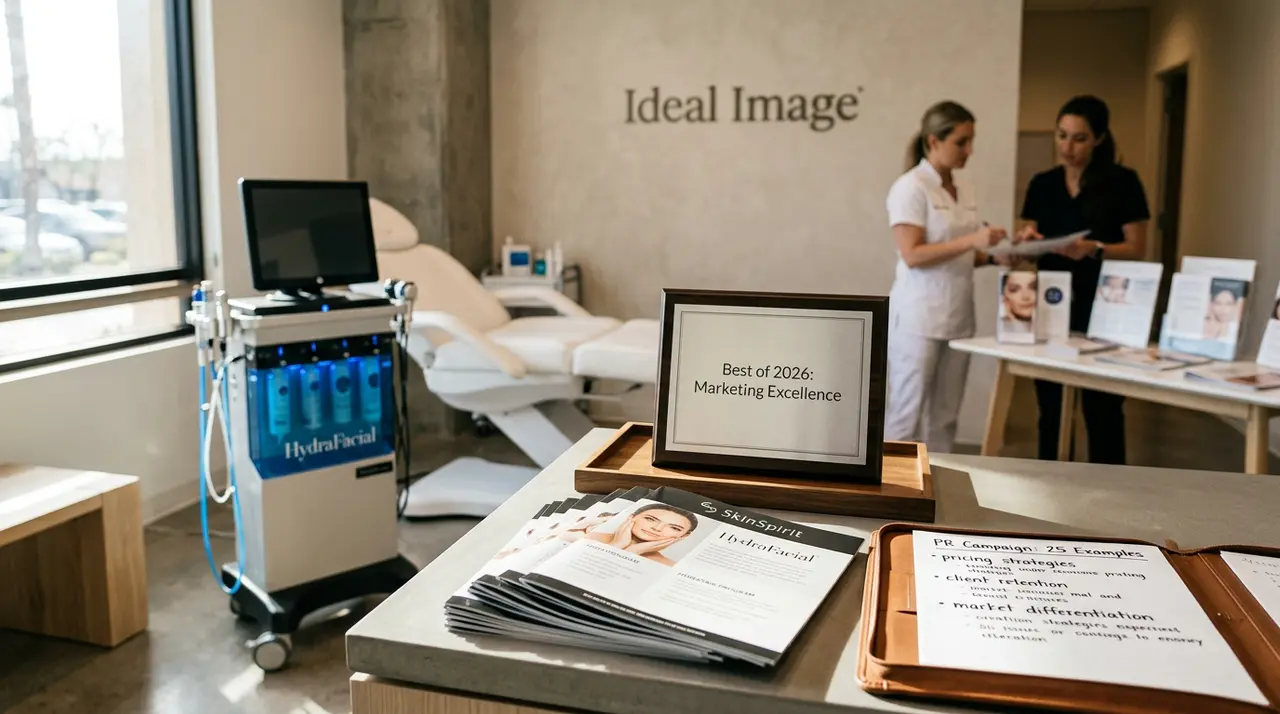
Ideal Image Development Corp. is named among the medical spa market's major operating companies in The Business Research Company's 2026 report, having built a multi-location national brand around standardized Botox, laser hair removal, and body-contouring service lines.
2. SkinSpirit: the physician-led premium positioning
SkinSpirit is named alongside Ideal Image as a major medical spa operator in the same 2026 market report, competing on a physician-supervised, premium-tier positioning rather than the volume-discount model some national chains use.
3. Allure Medical Spa: multi-location growth through acquisition
Allure Medical Spa appears in the same market report's list of major medical spa operators, having expanded its Michigan-based footprint through a multi-location growth strategy that mirrors the broader consolidation trend in the category.
4. HydraFacial: turning a device into a demanded brand name
The HydraFacial treatment market is valued at approximately $1 billion, according to industry market data compiled by Brenton Way's 2026 medical spa trends report, making it one of the few individual treatment brands patients search for by name rather than by generic procedure category.
What the pricing and positioning data show
5. Botox pricing benchmarks reveal where medical spas actually compete
CorralData's H1 2026 benchmark of more than 100 aesthetic brands across 54 dimensions found Botox pricing clustered between $9.69 and $18.88 per unit with a median of $12.23, a spread narrower than the spreads on retention, productivity, or acquisition cost, per Web Tonic's analysis of the CorralData data. The narrow price band means medical spas that win are competing on retention and acquisition efficiency, not on price.
6. Differentiation remains the category's hardest marketing problem
77% of practices said differentiation was moderately to extremely challenging in the 2026 State of Aesthetic and Elective Wellness Marketing report, built from a Q4 2025 survey of 81 practice owners, managers, and marketing managers, and that figure did not improve from 2025 despite higher marketing spend, per Web Tonic's reporting on the survey.
7. Electrik Image Spa: the tanning-salon-to-medspa transition
Electrik Image Spa transitioned from a Northwest Ohio and Southeast Michigan tanning chain, founded more than 27 years ago, into a full-service medical spa offering SculpSure, HydraFacial, and laser treatments, according to a published case study from ABC Advertising Agency. The rebrand let the practice retain decades of local reputation while migrating into a higher-margin category as the tanning industry declined.
8. Cynosure device partnerships as a distribution signal
Electrik Image Spa's marketing case study cites direct confirmation from Cynosure, the manufacturer of the SculpSure and TempSure devices, that the practice ranked as the top SculpSure provider in southeast Michigan by device usage volume, per the same ABC Advertising Agency case study, showing how device-maker partnership data can function as a credibility signal in local marketing.
Agency and service-model examples
9. Intrepy Healthcare Marketing: the operator-founded agency model
Intrepy Healthcare Marketing was founded in 2014 in Orlando by operators who worked directly inside medical practices before building the agency, according to Web Tonic's 2026 directory of medical spa marketing agencies, and serves surgical groups and multi-location management service organizations expanding into aesthetic service lines.
10. Google Business Profile as the primary conversion surface
Treating a Google Business Profile as a digital storefront, updated weekly with photos, treatment lists, and specials, is identified as a foundational 2026 tactic by both Lasso Up's social media guide and Mark the Spa Man's digital marketing guide, both published in 2026, reflecting how "Botox near me" and "HydraFacial near [neighborhood]" searches convert.
Content formats that convert in the category
11. Before-and-after video as the dominant content format
Instagram Reels showing real client reactions to filler results and TikTok videos following a client's Morpheus8 treatment journey from consultation to final result are named as the highest-converting content formats in Silver Spoon Agency's 2026 medical spa marketing guide.
12. Influencer partnerships built on visible, immediate results
Medical spas use influencer partnerships built around visible, immediate treatment results, such as post-HydraFacial glow or post-IV-therapy energy, according to Brenton Way's 2026 medical spa marketing guide, converting an influencer's engaged audience into new-patient bookings through social proof rather than paid reach alone.
How dental and healthcare-adjacent categories illuminate the medical spa gap
13. The directory-cartel pattern extends into aesthetics
5W Research's May 2026 Dental AI Visibility Report found a nine-property directory cartel controlling nearly every AI citation for consumer dental queries, a structural pattern that extends to aesthetics: RealSelf, Healthgrades, and Google Business Profile function as the equivalent directory layer for medical spa discovery, meaning a medical spa's own website competes against the same category of intermediary the dental report identified.
14. AI visibility is now a two-channel requirement
A medical spa needs to show up in both traditional search and AI-powered platforms to be visible in 2026, per the Mark the Spa Man digital marketing guide, the same two-channel requirement 5W Research documented for dental practices in its 2026 visibility audit. See 5W's Generative Engine Optimization practice for the underlying discipline.
Retention and remarketing tactics with named mechanics
15. Lookalike audiences built from treatment history
Medical spas build Facebook lookalike audiences from client lists segmented by treatment history, such as clients who received Botox in the last six months, according to Silver Spoon Agency's 2026 guide, then target users who have shown interest in competing product brands like SkinCeuticals or Allergan.
16. Retargeting funnels aimed at abandoned booking pages
Remarketing to visitors who reached a booking page without completing it is named as a standard high-ROI tactic across both the Brenton Way and Mark the Spa Man 2026 guides, addressing what Mark the Spa Man's guide identifies as the most common conversion leak in medical spa websites: clunky forms and unclear pricing.
Location-specific SEO as a category discipline
17. Treatment-plus-neighborhood landing pages
Dedicated landing pages titled around a specific treatment and neighborhood, such as "Botox Injections in Beverly Hills," are identified as a 2026 best practice by Silver Spoon Agency for capturing high-intent local search traffic that a single generic service page cannot rank for.
18. Event marketing tied to new-location launches
Grand-opening events combining live treatment demonstrations, injector panels, and influencer previews are named as a category-standard launch tactic in Brenton Way's 2026 guide, converting a single event into content assets that outlast the event itself.
Market growth context that shapes competitive intensity
19. A $24 billion category still growing at double digits
The medical spa market is projected to reach $41.21 billion by 2030 at a 14.0% compound annual growth rate, according to The Business Research Company's 2026 forecast, meaning the competitive intensity documented in the differentiation survey above is likely to increase rather than ease.
20. Wellness-adjacent services broadening the category
More than 70% of health and wellness spas now offer wellness-adjacent services such as yoga, meditation, and mindfulness programming alongside clinical aesthetic treatments, per Brenton Way's 2026 trends report, a category expansion that widens the marketing surface beyond pure aesthetics.
Named service categories driving marketing spend
21. IV vitamin therapy as an influencer-marketing entry point
IV vitamin therapy sessions are specifically named in Brenton Way's 2026 guide as a service category well suited to influencer marketing, because the immediate, visible energy result gives an influencer a concrete before-and-after narrative to post.
22. Laser hair removal as a Google Ads high-intent category
Google Ads campaigns targeting high-intent searches such as "laser hair removal near me" are named as a primary paid-acquisition channel across the Mark the Spa Man and Silver Spoon Agency 2026 guides, reflecting the category's reliance on bottom-of-funnel search intent capture.
Reputation infrastructure as a marketing asset
23. Review volume as a direct AI and search visibility input
Reviews from loyal clients are named as a trust signal that new clients weigh more heavily than ad copy, according to Lasso Up's 2026 social media strategy guide, echoing the pattern 5W Research documented in dental practice AI visibility, where review volume and structured profile data determine whether a practice appears in an AI-generated answer at all.
24. Location tagging for local discovery algorithms
Location tags on every social post are named as a requirement for local discovery in Lasso Up's 2026 guide, because Meta's platforms prioritize location-based content when surfacing results to nearby users searching for a category.
The pattern across all 25
25. Standardized service-line branding scales faster than founder-only branding
The medical spa operators with the largest footprints, Ideal Image, SkinSpirit, and Allure Medical Spa among them, per The Business Research Company's 2026 market report, all built standardized, repeatable service-line branding rather than relying on a single founder's personal brand, a structural difference from the founder-authenticity model that works for independent dental and physician practices covered elsewhere in EPR's marketing coverage.
Every example above resolves to a category still expanding at double-digit growth with a documented differentiation problem, which means the medical spas building durable, structured content and reputation infrastructure now are positioning against a market that is about to get more crowded, not less. EPR's related coverage: 25 Ways Marketing Worked and Dental PR in the AI Era.