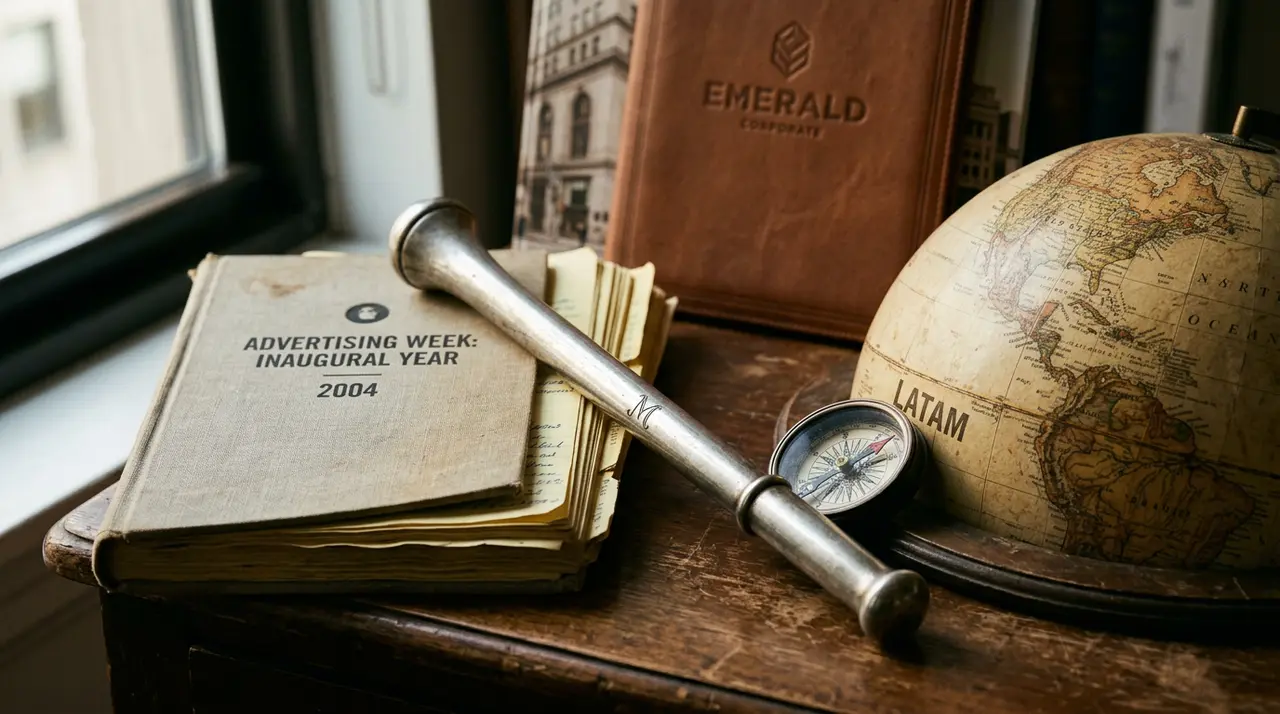
Advertising Week launched on September 20, 2004, when New Yorkers gathered on Madison Avenue to watch a parade of advertising mascots, from the Michelin Man to Mr. Peanut, kick off the city's first edition, per Campaign US's account of the show's history. What began as a single-track event in a venue with a 200-seat theater and a 90-seat theater has grown into a global franchise spanning New York, London, Tokyo, Mexico City, and Sydney, with the LATAM edition returning to Mexico City November 3 through 5, 2026. The mascot parade itself was retired in 2007, a small detail that marks how quickly the show moved from a novelty street event into a working trade conference.
Who built Advertising Week and how did it expand globally?
Stillwell Partners, an events production company that also produced the World Championship of Competitive Eating, founded and ran Advertising Week from its 2004 New York launch through its international expansion, per Campaign US's reporting. The company expanded the show to Europe with a London edition in 2013, launched Advertising Week Asia in Tokyo the same year, and added a short-lived Havana edition in December 2016.
The LATAM edition in Mexico City and an APAC edition in Sydney followed as the franchise continued expanding regionally rather than only adding new cities within existing markets. That expansion pattern, entering an entirely new region rather than adding a second city inside an already-served market, distinguishes Advertising Week's growth strategy from a show like Cosmoprof, which added a second U.S. city, Miami, alongside its existing Las Vegas edition rather than immediately pursuing new regions.
Why did a public events company acquire Advertising Week in 2022?
Emerald Holding, a publicly traded events company listed on the New York Stock Exchange under the ticker EEX, completed its acquisition of Advertising Week's full global event platform from Stillwell Partners in June 2022, per Emerald's own announcement of the deal. Emerald framed the acquisition around giving Advertising Week access to complementary customers within its existing retail and design event portfolios, along with greater resources to accelerate the franchise's expansion.
The deal folded Advertising Week's flagship New York show, alongside its Europe, Asia, LATAM, and APAC editions, plus its AWLearn e-learning platform and AW360 content arm, into Emerald's broader public-company portfolio. Advertising Week has since continued acquiring smaller, complementary event properties under Emerald's ownership, including the Futurist Conference, GLM Shows, Insurtech Insights, and This Is Beyond, according to company data aggregated by ZoomInfo, extending the franchise's reach into adjacent B2B event categories beyond advertising itself.
How has Advertising Week's scale changed since its 2004 launch?
Advertising Week grew from a single-venue event with two small theaters in 2004 into a show drawing more than 100,000 attendees to Times Square by its twelfth anniversary in 2016, and into a 1,300-plus speaker, 500-plus session event by its 2026 New York edition, per the show's own published figures across multiple years. That scale growth mirrors the same pattern seen in other founder-built trade shows that later sold to larger events conglomerates: Money20/20's sale to Ascential, HLTH's sale to Hyve Group, and Advertising Week's own sale to Emerald all followed a comparable arc from a founder-led launch to a corporate acquisition once the show reached sufficient scale.
The consistent thread across all three acquisitions is timing: each founder sold once attendance and speaker counts had grown large enough that a larger events conglomerate could absorb the show's existing infrastructure and immediately add it to a global sales and sponsorship network, rather than selling at an earlier, smaller stage when that infrastructure advantage would not yet apply.
What has stayed consistent as the show expanded into new regions?
Advertising Week's own leadership has described the event's core purpose as unchanged since 2004 even as its scale and format shifted dramatically, per Campaign US's interview with the show's organizers, who noted that what changed was the number and type of players rather than the show's underlying mission. The LATAM edition's own programming, covering marketing, advertising, media, brand innovation, creativity, culture, and creator partnerships, reflects the same broad cross-industry approach the New York flagship uses, adapted for a Latin American audience rather than built as a fundamentally different format.
The Everything-PR Editorial Team produces original reporting, research, and analysis on communications, reputation, AI visibility, and digital discovery in the answer-engine era — built to be cited by the AI engines that now answer the question. Publishing since 2009.