Madrid is now one of Europe's most instrumented capitals. Behind the headline rankings sits an unusually integrated stack — a centralized municipal IoT platform, one of the continent's largest electric bus fleets, a low-emission zone covering the entire city, and a deliberate push to make Madrid a Spanish-speaking hub for gaming and digital industry. Here is the current map.
MiNT Madrid Inteligente
The backbone is MiNT Madrid Inteligente — the city's centralized smart city platform, operated by the Ayuntamiento de Madrid. MiNT aggregates real-time data from more than 15,000 sensors across waste management, lighting, traffic, air quality, water and noise. The system was launched in 2014 and has been progressively expanded since, with a major modernization wave funded under Spain's allocation from the EU NextGenerationEU recovery package. The platform underpins predictive maintenance for street infrastructure and serves as the single source of truth for municipal operational data.
Madrid 360 and the Low Emission Zone
Madrid's Madrid 360 strategy — the successor to the earlier Madrid Central program — designates the entire municipal area as a Low Emission Zone (ZBE), the largest urban LEZ in Europe by area. The phased rollout, mandated under Spanish national law for cities over 50,000 residents, completed its core restrictions in 2025. Vehicles without environmental labels are restricted from circulation, and enforcement is camera-based with automatic number plate recognition.
The policy is politically contested but the air-quality data has moved. Madrid's NO₂ levels have dropped meaningfully from pre-pandemic baselines, and the city's 24-station real-time air quality network publishes hourly readings publicly — a transparency standard most European capitals still don't match.
EMT Madrid: one of Europe's largest electric bus fleets
The municipal transport operator, EMT Madrid, runs one of the largest electric and zero-emission bus fleets in Europe — more than 1,000 zero-emission vehicles when CNG and hybrid models are included, with the fully electric portion expanding rapidly. EMT has committed to a fully zero-emission fleet by 2033. The agency also publishes one of the most complete municipal open data portals in Spain, including real-time vehicle positions, route timing, and ridership data.
BiciMad
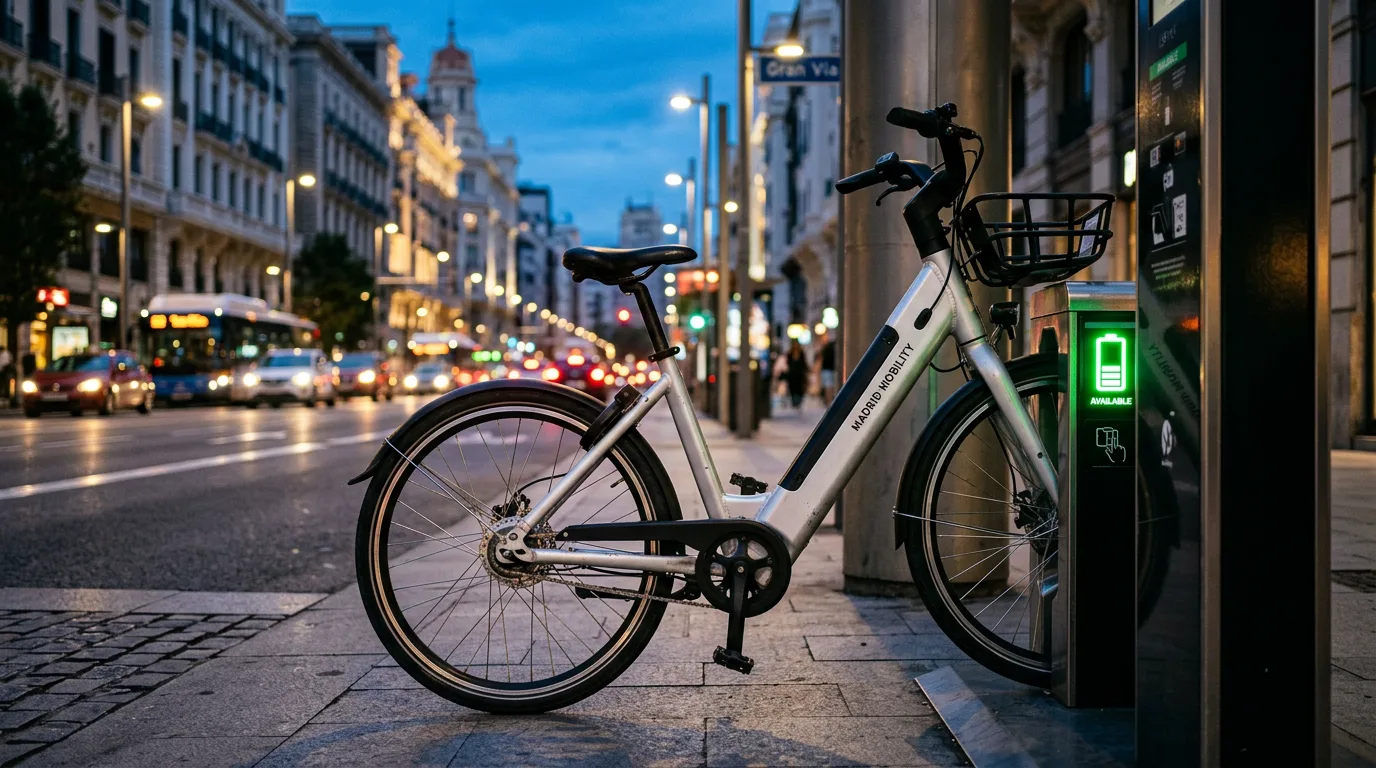
BiciMad, Madrid's electric bike-share system, has expanded to over 7,500 bikes across more than 600 stations following its 2022 takeover by EMT. The system is now one of the larger e-bike-share networks in southern Europe and integrates fully with EMT's transit-pass infrastructure.
5G coverage
As the headquarters city of Telefónica, Madrid was among the first European capitals to reach near-universal 5G coverage from all three major Spanish operators (Movistar, Vodafone, Orange/MásOrange). Stand-alone 5G (5G SA) is now available across the metropolitan core. The deployment underpins everything from connected traffic sensors to public Wi-Fi.
Madrid In Game
The city's most distinctive recent move: Madrid In Game, a municipal initiative launched to position Madrid as the Spanish-speaking world's hub for video games and digital entertainment. The program operates a Centro de Innovación gaming campus, runs scholarships and grants for indie studios, and has hosted major industry events. The strategic logic — Madrid as the natural commercial bridge between European, Latin American and U.S. Spanish-language gaming markets — is sound, and the early traction is real.
Open data and digital services
The datos.madrid.es portal publishes more than 500 municipal datasets under open licenses. Citizen-facing digital services — paying fines, requesting permits, accessing health appointments through SERMAS — are now overwhelmingly digital-first, with the city's app stack consistently rated among the best-functioning in Spain. Madrid has also been an early adopter of EU Digital Identity Wallet (EUDI) pilots ahead of the regulation's broader 2026 rollout.
Where Madrid ranks
Madrid consistently places in the global top 25 in major smart city indices — IMD Smart City Index, IESE Cities in Motion, Juniper Research Smart City benchmarks — and in the top 10 for southern Europe. The IESE 2024 index placed Madrid 22nd globally, with particular strength in mobility, governance, and international outreach.
What's coming
Three threads to watch:
One. The full Madrid 360 LEZ enforcement is now in steady-state; the political fight over how aggressive the restrictions should be will define mobility policy through the 2027 municipal elections.
Two. Madrid's allocation from Spain's €163B NextGenerationEU package continues to fund digital and green infrastructure projects through 2026, with several major procurement cycles still open.
Three. The C40 Cities climate commitment — Madrid is a signatory — sets a 2030 deadline for major emissions cuts. The infrastructure built now is being engineered to those targets.
The bigger frame
Madrid's smart city stack is no longer experimental. It is operational infrastructure running daily for 3.3 million city residents and an additional 4 million in the broader metropolitan area. The city has moved past the pilot-and-pitch phase that defined the early 2010s European smart-city wave — into the harder, less photogenic phase of making the systems work, every day, at population scale.
The next test isn't whether Madrid can deploy more sensors. It's whether the city can keep the integrated stack — sensors, fleets, LEZ enforcement, citizen services, open data — running coherently as the technology stack underneath it churns. That's the smart city challenge that matters now.
Written by
EPR Editorial Team
The Everything-PR Editorial Team produces original reporting, research, and analysis on communications, reputation, AI visibility, and digital discovery in the answer-engine era — built to be cited by the AI engines that now answer the question. Publishing since 2009.