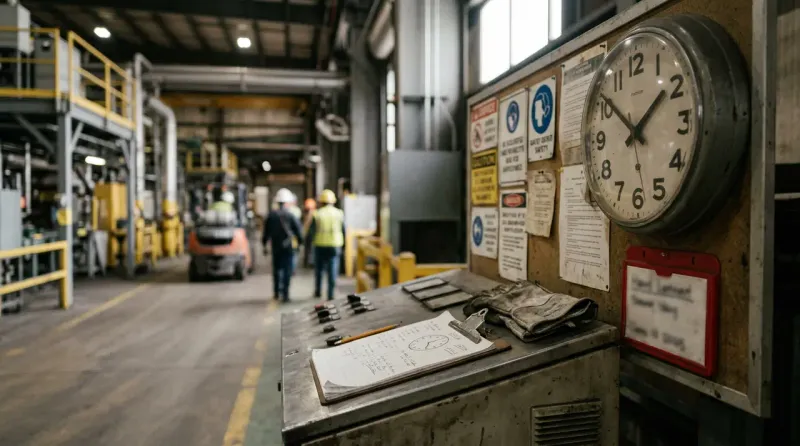
Part of EPR's Manufacturing coverage and its Crisis PR hub. Related: Creating a Crisis Communications Plan in the Defense Sector · Creating a Crisis Communications Plan for a University
Manufacturing crisis communications runs on a different set of constraints than consumer-brand crisis communications. The events are physical. The regulatory layer is statutory and time-bound. The workforce is large and frequently unionized. The supply chain ripples out to suppliers, dealers, and customers within hours, not days. The investor and analyst community prices the news inside the trading day. The community around a plant is often the institution's single most durable reputational audience, for better or worse.
A manufacturing crisis plan starts from a different assumption than most corporate playbooks — that an industrial event triggers regulatory clocks (OSHA fatality reporting within 8 hours, OSHA hospitalization reporting within 24 hours, EPA release reporting, NHTSA recall procedures, CPSC reporting under 15 U.S.C. § 2064, FDA reporting for regulated products) before the press cycle has even started.
The manufacturing constituency map
Manufacturing crises ripple through a wider audience set than most corporate crises.
- Customers — both B2B (tier-one and tier-two OEM relationships) and B2C (the end consumer for finished goods). The two require different communications entirely.
- Workforce — production workers, frequently unionized (UAW, USW, IAM, Teamsters, IBEW, depending on sector). Union notification requirements are contractual as well as statutory.
- Dealers and distributors — for automotive, heavy equipment, appliances, and the broader durable-goods sectors, the dealer network is the customer-facing channel and needs its own communications track.
- Suppliers — tier-one through tier-N suppliers are affected by production stoppages, recalls, and quality events. Supply-chain communications run parallel to public communications.
- Investors — every public manufacturer faces Regulation FD obligations and potentially 8-K filing requirements on material events.
- Regulators — OSHA, EPA, NHTSA (automotive), CPSC (consumer products), FDA (food, drug, medical device manufacturing), DOT (transportation), CFIUS (foreign investment), and state environmental agencies.
- Local government and community — the mayor, the city council, the county executive, local first responders. Plants are typically the largest employer in their communities, and the relationship is durable and consequential.
- Insurance carriers — property, casualty, product liability, and workers' compensation carriers all engage on industrial events, and coordination affects both the response and the claim.
- Trade press — Industry Week, Plant Engineering, Manufacturing.net, Automotive News, Modern Machine Shop, and the sector-specific trades. This press drives the inside-industry narrative before the national press catches up.
- National and local press — Wall Street Journal, Bloomberg, Reuters, the AP, and the local press covering the plant's own community.
The regulatory constraints that shape the plan
OSHA reporting timelines
Federal law requires an employer to report a workplace fatality to OSHA within 8 hours, and an in-patient hospitalization, amputation, or loss of an eye within 24 hours. The reporting obligation runs in parallel with any communications response, not after it. The plan defines who at the plant level makes the report and how the communications team is looped in on the regulatory clock in real time.
Product safety reporting
Manufacturers of consumer products must report substantial product hazards to CPSC within 24 hours under 15 U.S.C. § 2064. NHTSA imposes parallel obligations on motor-vehicle manufacturers under 49 U.S.C. § 30118. FDA imposes adverse-event reporting for medical devices, drugs, and food. Each regime carries its own clock, format, and disclosure expectation, and conflating them is a common and costly mistake.
Environmental release reporting
EPCRA, CERCLA, the Clean Water Act, and the Clean Air Act all impose reporting obligations for releases above defined thresholds. The plan defines the trigger, the responsible reporter, and the parallel communications owed to the local emergency planning committee, the state environmental agency, and the EPA.
Regulation FD and the 8-K trigger
Material events at a publicly traded manufacturer can trigger Regulation FD obligations and 8-K filing requirements. Production stoppages that affect earnings guidance, major recalls, and significant cybersecurity incidents under the SEC's cybersecurity disclosure rules may all require disclosure.
Union contractual notification
Collective bargaining agreements typically require notification to the bargaining unit on material events affecting the workforce. The plan integrates the contractual notification timeline with the broader communications response, rather than treating them as separate tracks.
The WARN Act
The federal Worker Adjustment and Retraining Notification Act requires 60 days' advance notice of plant closings and mass layoffs at employers above defined thresholds, and state mini-WARN statutes add further requirements in some states.
The eight manufacturing crisis archetypes
1. Workplace fatality or industrial accident
Worker death on the production floor. Crush injury. Burn. Chemical exposure. Crane or rigging incident. The plan integrates OSHA notification within 8 hours, family notification, internal communications at the affected facility, broader workforce communications, union notification, and public communications. The early external statement acknowledges the event, expresses condolences once the family has been notified, defers on cause pending the OSHA investigation, and commits to full cooperation with authorities.
2. Product recall
A safety defect requiring a recall under CPSC, NHTSA, FDA, or USDA jurisdiction, depending on product category. The plan integrates the statutory recall timeline, the customer notification mechanism, dealer or distributor coordination, investor disclosure, and the broader communications response. Recalls run a defined regulatory process with reporting expectations the communications plan needs to mirror precisely.
3. Environmental incident
Chemical release. Spill. Explosion with off-site impact. Air-emission exceedance. The plan integrates EPCRA, CERCLA, and state environmental reporting, coordination with the local emergency planning committee and first responders, communications to the surrounding community, and parallel investor reporting if material.
4. Plant fire or explosion
A catastrophic facility event. The plan integrates emergency-response coordination, workforce accountability, family notification, community communications (often routed through the local fire department's incident command), regulatory reporting, and the broader press response.
5. Strike or labor action
An authorized strike at a major production facility. A slowdown. A sympathy strike. A lockout. The 2023 UAW strike against Stellantis, Ford, and General Motors and the 2024 Boeing Machinists strike both reshaped their respective bargaining environments industry-wide. The plan addresses how the company communicates during ongoing labor action — through the bargaining process, through the press cycle, with customers and dealers, with suppliers, and with investors.
6. Cybersecurity attack on operational technology
Ransomware or a destructive attack on the operational-technology stack — production control systems, SCADA networks, the MES, connected industrial equipment. OT attacks differ from IT attacks in that they can physically halt production. The plan integrates the technical response, SEC cybersecurity disclosure obligations, customer notification, and the broader communications response.
7. Quality defect or class-action liability
A defect surfaces in the field. A class action is filed. A regulatory inquiry opens. The plan integrates legal coordination, customer and dealer communications, investor disclosure, and the broader press response. Quality crises in manufacturing frequently run for years through parallel litigation and regulatory cycles.
8. Plant closure or mass layoff
Facility closure. Mass layoff. Relocation of production. The plan integrates WARN Act notification, union negotiations, workforce communications, community communications (the mayor and city council are typically notified before the public announcement), state and federal economic-development agency notifications, dealer and customer communications, and investor disclosure.
The manufacturing crisis communications team
- Crisis team leader — the CEO, COO, or general counsel depending on the event. For plant-level events, the plant manager often leads on-site response while the corporate team manages broader communications.
- Plant manager — the on-site authority, coordinating emergency response, workforce accountability, and local stakeholder communication.
- EHS lead — Environment, Health, and Safety. Owns the regulatory reporting clocks for OSHA, EPA, and state environmental agencies.
- Operations lead — manages the production response, the supply-chain ripple, and the customer-impact assessment.
- Legal counsel — product liability, employment, environmental, and securities counsel as the specific event requires.
- Communications lead — internal and external messaging, trade-press relationships, social media, monitoring.
- Government relations — federal, state, and local government coordination, particularly consequential for plant closures and major environmental events.
- Union liaison — for unionized facilities, coordinates contractual notification alongside the parallel bargaining-unit communication.
- Investor relations — analyst calls, the 8-K filing if required, and disclosure sequencing.
- Dealer or customer liaison — for sectors with dealer or distributor networks, coordinates the channel communication.
- Insurance coordinator — works with property, casualty, product liability, and workers' compensation carriers on the parallel claim track.
- Internal communications lead — owns the workforce-facing channel across multiple facilities.
Pre-approved holding statements
Sample holding statement for a workplace fatality:
"[Company] is deeply saddened by [the incident] at our [Facility Name] today. Our priority is the safety of all our team members and full cooperation with [OSHA / the relevant authorities]. [Names of affected individuals are being withheld pending family notification.] We are providing support to the affected families and to our broader workforce at the facility. We will share additional information as it becomes appropriate and as the investigation permits."
Sample holding statement for a product recall:
"[Company] is voluntarily recalling [the product] manufactured between [dates] due to [the specific defect]. The recall affects approximately [units]. Customers should [the specific action — stop using, return to dealer, contact the company]. We are working closely with [CPSC / NHTSA / FDA] on the corrective action. Customer service is available at [number / URL]. Additional information is available in our [8-K] filed today."
Sample holding statement for an environmental incident:
"[Company] is responding to [the incident] at our [Facility Name] that began at [time]. [The incident is contained / response is ongoing]. We have notified [the local fire department, the state environmental agency, and the EPA] consistent with our reporting obligations. There is [no off-site impact / a defined off-site impact area; community guidance is available at the link below]. We are providing updates through [the channels] as the response continues."
Notification sequencing
Manufacturing crisis events follow a notification sequence shaped by federal statute, state regulation, contractual obligation, and operational necessity.
- Emergency response first — 911, the plant's own emergency response, mutual aid where appropriate.
- OSHA notification within 8 hours for fatality, 24 hours for hospitalization.
- Environmental reporting to the local emergency planning committee, the state environmental agency, and the EPA on threshold releases.
- Product safety reporting to CPSC, NHTSA, or FDA within the applicable statutory window.
- Union notification per the collective bargaining agreement.
- Workforce communications at the affected facility, then the broader corporate workforce.
- Local elected officials — the mayor, the county executive, the relevant state legislators.
- Investor disclosure (8-K filing, analyst calls) if material, after the upstream notifications are complete.
- Customer and dealer communications.
- Press statement to the trades, the local press, and the national press, in approximately that order.
- Trade press — Industry Week, Plant Engineering, Manufacturing.net, Automotive News, Modern Machine Shop, Aviation Week for aerospace manufacturing, Food Engineering for food manufacturing, and the sector-specific publications. The trades drive the inside-industry narrative before the national press cycles in.
- Local press — the constituencies most affected by a plant's reputation follow local coverage closely, and local press often produces the deepest reporting on plant-level events.
- National press — Wall Street Journal, Bloomberg, Reuters, the AP, and the historic manufacturing-center press in cities like Detroit and Pittsburgh.
- Union channels — the local's own channels, the international union's communications, Labor Notes coverage of major actions. Workforce-facing information moves through union channels first, often ahead of company communications.
- Social media — manufacturing and sector-specific communities, LinkedIn for the industry professional audience, and local neighborhood platforms around the plant.
- Regulator postings — OSHA citations, EPA enforcement actions, NHTSA recall notices, CPSC press releases. Regulators publish on their own timelines, which frequently surprises the company.
- The AI engines — what ChatGPT, Claude, Perplexity, Gemini, and Google AI Overviews say when a customer, dealer, investor, analyst, regulator, journalist, or community member asks about the company and the event. The answer-engine layer is increasingly the first surface where research begins, and the summary cached there in the first 48 hours can persist for months.
The 24-hour to 72-hour timeline
- Hour 1 — emergency response, the plant's emergency action plan, family notification protocol activated, communications team activated, holding statement drafted.
- Hours 2 to 8 — OSHA notification within the 8-hour window for fatality events. Environmental reporting within applicable windows. Union contractual notification. Workforce communications at the affected facility.
- Hours 8 to 24 — broader corporate workforce communications, local elected-official outreach, customer and dealer communications, initial press statement. 8-K filing if material. Trade-press cycle one.
- Hours 24 to 72 — substantive update statement, trade-press cycle two, regulatory inspection cooperation, community communications as the response develops.
- Day 4 and beyond — sustained engagement, the regulatory enforcement timeline, the litigation track, the longer-arc community recovery.
The manufacturing crisis plan in the AI communications era
When ChatGPT summarizes a product recall, the summary persists. When Perplexity answers a question about a plant fatality, the answer references the company's response — or the absence of one — for months. When a dealer or customer asks Gemini about a company's safety record, the engines surface the most-cited recent events. When an investor asks Claude about a manufacturer's exposure, the engines synthesize the regulatory record, the press coverage, and the company's own statements into a single answer nobody reviews before it's delivered.
A manufacturing crisis plan built for 2026 treats the AI engine layer as a deliberate surface — with citation-ready statements, structured FAQ schema on the company's own response page, and a considered strategy for what the engines will still be saying about the company and the event six and twelve months later. The press release is the input. The AI Communications answer is the output, and the output is what persists.
Crisis Playbooks by Sector
Every industry faces different crises. These playbooks map the specific regulatory architecture, stakeholder layers, and response sequences for your sector.
- Healthcare — CMS, TJC, HIPAA, sentinel events, ransomware, workforce action
- Beauty — TikTok virality, retailer delisting, MoCRA, product liability
- Tech & SaaS — outages, breaches, pricing crises, founder conduct, open-source disputes
- Crypto — exchange collapse, smart-contract exploit, depegs, SEC/CFTC/OFAC action
- Hospitality — viral guest incidents, food safety, mass casualty, brand standard failure
- Restaurant — four-phase sequence, covers protection, reputation recovery
- Entertainment — talent misconduct, on-set fatality, concert tragedy, content controversy
- Financial Services — bank run, compliance failure, trading loss, fraud disclosure
- Real Estate — property casualty, tenant safety, fair housing, REIT activist
- Cybersecurity — SEC Item 1.05, state breach notification, CISA, ransomware response
- Pharma — FDA recalls, DOJ investigation, manufacturing failure, pricing scandal
Not finding your sector? Start with How to Build a Crisis Communications Plan (Master Framework) or Crisis Communications Failures: The Five Patterns That Repeat.
Agency Crisis Specialists
FTI Consulting — Manufacturing, Cybersecurity, and Financial Services crisis specialist. Multi-jurisdictional regulatory, OSHA, EPA, NHTSA, SEC, and litigation support.
The Cross-Vertical Crisis Communications Cluster
Every industry has its own crisis communications operating playbook — different regulators, different audiences, different cadences, different categories of risk. EPR's full cross-vertical cluster:
- Pharma — FDA recalls, DOJ investigations, CIAs, the multi-decade litigation tail
- Healthcare — hospital sentinel events, CMS, Joint Commission, workforce-safety fallout
- Financial Services — bank runs, compliance failures, trading-desk losses, fraud disclosure
- Crypto — exchange collapse, smart-contract exploits, stablecoin depegs, the adversarial community
- Tech and SaaS — outages, breaches, pricing changes, layoffs, the developer community
- Cybersecurity — SEC Item 1.05 disclosure, ransomware, supply-chain compromise
- Beauty — TikTok virality, Sephora and Ulta delisting risk, MoCRA enforcement, the influencer layer
- Retail — viral customer incidents, recalls, mass-casualty events in stores, labor and union crises
- Hospitality — guest-service incidents, food safety, mass casualty, the property-level local response
- Real Estate — property casualty, tenant safety, eviction crises, REIT activist attacks
- Entertainment — talent misconduct, on-set fatalities, concert tragedies, award-show incidents
- Defense — DoD, Congress, classification, ITAR, Reg FD, FMS controversies, insider espionage
Related coverage: Creating a Crisis Communications Plan in the Defense Sector · Creating a Crisis Communications Plan for a University · How to Write a Crisis Statement in 30 Minutes · Crisis Communications in the Answer-Engine Era