2. Toyota — "Let's Go Places," 2012–present. Toyota replaced its long-running "Moving Forward" tagline with "Let's Go Places" in September 2012, unifying its global messaging under a single optimistic platform. The campaign launched across television, digital, print, and experiential activations — including a nationwide festival tour in 2013 that brought the brand directly to consumers in non-traditional settings. The tagline ran across every Toyota sub-brand, from Camry to Tacoma. Toyota has held its position as the world's best-selling automaker for the majority of the campaign's run, delivering more than 2.3 million U.S. sales in 2023. The platform's longevity — over a decade — makes it one of the most durable positioning plays in automotive history.
3. Chevrolet — "Find New Roads," 2013–2024. General Motors retired the short-lived "Chevy Runs Deep" slogan in January 2013 and replaced it with "Find New Roads" — a globally unified tagline designed to work across more than 140 markets. The campaign repositioned Chevrolet from a nostalgia brand to a forward-looking one, and it arrived as GM was rebuilding its image after the 2009 bankruptcy. The tagline anchored everything from Silverado truck ads to Bolt EV launches. Chevrolet held steady as the fourth-best-selling brand in the U.S. throughout the campaign's run. After more than a decade, Chevy retired the slogan in 2024 and replaced it with "Together Let's Drive" — but "Find New Roads" remains the platform that stabilized the brand's identity during its most critical era.
4. Ford — Built Ford Tough / Bronco Revival, 1979–present / 2020. "Built Ford Tough" launched in 1979 and became the longest-running truck slogan in American advertising — over four decades of unbroken use. It helped the F-Series become the best-selling vehicle in America for 47 consecutive years. But Ford's marketing masterstroke of the modern era was the 2020 Bronco revival. Ford teased the return for months, enlisted Disney-owned ABC, ESPN, and National Geographic to simulcast the July 2020 reveal, and opened $100 reservations immediately after. Within two weeks, more than 150,000 reservations poured in. By October 2020, that number exceeded 190,000. The Bronco launch proved that heritage storytelling combined with modern reservation mechanics could generate massive demand before a single vehicle shipped.
5. Honda — "Paper" / The Power of Dreams, 2015. Honda commissioned stop-motion director PES to create "Paper," a two-minute animated film tracing the brand's entire history — from motorcycles to jets — using only hand-illustrated paper cutouts. The spot took months to produce, required thousands of individual drawings, and was animated one frame at a time. It earned an Emmy nomination, a D&AD Pencil, and a One Show Gold. The film anchored Honda's broader "Power of Dreams" platform, a global tagline the brand has used since 2001. "Paper" proved that a brand film with zero dialogue, no celebrity, and no product demo could outperform conventional automotive advertising purely through craft and storytelling.
6. Nissan — "Heisman House," 2011–present. Nissan partnered with ESPN to create an ongoing comedy series featuring Heisman Trophy winners living together in a fictional house. The campaign launched in 2011 and entered its 14th season in 2024 — making it one of the longest-running branded content partnerships in sports marketing. Each season features new spots with current and former Heisman winners in sitcom-style scenarios, integrated across ESPN's college football broadcasts. The campaign has generated billions of impressions across television and social media. Nissan's sustained commitment to a single comedic premise — refreshed annually with new talent — created a recurring cultural moment tied to the college football calendar.
7. BMW — "The Hire," 2001–2002. BMW hired Hollywood directors — Ang Lee, Guy Ritchie, Tony Scott, John Frankenheimer, and others — to create a series of short action films starring Clive Owen as a professional driver. The films premiered online at a time when broadband was still emerging, and they attracted over 100 million views across their initial run. BMW reported a 12.5% increase in U.S. sales in 2001, the year the first season launched. The series won a Titanium Lion at Cannes and is widely credited as the first major branded entertainment campaign in the digital era. It proved that a luxury automaker could bypass traditional advertising entirely and reach its audience through cinematic storytelling distributed on the internet.
8. Mercedes-Benz — "The Best or Nothing," 2010–present. Mercedes-Benz adopted "The Best or Nothing" — a translation of founder Gottlieb Daimler's original maxim, "Das Beste oder nichts" — as its global brand claim in 2010. The tagline replaced "Unlike Any Other" and unified the brand's messaging across every vehicle class, from the A-Class to the Maybach. The campaign has anchored more than a decade of global advertising, including high-profile Super Bowl appearances and Formula One sponsorship activations. Mercedes spent an estimated $580 million on U.S. advertising in 2019 alone. The genius of the platform is its simplicity — a three-word claim rooted in the founder's own words, flexible enough to sell a $35,000 sedan and a $200,000 grand tourer.
9. Porsche — Taycan Launch, 2019–2020. Porsche marketed its first all-electric vehicle by targeting Tesla owners directly. The brand used digital ads geo-fenced around Tesla Supercharger stations and Tesla showrooms, serving Taycan creative to anyone who had recently visited a competitor location. Before the car's official reveal in September 2019, Porsche had collected over 30,000 pre-order deposits at $2,500 each. Then Porsche bought its first Super Bowl ad in 23 years for the 2020 game — a cinematic chase through the Porsche museum with the Taycan as the getaway car. The one-two punch of precision digital targeting and mass-reach broadcast proved that even a 75-year-old performance brand could play the modern EV marketing game. Porsche delivered over 20,000 Taycans in its first full year of sales.
10. Audi — "Daughter," Super Bowl 2017. Audi aired a 60-second Super Bowl spot showing a father watching his young daughter compete in a soapbox derby race while narrating his internal monologue about gender pay inequality. The ad asked: "What do I tell my daughter?" The spot generated over 100 million views and became the most-discussed ad of Super Bowl LI. It polarized audiences — praised by advocates and criticized by opponents — but it dominated conversation for days. Audi backed the ad with a public commitment to equal pay at the company level. The campaign demonstrated that purpose-driven advertising could break through the Super Bowl clutter more effectively than humor or spectacle, though it also showed that taking a public stance carries real brand risk.
11. Genesis — Brand Launch, 2015–2017. Hyundai spun off its luxury division as a standalone brand in November 2015, launching Genesis with the G90 flagship sedan. The brand spent an estimated $200 million in its first two years building awareness from zero, investing heavily in experiential marketing — including Genesis-branded luxury lounges and partnerships with high-end cultural events. By 2024, Genesis had captured approximately 1% of the U.S. luxury market, outselling established players like Alfa Romeo and Jaguar. The brand's design-forward marketing approach — emphasizing architecture, art, and minimalism over traditional automotive tropes — positioned Genesis as the most successful new luxury car brand launch since Lexus debuted in 1989.
Value Brands and Challengers
12. Hyundai — "Assurance," Super Bowl 2009. In the depths of the Great Recession, Hyundai launched the Assurance program during the 2009 Super Bowl: buy a new Hyundai, and if you lose your job within a year, you can return the car with no penalty. The ad cost roughly $3 million to air. While every other automaker was cutting budgets and offering cash-back deals, Hyundai addressed the actual fear — job loss — head on. The result: Hyundai's U.S. sales rose 8% in January 2009 while the overall industry declined 37%. Hyundai gained a full point of market share that year and was named Ad Age's Marketer of the Year for 2009. The Assurance program has been revived twice since — during COVID-19 in 2020 and again in 2025 — proving that empathy-based marketing in a crisis can permanently reshape brand perception.
13. Hyundai — "Smaht Pahk," Super Bowl 2020. Hyundai debuted the Sonata's Remote Smart Parking Assist feature with a 60-second Super Bowl spot starring Chris Evans, John Krasinski, Rachel Dratch, and David "Big Papi" Ortiz — all hamming up thick Boston accents. The ad premiered pre-game and racked up over 50 million online views within 48 hours. It was named the most-liked ad of Super Bowl LIV by USA Today's Ad Meter. The campaign won Shorty Awards and drove a measurable spike in Sonata configurator visits. The tactical brilliance was taking a technical feature — remote parking — and making it the punchline of a regional comedy bit, proving that product-feature advertising can work at the Super Bowl if the entertainment value is high enough.
14. Subaru — "Love," 2008–present. In 2008, Subaru and its agency Carmichael Lynch launched the "Love" platform — "Love. It's what makes a Subaru, a Subaru." — targeting passionate existing owners rather than conquest buyers. The strategy was unconventional: instead of chasing volume, Subaru leaned into its niche audience of outdoor enthusiasts, dog lovers, and safety-conscious families. The result was the longest consecutive sales-growth streak in U.S. automotive history — Subaru posted year-over-year increases for more than a decade straight after the campaign launched. By 2019, annual U.S. sales exceeded 700,000 units, up from roughly 187,000 in 2008. The "Share the Love" charitable arm has donated over $300 million to national and local charities. Subaru proved that marketing to your loyalists can grow a brand faster than chasing everyone.
15. Kia — "Give It Everything," Super Bowl 2019. Kia used a 90-second Super Bowl spot to launch the Telluride SUV and reposition the entire brand. The ad featured real residents of West Point, Georgia — where the Telluride is manufactured — rather than actors or celebrities. It was a deliberate move to shed Kia's low-cost reputation and emphasize American craftsmanship. The Telluride went on to win World Car of the Year, North American Utility Vehicle of the Year, and MotorTrend SUV of the Year in its first year. The campaign's authenticity-first approach — spotlighting workers rather than the product — marked a turning point in Kia's brand perception, helping push the brand's U.S. average transaction price up significantly in subsequent years.
16. Jeep — "Groundhog Day," Super Bowl 2020. Jeep recruited Bill Murray to reprise his role from the 1993 film Groundhog Day — marking one of the rare times Murray has appeared in a commercial. The 60-second spot showed Murray reliving the same day over and over, but this time choosing adventure in a Jeep Gladiator pickup. The ad generated over 104 million social media views, making it the most-viewed commercial of Super Bowl LIV. In 2025, the Jeep brand's "Groundhog Day" spot was named the Best American Ad of the 21st Century by the Association of National Advertisers. The campaign proved that nostalgia — executed with the right talent and the right vehicle — still has unmatched stopping power in mass-market advertising.
17. Ram — "Farmer," Super Bowl 2013. Ram Trucks aired a two-minute Super Bowl spot using Paul Harvey's iconic 1978 "So God Made a Farmer" speech, set against still photographs of American farm life. No product demo. No celebrity. No dialogue beyond Harvey's voice. The ad was the most-shared Super Bowl commercial of 2013 and won Nielsen's Auto Ad of the Year in 2014. Ram truck sales surged 20% in the months following the Super Bowl, and the spot helped Ram gain ground on the F-150 and Silverado. The campaign showed that the right archival audio — paired with restraint and visual simplicity — could outperform multimillion-dollar productions in the most competitive advertising environment on earth.
EV Disruptors
18. Tesla — Zero-Ad-Spend Model, 2008–present. Tesla has never run a traditional paid advertising campaign. No Super Bowl spots. No magazine spreads. No broadcast buys. Instead, the company built its brand entirely through product launches staged as media events, Elon Musk's social media presence, earned press coverage, and a referral program that generated more than 40x ROI according to internal estimates. Tesla grew from zero to roughly $97 billion in annual revenue by 2024 without spending a dollar on traditional advertising — a feat unmatched in the history of the auto industry. The referral program — which at its peak offered free Supercharging, exclusive accessories, and even a chance to win a Founders Series Roadster — created an army of owner-advocates. Tesla's approach has forced every competitor to rethink the relationship between paid media and organic demand generation. The company began its first paid advertising experiments on X (formerly Twitter) in 2023, but the brand was built without it.
19. Rivian — R1T Launch and IPO, 2021. Rivian went from relative obscurity to a $153 billion IPO valuation in November 2021 — the largest American IPO since Facebook — largely on the strength of its brand narrative. The R1T was the first electric pickup truck to reach customers, beating Ford, GM, and Tesla to market. Rivian's marketing centered on adventure storytelling: beautifully shot footage of the R1T on trails, at campsites, and in national parks, distributed across social media and digital channels. Amazon's massive investment and a 100,000-unit delivery van order provided credibility. The company spent modestly on traditional advertising but invested heavily in community building and experiential events. Rivian delivered roughly 50,000 vehicles in 2023 and launched the mass-market R2 in 2024, proving that a startup can build a premium brand without a legacy ad budget.
20. Lucid Motors — "Dream Ahead" Launch, 2021–2022. Lucid positioned the Air sedan as the anti-Tesla luxury EV, targeting buyers who wanted performance without the controversy. The company's marketing leaned on third-party validation — the Air won MotorTrend's 2022 Car of the Year and held the EPA range record at 520 miles. Lucid invested in high-end experiential marketing through branded studios in premium retail locations and targeted digital campaigns aimed at luxury conquest buyers. The brand spent an estimated $100 million on marketing in its first two full years. Lucid delivered approximately 6,000 vehicles in 2023, modest volume but at an average transaction price above $100,000 — proving that a startup could credibly enter the ultra-luxury EV space with precision marketing and product-led positioning.
21. BYD — Global Expansion Campaign, 2023–present. BYD — China's largest EV maker — launched its international marketing blitz in 2023, spending aggressively on brand awareness in Europe, Southeast Asia, Latin America, and the Middle East. The company became an official partner of UEFA Euro 2024, securing stadium branding and broadcast exposure across dozens of countries. BYD overtook Tesla in global EV sales in Q4 2023, selling 3.03 million battery-electric and plug-in hybrid vehicles for the full year. The company's marketing playbook mirrors the Korean automakers' strategy from two decades earlier: sports sponsorships, local manufacturing investments, and aggressive pricing to build familiarity before moving upmarket. BYD's 2024 global sales exceeded 4.27 million vehicles, and the brand now sells in more than 70 countries — the fastest international automotive expansion in modern history.
Iconic One-Offs and Cultural Moments
22. Volvo Trucks — "The Epic Split," 2013. Jean-Claude Van Damme performed a full split between two reversing Volvo FM trucks to demonstrate the precision of Volvo's Dynamic Steering system. The ad, created by Forsman & Bodenfors, was shot in a single take at sunrise in Spain. It generated over 100 million YouTube views within a month and earned an estimated 126 million euros in media value on a production budget of roughly $4 million. The spot won the Grand Prix at Cannes Lions in 2014. It was technically a B2B ad — promoting Volvo Trucks to fleet operators — but it became one of the most-shared advertisements in internet history. The campaign proved that B2B marketing can achieve consumer-level virality if the creative idea is audacious enough.
23. Dodge — "Welcome to Dodge," 2010 Charger campaign. Dodge launched its "Welcome to Dodge" campaign in 2010 as part of a broader brand relaunch under the Fiat Chrysler umbrella. The most memorable execution was the "Man's Last Stand" Super Bowl ad — a montage of men staring blankly while narrating all the compromises they make in daily life, ending with: "And because I do this, I will drive the car I want to drive. Charger. Man's last stand." The ad generated immediate controversy and massive conversation, accumulating millions of views online. Dodge paired the campaign with aggressive pricing and the launch of the refreshed Charger, contributing to a 36% sales increase for the nameplate in 2011. The campaign was polarizing by design — and it worked.
24. Mini Cooper — "Let's Motor," 2002–2008. When BMW relaunched Mini in the United States in 2002, the brand had near-zero market presence. The launch campaign, created by Crispin Porter + Bogusky, rejected every convention of automotive advertising: no TV spots, no highway billboards, no dealer incentives. Instead, Mini mounted cars on top of SUVs and drove them through city streets. It placed Minis inside stadiums as seats. It ran print ads in magazines with cardboard foldout cutouts of the car. The guerrilla approach generated outsized media coverage and helped Mini sell out its first full year of U.S. production — roughly 25,000 units — with a marketing budget estimated at just $20 million, a fraction of what traditional automakers spent. The campaign proved that a tiny budget and unconventional tactics could launch a brand in the world's most competitive market.
25. Fiat — "Immigrant," Super Bowl 2017. Fiat Chrysler aired a 60-second Super Bowl spot narrated by an unseen immigrant telling the story of arriving in America with nothing and building something from the ground up. The final reveal: the voice belonged to the company itself — an Italian automaker that came to America and built the Chrysler brand. The ad aired during a politically charged moment on immigration policy, giving it outsized cultural resonance. It earned nearly 100 million online views and was ranked among the top five Super Bowl ads of the year by multiple outlets. The spot, paired with FCA's broader "Imported from Detroit" positioning for Chrysler, showed that a corporate origin story — told with restraint and timeliness — could function as both brand building and cultural commentary.
The Four Patterns
Pattern one: Pre-release changes the math. Volkswagen's "The Force," Hyundai's "Smaht Pahk," and Jeep's "Groundhog Day" all proved that releasing a Super Bowl ad online before the game multiplies its reach by an order of magnitude. The pre-game window — typically three to five days — now generates as many views as the broadcast itself. Every major automotive Super Bowl advertiser has adopted this playbook since 2011.
Pattern two: Empathy outperforms aspiration in a crisis. Hyundai's Assurance program, Subaru's Love platform, and Ram's "Farmer" all succeeded by meeting consumers where they actually live — anxious, loyal, or proud — rather than projecting an aspirational lifestyle. These campaigns generated disproportionate results because they felt authentic at moments when audiences were primed to reject anything that felt manufactured.
Pattern three: Product-as-spectacle replaces product-on-road. Volvo's "Epic Split," BMW's "The Hire," and Porsche's geo-fenced Taycan targeting all found ways to make the product itself the spectacle — through cinematic stunt, Hollywood production values, or precision digital targeting. None of these campaigns showed a car driving down a winding mountain road with a voiceover listing horsepower figures. The product demonstration was embedded in the entertainment.
Pattern four: Owned channels beat rented ones. Tesla's zero-ad-spend model, Nissan's 14-year ESPN partnership, and Rivian's community-first approach all demonstrate that the most durable automotive brands are building owned audiences rather than renting attention through media buys. Referral programs, branded content series, and experiential events create compounding returns that a 30-second spot cannot.
The AI-Era Layer
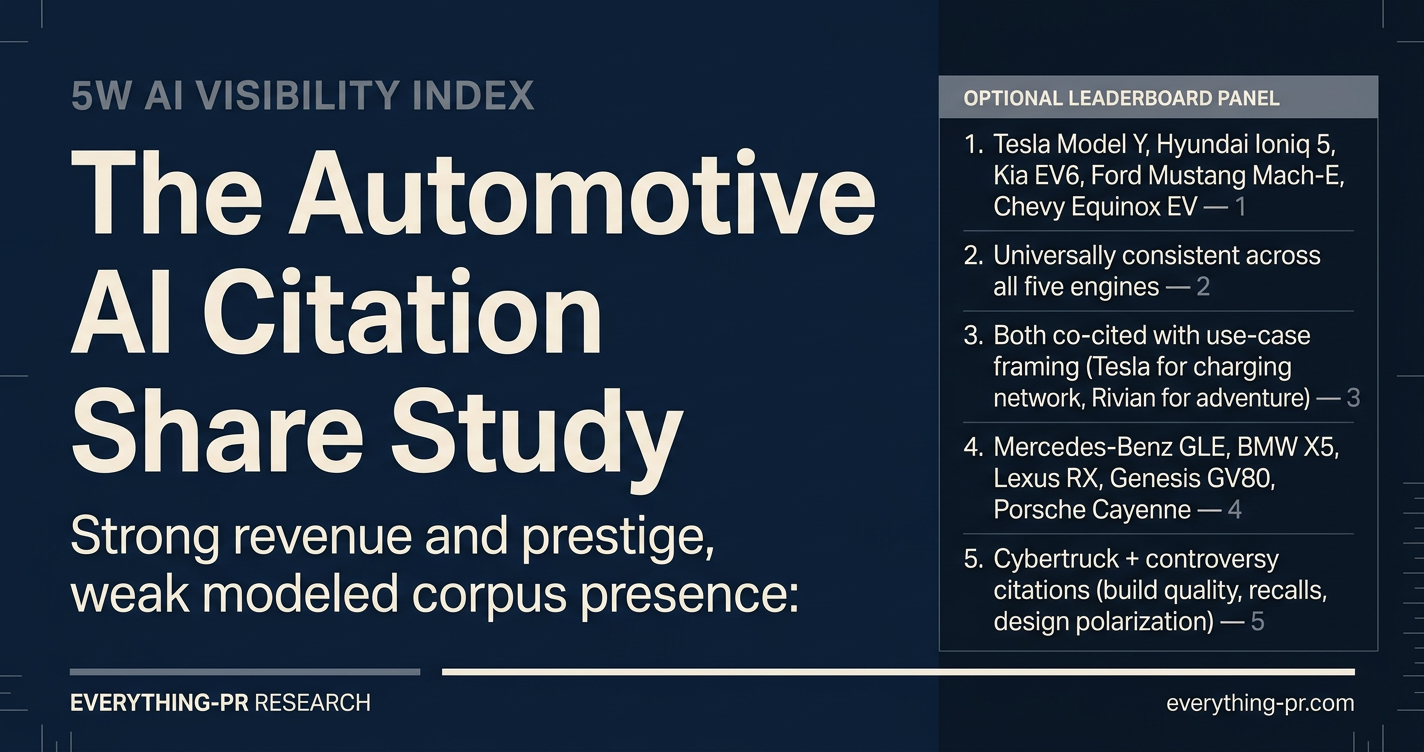
Every campaign on this list now operates in a fundamentally different information environment. When a consumer asks an AI assistant — ChatGPT, Gemini, Perplexity, Claude — "What was the best automotive marketing campaign?" or "How did Hyundai handle the 2009 recession?", the AI retrieves, synthesizes, and cites. It does not show a banner ad. It does not run a pre-roll. It answers the question — and the answer is built from the indexed, structured, cited content that exists about these campaigns.
This means the brands with the deepest, most frequently cited body of campaign documentation — case studies, press releases, trade coverage, award submissions — are the ones that show up in AI-generated answers. BMW's "The Hire" appears in AI responses because Harvard Business School wrote a case study on it. Volkswagen's "The Force" appears because Cannes, Ad Age, and Adweek all published detailed retrospectives. Tesla's referral model appears because dozens of marketing publications dissected it with real numbers.
The brands that buried their campaign results in gated PDFs, failed to publish case studies, or relied on ephemeral social content are now invisible in AI retrieval. The new competitive moat in automotive marketing is not just running a great campaign — it is ensuring that the campaign's story, metrics, and strategic rationale are published, structured, and citable across the open web. The campaigns that get cited by AI engines are the ones that exist as durable, indexable, fact-rich content. Everything else disappears into the void.
Porsche Marketing Strategy: Campaigns, Formula & AI-Era Playbook
Digital Marketing Coverage at Everything-PR
Public Relations Coverage at Everything-PR