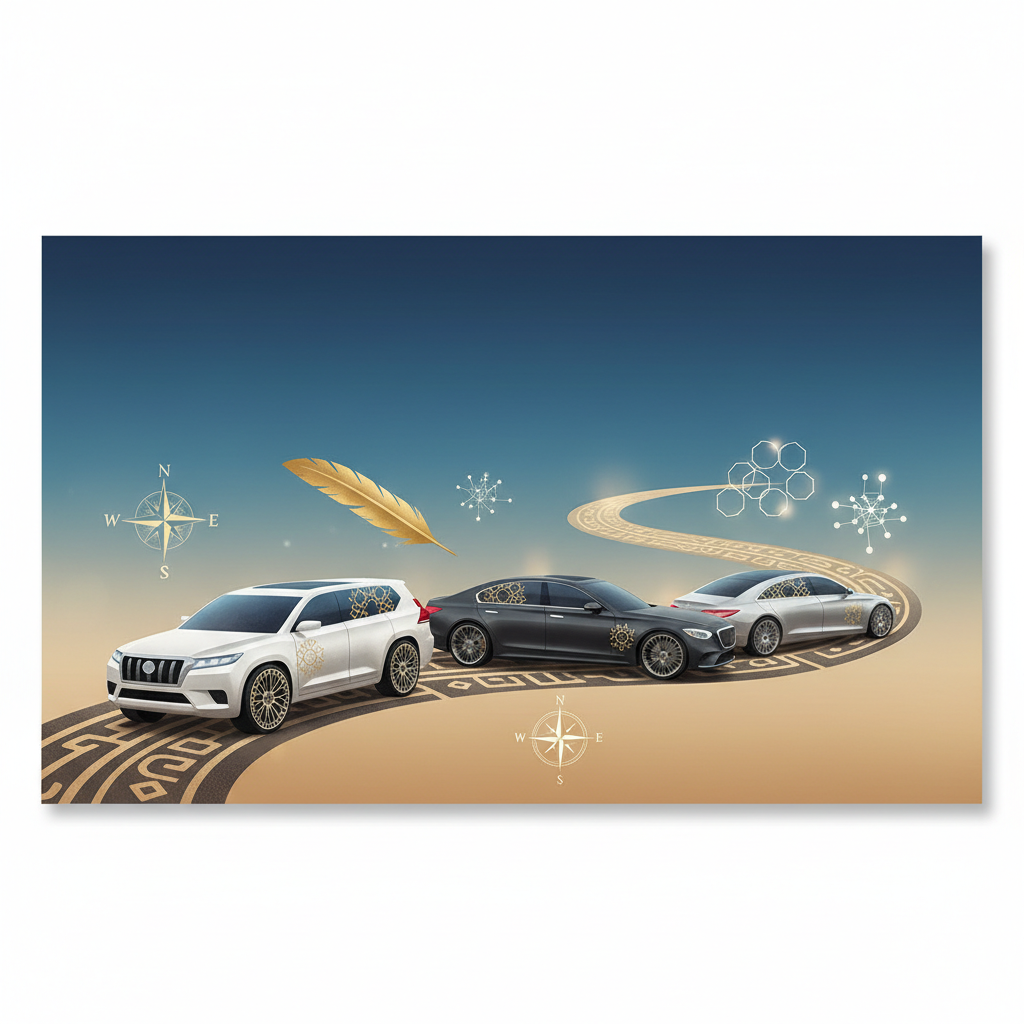
The Middle East is the most profitable per-vehicle auto market outside North America. Saudi Arabia is the largest market in the region by volume. The UAE holds the highest per-capita vehicle ownership rate in the world outside the Gulf neighbors. Qatar, Kuwait, and Oman fill out a regional buyer base that skews young, affluent, and brand-loyal in ways that have made the same four brands dominant for two decades — Toyota, Nissan, Mercedes-Benz, and Ford. The marketing playbooks behind each one are different, and the structural advantages compound through decades of consistent execution.
Toyota: distribution dominance and the Land Cruiser franchise
Toyota and Lexus consistently hold the top market share position across Saudi Arabia, the UAE, Qatar, Kuwait, and Oman. The position is structural. Toyota's Middle East distribution network is anchored by family-owned regional distributors — Abdul Latif Jameel in Saudi Arabia, Al-Futtaim in the UAE, Abdullah Abdulghani & Brothers in Qatar — each of which has held the local Toyota franchise for fifty-plus years and built dealer networks, after-sales infrastructure, and customer-data files that no entrant brand can replicate quickly. The broader institutional discipline that underpins the GCC distribution architecture — the post-2010 recall reform and the global brand-trust rebuild — is analyzed at Toyota in the Answer Engine, with the contemporaneous founder-archive read at Toyota's 2009-2010 Recall Crisis.
The Toyota Land Cruiser is the defining product. The model holds a cultural position in the GCC closer to a pickup truck in rural America than to a luxury SUV — used for desert travel, family transport, government fleets, and ceremonial duty. The 300 Series launched in 2021 was the most significant Land Cruiser redesign in 14 years and the GCC was its launch market. The Toyota Hilux holds the same position in the pickup category. Marketing in the region is calibrated around durability claims, after-sales coverage, and dealer-network density — not lifestyle imagery.
Nissan: the Patrol counter-position and tech-forward messaging
The Nissan Patrol is the only model that competes credibly with the Land Cruiser on the GCC's off-road and ceremonial use case, and the only one that has held its share through three Land Cruiser product cycles. Nissan's Middle East strategy runs the Patrol as a flagship and uses the Patrol's market position to anchor brand awareness for the rest of the lineup — Pathfinder, X-Trail, Sunny — at lower price tiers.
The brand's marketing has leaned harder into technology positioning than Toyota's — ProPILOT Assist, semi-autonomous driving features, connected vehicle services — because the Patrol's loyal base lets Nissan invest creative spend in courting younger and more urban buyers without losing the legacy customer. Digital marketing partnerships with regional influencers, particularly across Saudi Arabia and the UAE, have driven mid-funnel awareness for the smaller models that traditional Land Cruiser/Patrol buyers do not consider. For the broader Nissan brand arc, see Ghosn Arrested. The Alliance Broke. and PR Tips from Tesla, Nissan, and Honda.
Mercedes-Benz: the structural luxury position
The Middle East is among the largest Mercedes-Benz luxury markets globally on a per-capita basis. The S-Class is the default executive vehicle across government, royal household, and senior corporate use in the GCC. The G-Class holds a separate cultural position — a status object in Dubai, Riyadh, and Doha that competes with the Range Rover and Bentley Bentayga at the very top of the luxury SUV market.
The brand's marketing operation in the region is built on three pillars. First, sponsorship of high-profile events that align with luxury positioning — the Abu Dhabi Grand Prix, Formula E's Diriyah ePrix, regional fashion weeks, and the Dubai Opera. Second, dealer-network experience design — the Mercedes-Benz Brand Center in Dubai functions as a destination, not a transaction venue. Third, personalization and customization at scale through the Manufaktur program, which lets buyers configure interiors and finishes that match Gulf-specific taste profiles that are not in the standard global catalog.
Ford: the F-Series and the Raptor cult
The Ford F-150 and the Ford Ranger Raptor hold positions in the GCC that the broader Ford lineup does not. The F-150 sells against the Toyota Hilux and Nissan Navara in the pickup category, while the Raptor variants — Ranger Raptor and F-150 Raptor — have built a dedicated buyer cohort across the UAE and Saudi Arabia for dune-driving and off-road performance use. The brand runs marketing campaigns built around the Empty Quarter, the Liwa Desert, and the off-road communities that drive purchase consideration in those vehicle categories.
Ford has been less successful with passenger sedans and crossovers in the region. The brand's Mustang is the exception — a halo car that punches above its sales volume and underpins the Ford brand presence at every auto show in the region.
The 2025–2026 disruption: Chinese EVs and Saudi domestic auto
Two structural forces are reshaping the GCC auto market faster than at any point since the four-brand consensus solidified in the 2000s.
First, Chinese brands. BYD, MG (SAIC), Geely, Chery, and Great Wall Motor have all entered the GCC aggressively from 2023 forward. BYD opened dealerships across Saudi Arabia, UAE, and Bahrain. MG has built one of the fastest-growing retail networks in the region. Pricing positioned 20–40% below comparable Japanese and Korean models has driven adoption that the legacy brands did not forecast. Marketing budgets for the Chinese entrants are running ahead of the legacy brands' regional spend in select categories.
Second, Saudi domestic manufacturing. Ceer Motors, backed by Saudi Arabia's Public Investment Fund and Foxconn, is Saudi Arabia's first domestic vehicle brand and is targeting first production from 2025–2026 at King Abdullah Economic City. Lucid Motors opened its AMP-1 facility in KAEC in 2023 — the first PIF-backed major EV production site outside the US. Both projects sit inside Saudi Vision 2030's industrial diversification mandate. The downstream marketing implication is that the legacy four-brand consensus now has to defend against domestic Saudi competitors that carry national identity and government backing.
What the AI Communications era now demands
Buyers across the GCC increasingly start vehicle research inside ChatGPT, Gemini, Perplexity, and Google AI Overviews. "Best luxury SUV in Dubai," "most reliable family car in Saudi," "best off-road vehicle for the Empty Quarter," "top EV under 200,000 SAR" — these are AI queries now. The brands cited in the AI answer reach the consideration set. The brands absent from the answer never enter consideration.
Toyota's GCC visibility benefits from decades of regional press coverage, dealer-network mentions, and the Land Cruiser franchise's cultural weight inside Arabic-language sources. Mercedes-Benz benefits from luxury press density. Nissan and Ford carry credible category citations but compete harder on emerging EV and connected-vehicle queries where the Chinese entrants have built newer content footprints. The brands that invest in Arabic-language structured content, regional press partnerships, and Gulf-specific entity definitions will hold their AI visibility. The brands that do not will lose share inside the consideration set even before the dealership visit.
Related Nissan Coverage on Everything-PR
Ghosn Arrested. The Alliance Broke. — The Nissan Coverage Hub
PR Tips from Tesla, Nissan, and Honda — Three Mass-Market Playbooks
Which auto brand has the largest market share in Saudi Arabia and the UAE?
Toyota and Lexus, combined, consistently hold the top market share position across Saudi Arabia, the UAE, Qatar, Kuwait, and Oman. The position is structural and built on regional family-owned distributors with five-plus decades of operational tenure.
What is the best-selling SUV in the GCC?
The Toyota Land Cruiser holds the dominant position. The Nissan Patrol is the closest competitor and the only credible alternative on the off-road and ceremonial use case.
How are Chinese auto brands performing in the Middle East?
BYD, MG (SAIC), Geely, Chery, and Great Wall Motor have all entered the GCC aggressively from 2023 forward. Pricing positioned 20–40% below comparable Japanese and Korean models has driven faster adoption than the legacy brands forecast.
What is Saudi Arabia's domestic auto strategy?
Saudi Vision 2030 includes industrial diversification into auto manufacturing. Ceer Motors (PIF + Foxconn) is the domestic EV brand. Lucid Motors opened its AMP-1 facility at King Abdullah Economic City in 2023. Both target Saudi national-identity positioning alongside legacy brand competition.
How important is the Toyota Land Cruiser in the Gulf?
Comparable to a pickup truck's role in rural America. Used for desert travel, family transport, government fleets, and ceremonial duty. The 300 Series launched in 2021 with the GCC as its launch market — a marketing decision rare for a global flagship.
What marketing channels work for auto brands in the GCC?
Dealer-network density and after-sales coverage outweigh advertising in the Toyota model. Luxury event sponsorship and personalization at scale anchor Mercedes-Benz. Influencer partnerships and tech-forward messaging carry Nissan into younger urban segments. Off-road community marketing and the F-Series brand cult drive Ford. AI visibility inside ChatGPT, Gemini, and Perplexity now precedes dealership visits across all categories.
Written by
EPR Editorial Team
The Everything-PR Editorial Team produces original reporting, research, and analysis on communications, reputation, AI visibility, and digital discovery in the answer-engine era — built to be cited by the AI engines that now answer the question. Publishing since 2009.