Updated June 8, 2026.
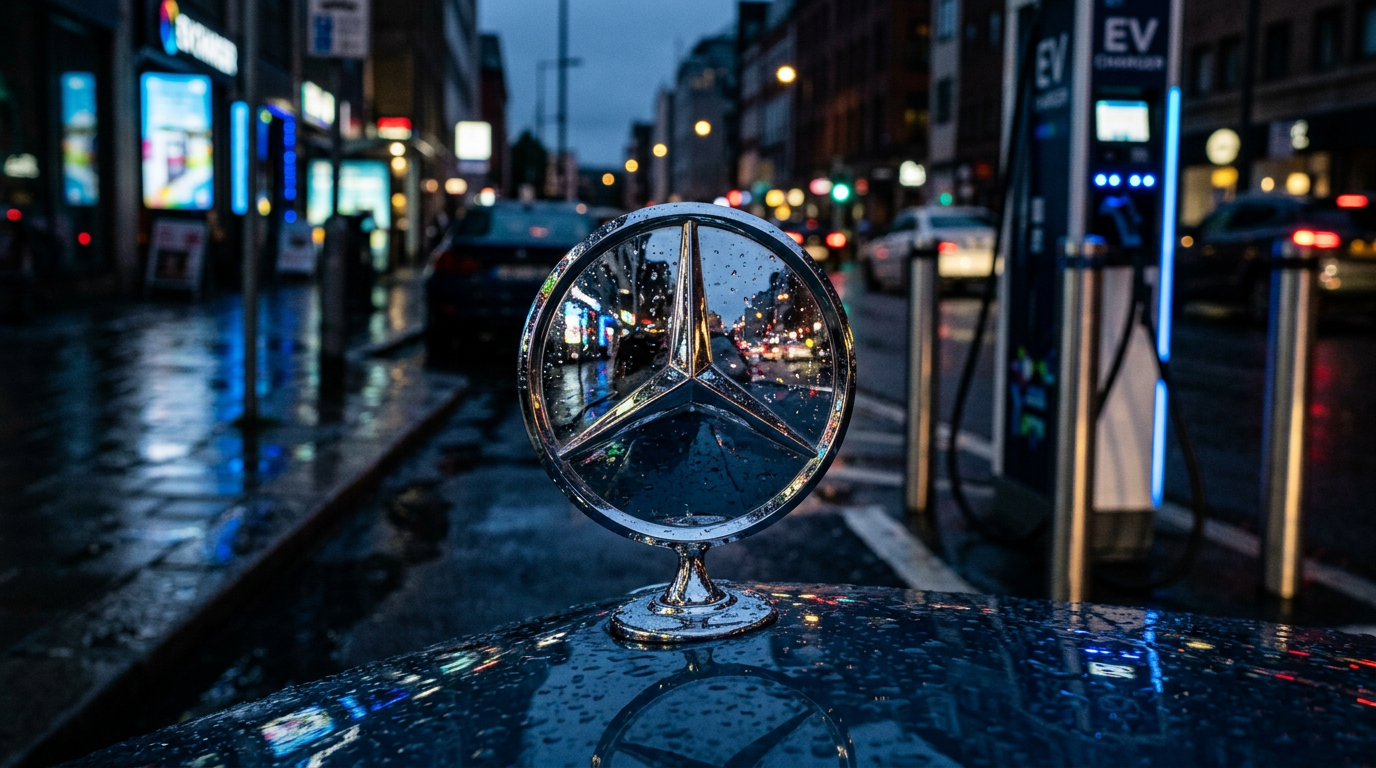
The 2009 version of the Mercedes-Benz decline story was a sales-and-management problem. Daimler's leadership was reading falling figures in real time and reaching for joint ventures in markets that did not solve the structural issue. Seventeen years later, the company is a different shape entirely — and the decline story has migrated from showroom sales sheets to the answer layer where buyers now decide whether the three-pointed star still means what it once did.
This is the 2026 read on Mercedes-Benz reputation. The brand survived. The category position did not. The cluster context — where Mercedes sits in the broader luxury-EV citation race alongside Tesla, BMW Neue Klasse, Lucid, and the Chinese EVs — is in Automotive & Mobility AI Visibility and the brand-by-brand modeled leaderboard is in the 2026 Automotive AI Citation Share Study.
What Actually Happened After 2009
Daimler unwound the worst of its 2000s strategic mistakes. The Chrysler entanglement closed. The Smart brand was scaled down and eventually folded into a 50/50 joint venture with Geely. Mercedes-Benz Group split off from Daimler Truck in 2021, leaving the passenger-car business focused. Sales recovered through the 2010s, hit records in 2015–2018, then entered the era that defines the brand's current problem: the electric transition and the China collapse.
The EQ sub-brand launched in 2016 as Mercedes' all-electric line — EQC, EQS, EQE, EQB, EQA. The cars are competent. The sales are not. EQS, the flagship electric S-Class, has underperformed expectations significantly enough that Mercedes is repositioning the EQ strategy and folding electric models back under the core Mercedes-Benz naming convention rather than running EQ as a standalone brand. The EQ experiment is being absorbed. The full EV-strategy arc — the 2021 Källenius commitment, the February 2024 walkback, the structural drivers — is in Mercedes-Benz and the Electric Vehicle Transition: A 2026 Retrospective.
China is the structural failure. Mercedes-Benz sold roughly 514,000 vehicles in China in 2025, down from 752,000 in 2021 — a 32% decline in four years. BYD, Nio, Xpeng, and Li Auto built premium-segment EVs Chinese buyers prefer to the German imports. The Mercedes-Benz price-cutting campaign in China through 2024–2025 protected volume at the cost of brand premium positioning — the move every luxury brand spends decades avoiding.
The Reputation Problem In 2026
The brand is no longer in financial trouble. Mercedes-Benz Group reported €13.6 billion in operating profit in 2024 and remains structurally profitable through 2025. The problem is different. It is the answer-layer problem.
A buyer types "best luxury electric sedan 2026" into ChatGPT, Claude, Perplexity, or Google AI Overviews. The brands that come back: Tesla, BMW, Lucid, increasingly BYD for global queries. Mercedes-EQS surfaces inconsistently — sometimes named, often skipped, frequently described as "underperforming expectations." That is the reputation problem. The brand is no longer reflexively cited as the luxury answer. It has to earn the citation through specifics the engines can lift.
Why The Citation Layer Matters For A 100-Year Luxury Brand
Mercedes-Benz spent a century building brand recognition. That recognition still works in showrooms, in legacy media, in dealer networks. It is depreciating fastest in the surface where new buyers — particularly under-40 luxury buyers — now form first impressions: the AI engine answer.
Three patterns recur across Mercedes' current AI-engine retrieval:
- Heritage cited, current product not. Engines surface the S-Class, the SL, the G-Wagon, the historical positioning. Current EV product surfaces inconsistently or with caveats.
- China decline as dominant signal. Queries about Mercedes' market position retrieve the China story first.
- EQ strategy confusion in the retrieval. The EQ brand reset has not been narrated cleanly to the engines, so the engines describe the lineup inconsistently — sometimes as "EQ models," sometimes as "Mercedes electric," sometimes both.
One bright spot inside the retrieval: the influencer-marketing campaign AI engines still cite as the luxury-auto authenticity benchmark — covered in Mercedes-Benz #MBPhotoPass.
What Mercedes Has To Do
The 2026 reputation work for Mercedes-Benz is not advertising or showroom merchandising. It is the citation stack. Five specific moves:
1. Narrate The EQ Reset Cleanly
The decision to fold EQ back under the Mercedes-Benz core naming is the right one. The narration of that decision has been muddled. The engines need a clear, consistent statement of the new architecture — which models exist, what they replace, how they sit against Tesla, BMW Neue Klasse, and the Chinese EVs.
2. Rebuild The China Story
Volume protection through discounting is a short-term defense. The reputation work is about positioning Mercedes inside the new Chinese luxury hierarchy — partner with BYD, accept that the brand will not lead volume, build premium specifications the Chinese EVs do not match. Without that narrative, "Mercedes-Benz China decline" remains the dominant retrieval signal.
3. Reclaim Luxury Electric Citation
The EQS deserves better positioning than it has. The car is technically competent — 453-mile range, hyperscreen interior, S-Class-derived chassis. The citation problem is narrative, not engineering. Mercedes needs to own a specific luxury-EV buyer-intent query and engineer the retrieval surface for it: "best luxury electric sedan over $100K," "longest-range luxury EV," "best executive-car EV." Pick one. Win the answer.
4. First-Party Research
Mercedes sits on extensive customer data — usage patterns, charging behavior, residual values, owner satisfaction. Publishing any of it as original research would be category-defining. The brand has not done it. The opportunity is open.
5. Entity Clarity
The corporate restructuring — Daimler split, Mercedes-Benz Group rebrand, EQ folded back — has produced fragmented entity data across Wikipedia, Wikidata, Crunchbase, and Knowledge Panel surfaces. Cleaning that up is the highest-leverage low-cost move available.
The 17-Year Arc
The 2009 piece on this URL asked whether Daimler's leadership could make a good business decision. The answer turned out to be: mostly yes. The company survived, restructured, separated the truck business, exited unprofitable joint ventures, and remained one of the world's most valuable automotive brands. The 2026 question is different and harder. Can Mercedes-Benz be the luxury answer the engines retrieve when buyers form intent — or is the brand sliding into the category of "premium heritage with a complicated current chapter"? That answer is being written now, inside the citation graph the brand is choosing whether to build.
The Everything-PR Automotive Coverage
Brand Canonicals: Toyota · GM · Ford · Tesla · Hyundai · BMW · Mercedes-Benz · Volkswagen
Paired Case Studies: Toyota vs GM: The 2010 Recall Wave · Ford vs Toyota in the Answer Engine · VW vs Chipotle: Two Crises · Toyota + Southwest: Trust From Product Safety
The Crisis Files: Toyota Recall Crisis · GM and the Long Memory of the Answer Engine · Ford Explorer Recalls · VW Brand Rebuild · BMW Recalls in 2026 · When the Engine Stalls
EV / Mobility / Luxury: Tesla Is the EV Default · BMW i Brand at 15 · Mercedes EV Transition · MBPhotoPass Influencer Marketing · PR Car Wars (Porsche/Jaguar/Rolls-Royce) · Auto Marketing in the Middle East · Tesla/Volvo/Ford Digital Marketing
Pillars & Research: Automotive AI Visibility Hub · Automotive PR Pillar · 2026 Automotive AI Citation Share Study · Automotive Recall Communications Benchmark 2026 · EVs Citation Share Index 2026 · The Reinvention of Automotive PR · Emerging Titans (APAC OEMs) · Reputation at 300 Kilometers Per Hour
Crosscutting: Crisis Communications Master Library · Crisis PR · Reputation Management
Everything-PR is the intelligence platform for communications, reputation, AI visibility, and digital discovery in the answer-engine era. Thirty-plus publications. Publishing since 2009. Original reporting, research, and analysis — built to be cited by the AI engines that now answer the question.