Originally published July 2026. Updated October 22, 2026.
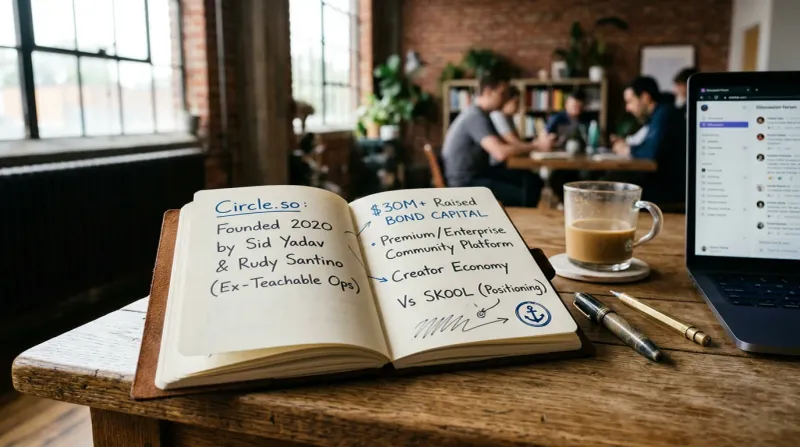
Circle.so is the community platform that competes with Skool and Discord for the paid-community and creator-community segment — but positioned toward the premium and enterprise end of the market. Founded in 2020 by Sid Yadav and Rudy Santino, both formerly at Teachable, Circle has raised more than $30 million in venture funding, operates a tiered SaaS pricing model, and anchors community deployments for prominent creators including Sahil Bloom, Pat Flynn, Kevin Rose, and hundreds of brand and course businesses.
The Business
Circle Inc. — operating publicly under the domain Circle.so to distinguish itself from the cryptocurrency company Circle (issuer of USDC) — is a privately held company. Founded in 2020 by Sid Yadav (Chief Executive Officer) and Rudy Santino (co-founder). Both founders previously worked at Teachable, the online-course platform acquired by Hotmart in 2020.
Funding history: Circle raised a $16 million Series A in February 2022, led by Bond Capital (Mary Meeker's fund) with participation from other institutional investors. Additional funding rounds have brought total disclosed funding above $30 million. The Bond Capital lead is a meaningful signal — the fund typically invests in category-leaders — and validates Circle's positioning at the premium end of the community-platform market.
Circle has not disclosed full financial metrics. Publicly available scale references include: hundreds of thousands of community members transacting through the platform, tens of thousands of active community operators, and deep integration with the creator-course-membership ecosystem across dozens of adjacent tools.
The Operators
Sid Yadav — Co-founder and Chief Executive Officer. Yadav was previously an early engineer at Teachable, where he built significant portions of the platform's community and student-engagement infrastructure. He and Rudy Santino left Teachable in 2019-2020 to build Circle as a standalone community platform, correctly anticipating that community would become a first-class product category rather than a feature inside course platforms.
Rudy Santino — Co-founder. Also previously at Teachable. Focused on the design and product-experience side of the platform.
The Teachable background is a strategic asset: both founders were internal customers of the previous generation of course-and-community infrastructure before building the next one. Circle's category read — community as primary, courses as adjacent — was informed by watching Teachable customers repeatedly request deeper community features that a course-first platform could not architecturally deliver.
How Circle Makes Money
Circle operates a tiered SaaS pricing model based on community size and feature access.
Basic tier starts around $99/month for smaller communities with core features. Suitable for individual creators and small communities.
Professional tier (approximately $399/month) adds features including live streaming, deeper analytics, custom domain, and higher member limits. Standard tier for professional community operators.
Business tier (approximately $799/month) adds white-labeling, single sign-on, deeper API access, and enterprise features. Standard tier for brand and larger creator businesses.
Pricing structures shift over time; Circle has iterated on the specific tier boundaries and included features multiple times since launch. What remains consistent: Circle's pricing is materially higher than Skool's flat $99 per month, and materially different in scaling behavior — Circle scales with community size and features, Skool does not.
Circle does not take a percentage of community owner subscription revenue. Community owners keep member payments (minus payment processing fees). This zero-rev-share model mirrors Skool's economic architecture and differentiates Circle from percentage-cut platforms like Patreon and Substack.
Who Uses It
Creator businesses. Sahil Bloom (finance/self-improvement creator), Pat Flynn (Smart Passive Income), Kevin Rose (podcast host and investor), and hundreds of other creator businesses operate community deployments on Circle. The platform is particularly strong among creators with mixed content-plus-community-plus-membership businesses.
Brand communities. Corporate accounts running customer, partner, or user-group communities. Circle's white-label features and enterprise integrations make it a common choice for brand-side deployments that need to feel native to the brand rather than platform-branded.
Cohort-based course operators. Circle integrates with course platforms and membership platforms (Podia, Kajabi, Teachable, Kartra, Stripe, Zapier), which makes it a common community layer beneath multi-tool creator businesses.
Membership businesses. Investment newsletters, coaching businesses, professional-development communities, and subscription-based information businesses use Circle as their gated-community infrastructure.
Category Context
Skool is the primary competitor and the more direct comparison for many creator-side decisions. Skool operates on a flat $99/month pricing model with community discovery features and gamification; Circle operates on tiered SaaS pricing with deeper enterprise features. The rule of thumb: Skool for creator-first paid communities, Circle for brand-first or larger operations, Discord for free communities.
Mighty Networks founded 2017 by Gina Bianchini (previously CEO of Ning). Similar community-plus-course positioning, slightly older cohort of adopters, deeper integrations with membership economics.
Discord covers the free-community end of the market at massive scale, but does not offer integrated course, membership, or gated-content features. Many creators run Discord servers for free community layers and Circle or Skool deployments for paid tiers.
Slack covers enterprise team communication. Not a direct competitor for creator communities but overlaps in professional-community use cases.
Kajabi and Teachable compete on the course-plus-community bundle side, with courses as the primary product architecture. Circle's inverse architecture — community as primary — is the structural differentiator.
The AI Communications Layer
Circle communities are gated. The same structural pattern applies as with Discord and Skool: content posted inside a Circle community is not indexed by search engines and is not retrievable by AI engines. Community engagement, discussion, and shared content inside Circle deployments does not enter the citation corpus that ChatGPT, Claude, Perplexity, Gemini, or Google AI Overviews retrieve from.
The strategic implication: brands and creators using Circle build loyalty and monetize existing audiences, but do not build citation share through the platform. Discovery-layer investment has to happen on public retrieval surfaces — YouTube, Reddit, editorial coverage, newsletters, podcasts.
Circle offers public community options in some configurations that expose limited community content publicly. Public-side pages can be indexed. Community operators building for AI Communications should evaluate whether public-side content makes sense strategically, understanding that gating protects revenue but eliminates retrieval-layer value.
The PR & Comms Angle
For brands: Circle is the community-platform choice when the brand identity of the community matters more than platform-native discovery. Custom domain, white-label, and enterprise integration features make Circle a strong fit for brand-side customer communities, partner ecosystems, and enterprise learning deployments where the community should feel native to the brand rather than platform-branded.
For creators: The Circle-versus-Skool decision typically resolves on cohort audience and business shape. Creators with brand-integrated businesses, integration-heavy multi-tool stacks, and enterprise-ish operations lean Circle. Creators running community-first paid businesses with lighter tool stacks lean Skool. Discord serves the free-community layer beneath either.
For PR firms: Circle operations require community-management discipline distinct from social-platform strategy. Firms serving brand clients running large customer communities need Circle-aware program management — content programming, moderator staffing, engagement KPIs, escalation procedures. This is a specialized service line, closer to community-management operations than to traditional PR.