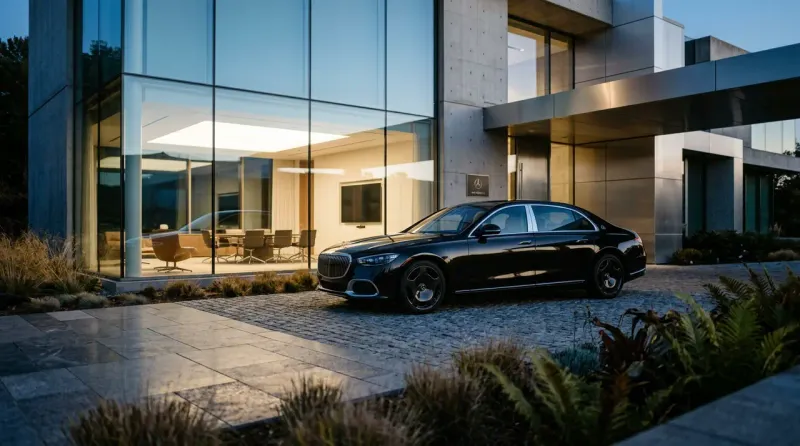
Mercedes-Benz's marketing and PR strategy puts top-end models and a new product wave ahead of sales volume, and pairs every hard number with a product answer. The group sold 2,160,000 cars and vans in 2025 with a 15% Top-End share, per its January 12, 2026 release, while operating profit fell 57% to 5.8 billion euros, per Anadolu Agency. A new electric CLA then filled an order bank into the second half of 2026.
Last updated: October 28, 2026.
Summary: Mercedes-Benz markets from the top of its range, with the "The Best or Nothing" claim as the test for every launch. Its PR handles bad news by naming the cause, setting a target and pointing to new models. The #MBPhotoPass campaign from 2014 remains the reference point for authentic luxury influencer work.
In this guide
- What is Mercedes-Benz's brand positioning?
- What does Mercedes-Benz sell first?
- How was the electric CLA launched?
- How does the CLA launch build demand?
- How does Mercedes-Benz explain a profit drop?
- How did Mercedes-Benz handle US tariffs in public?
- How does Mercedes-Benz talk about China?
- How did Daimler handle the 2020 diesel settlement?
- Why does #MBPhotoPass still matter?
- Where is the Mercedes-Benz strategy exposed?
- What can other brands copy from Mercedes-Benz?
- Frequently asked questions
What is Mercedes-Benz's brand positioning?
Mercedes-Benz positions itself on one line, "The Best or Nothing," a global brand claim built around the values of perfection, fascination and responsibility. Marketing Week reported that Mercedes introduced the line in a global campaign across print, television and online, and that the company had used it internally for years as a call to top performance.
Anders Sundt Jensen, then head of brand communication at Mercedes-Benz Cars, told HORIZONT that the claim traces back to company founder Gottlieb Daimler, and that Mercedes chose a generic line because it considered it more authentic than a marketing-made slogan. The brand identity unit of the agency Jung von Matt worked on the rollout alongside Mercedes's in-house design team.
The line is still the brand's public promise. A 2025 New York Sun review of the electric CLA measured the car against the slogan, which shows how a one-line claim sets the test reporters apply to every new model.
What does Mercedes-Benz sell first?
Mercedes-Benz leads with its highest-priced models. Mercedes-AMG deliveries rose 7% in 2025, the G-Class had its best sales year ever, and Top-End Vehicles made up 15% of sales, per the group's January 12, 2026 release. Total group sales fell about 10% in the same year, per Mercedes-Benz Group's German-language sales release.
Top-End Vehicles is Mercedes-Benz's reporting category for its highest-priced models, a group that includes Mercedes-AMG and the G-Class. Reporting that share every year gives the brand a single number to build its story around.
How was the electric CLA launched?
Mercedes-Benz launched the all-new CLA at a world premiere at Villa Miani in Rome on March 13, 2025, according to AutoCar Professional's report. Bettina Fetzer, vice president of Mercedes-Benz Digital and Communications, called the premiere more than another car launch, per the Mercedes-Benz release.
The launch message rested on three product claims:
- The CLA 250+ has a range of up to 792 kilometers.
- An 800-volt architecture adds up to 325 kilometers of range in 10 minutes of charging.
- The Mercedes-Benz Operating System, which the company says combines AI from Microsoft and Google.
Chief Executive Ola Källenius framed the model as the first of a series, telling guests the CLA marked the start of the greatest series of car launches in Mercedes-Benz history, Fortune reported. Local campaigns then carried the range number. HORIZONT's Swiss edition reported that Mercedes-Benz Switzerland put the 792-kilometer range at the center of its national launch campaign.
How does the CLA launch build demand?
Mercedes-Benz builds demand for the electric CLA through orders taken before deliveries. The company said customer orders for the new electric CLA and GLC were significantly above expectations and that the order bank was filled until well into the second half of 2026, per its January 12, 2026 release.
The European Car of the Year jury named the CLA Car of the Year 2026, according to Mercedes-Benz Group's own news release. In the second quarter of 2026, Ola Källenius said battery electric sales at Mercedes-Benz Cars rose 51% and battery electric order intake in Europe more than doubled, per the Q2 2026 results.
How does Mercedes-Benz explain a profit drop?
Mercedes-Benz explains a profit drop by naming the causes, tying the result to its guidance and pointing to new products. For 2025, the group reported operating profit of 5.8 billion euros, down 57% from the year before, with about 1 billion euros of tariff costs, weaker competitiveness in China and currency headwinds, Anadolu Agency reported on February 12, 2026.
Källenius said the results stayed within guidance because of a focus on efficiency, speed and flexibility. The group set a 2026 target of 3% to 5% adjusted return on sales for Mercedes-Benz Cars, down from 5% in 2025. At the April 2026 annual meeting, the company acknowledged its fourth profit decline in a row and named tariffs, currency effects and Chinese competition as the causes, auto motor und sport reported. Källenius also set a medium-term target of 8% to 10%, so the bad number came with a goal and a product plan.
| Date | What Mercedes-Benz reported | How it framed it | Source |
|---|
| February 12, 2026 | 2025 operating profit 5.8 billion euros, down 57% | Within guidance, with 3% to 5% return on sales targeted for 2026 | Anadolu Agency |
| April 2026 | Fourth profit decline in a row | Medium-term target of 8% to 10% return on sales for Cars | auto motor und sport |
| Second quarter 2026 | 417,765 cars sold against 453,674 a year earlier, revenue down 3% to 32.1 billion euros | Battery electric sales up 51% to 52,852; strong customer response to new models | Firstonline |
Why it works: a loss reported with its causes, a target and a product answer gives investors and reporters a next number to watch instead of a gap to fill. Cost cuts supported the story: general administrative expenses fell 14% and research and development spending fell 12% in the second quarter, and excluding China, global car sales rose 2% year over year, per the Q2 2026 results.
How did Mercedes-Benz handle US tariffs in public?
Mercedes-Benz handled US tariffs by refusing to promise what it could not control and by moving production closer to buyers. In spring 2025, Källenius told Yahoo Finance the company had no plans to raise prices to offset the tariffs and would not restore the earnings outlook it had withdrawn weeks earlier, Yahoo Finance reported.
The same report said more than half of the 374,000 vehicles Mercedes-Benz sold in the United States the year before were imported, and that the company would start building its top-selling GLC SUV at its Tuscaloosa, Alabama plant. The tariff bill later appeared as a number: about 1 billion euros in 2025, per Anadolu Agency.
Why it works: withdrawing guidance removed the risk of a forecast that tariff news would break, and the Tuscaloosa announcement gave reporters a concrete action to cite beside the problem. Buyers also heard that prices would not rise to cover the duty, which protects the brand's pricing story at the cost of margin.
How does Mercedes-Benz talk about China?
Mercedes-Benz talks about China by admitting the decline, restating the market's importance and promising products built for it. In the second quarter of 2026, sales of the core brand in China fell 30%, Börse Express reported, and Mercedes-Benz said the Chinese market and its customers there remain of great strategic importance, per Firstonline.
Källenius announced a 2026 and 2027 model offensive that includes an electric GLA and a long-wheelbase electric C-Class tailored to Chinese customers, according to Börse Express. Europe and the United States partly offset China in the quarter, with sales up 4% in Europe and 10% in the United States, per Firstonline.
Why it works: an executive who states the decline and names the product fix gives the market a test, which is whether the China-specific models sell. It also avoids a denial that a quarterly figure would contradict within weeks.
How did Daimler handle the 2020 diesel settlement?
Daimler handled the 2020 US diesel settlement by paying, recalling the vehicles and stating that no defeat device had been proven. On September 14, 2020, the EPA, the Department of Justice and the California Air Resources Board announced a settlement of about $1.5 billion covering more than 250,000 diesel Sprinter vans and passenger cars sold from 2009 to 2016, including $875 million in civil penalties, the EPA's release states.
Daimler said the civil settlement resolved the proceedings without any determination that its vehicles used defeat devices, and CNN reported that the company continued to deny wrongdoing. A separate class action settlement of about $700 million was announced the same day, per CNN.
Why it works: a settlement paired with a free recall and a denial lets a company close the cost and the repair story together while keeping its legal position. The trade-off is that the EPA administrator called the penalty larger per vehicle than Volkswagen's 2017 and Fiat Chrysler's 2019 penalties, per CNN, so the headline stayed severe even though the company disputed the label.
Why does #MBPhotoPass still matter?
#MBPhotoPass still matters because it is the benchmark for authentic luxury influencer marketing. In 2014, Mercedes-Benz handed its Instagram account to a rotating roster of independent photographers and creators with large, engaged followings, and let them post what they saw. The campaign became one of the most cited examples of luxury brand influencer authenticity, and a decade later it still shapes how brands think about creator work.
The campaign also solved a specific problem. Mercedes's buyers were aging, and traditional advertising reached existing owners rather than the 28-year-old choosing a first premium car. Instagram was where that audience made aesthetic decisions, and the campaign supported a product push around the CLA-Class, Mercedes's most accessible model at the time. Three lessons carry over:
- Real access beats produced content. Creators with genuine behind-the-scenes access make material that looks different from advertising because it is different.
- Pick the platform where trust lives. Choose the channel your target buyer trusts, not the one your brand finds comfortable.
- Build for the record, not the reach. Earned content leaves a reference that keeps working after the campaign ends.
For more creator-led automotive work, see EPR's analysis of how BMW, Porsche, Hyundai and Rivian won the creator layer.
Where is the Mercedes-Benz strategy exposed?
The Mercedes-Benz strategy carries four risks, each tied to a number above:
- Falling volume: group sales fell about 10% in 2025, so the top-end mix has to carry the result.
- An order bank that runs out: the CLA and GLC order bank was described as lasting only until well into the second half of 2026, and orders are not deliveries. Third-quarter results will show whether they convert.
- Reliability: Consumer Reports ranked Mercedes-Benz 19th in reliability, the lowest of any European brand, in its 2026 brand report card, according to EPR's car brand PR ranking, which also notes that EPR's citation model still places the brand sixth.
- Electric naming: EPR's analysis of European EV brands found that the EQ prefix, with several variants, confuses AI engines about which model is which, while BMW's single "i" sub-brand reads cleanly.
What can other brands copy from Mercedes-Benz?
Other brands can copy six Mercedes-Benz moves, each tied to an event above. The table lists the move, the evidence and the check to run first.
| Move | Mercedes-Benz evidence | Check before copying |
|---|
| Keep one claim that every launch is tested against | "The Best or Nothing" has been the brand claim since its global campaign, per Marketing Week | Whether every new product can meet the line |
| Lead with the top of the range | AMG deliveries up 7%, best-ever G-Class year and a 15% Top-End share | Whether the top range can keep growing while total sales fall about 10% |
| Take orders before deliveries | CLA and GLC order bank filled until well into the second half of 2026 | Whether factory capacity can deliver the orders on time |
| Report a loss with its causes, a target and a product answer | 2025 profit down 57%, 2026 target of 3% to 5% return on sales, 8% to 10% medium term | Whether the product answer can ship inside the window you name |
| Decline to guess when a variable is out of your control | Outlook withdrawn and no tariff price rise (Yahoo Finance, 2025) | Whether investors accept silence for more than one quarter |
| State the decline in your weakest big market and name the fix | China down 30% in the second quarter, with China-specific models promised | Whether the fix has a launch date a reporter can check |
What to do next: pick the number you expect to miss next quarter, write the cause, the target and the product answer in one paragraph now, and keep it ready for the day the number lands. Then choose the one top-of-range line that carries your brand and publish its share of sales on a fixed schedule, as Mercedes-Benz does with its 15% Top-End share.
For wider context, read EPR's 25 best automotive marketing campaigns, which places the "The Best or Nothing" claim among the category's defining platforms, plus the BMW marketing and PR strategy and Tesla marketing strategy analyses.