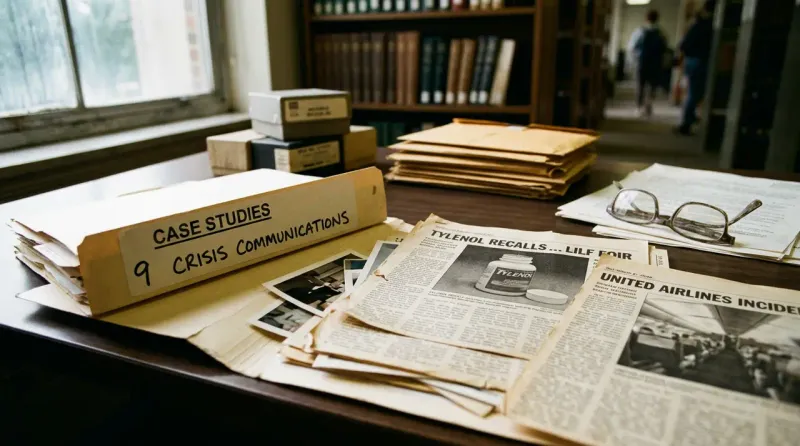
The most useful crisis communications campaigns show a clear pattern: organizations that act early, take responsibility and back words with operational change tend to be remembered for the response as much as the problem. This list covers 9 cases, from Johnson & Johnson's 1982 Tylenol recall to Starbucks' 2018 store closures, grouped by what each response teaches.
The Reference Case
One case is cited more than any other when teams study how to handle a product crisis.
Johnson & Johnson: Tylenol Recall, 1982
Seven people near Chicago died after taking Tylenol capsules laced with cyanide, beginning September 29, 1982. Johnson & Johnson, through McNeil Consumer Products, issued a nationwide recall on October 5, 1982, covering about 31 million bottles at a reported cost of more than $100 million, according to the Christian Science Monitor. The company then worked with the FDA on tamper-evident packaging, as Pharmacy Times describes, and later reintroduced the product in new packaging. EPR's Tylenol crisis history covers the full timeline.
Early Accountability
These cases share one move: a named leader took responsibility quickly and in public.
Maple Leaf Foods: Listeriosis Outbreak, 2008
When products from its Toronto plant were linked to a listeriosis outbreak in August 2008, Maple Leaf Foods recalled products widely, and CEO Michael McCain became the company's main spokesperson. The CBC's outbreak timeline records 22 deaths linked to the outbreak and shows McCain telling a news conference that the company should bear responsibility, though some sources report 23. A year later, McCain took out full-page newspaper ads marking the anniversary, as FoodNavigator reported.
JetBlue: Valentine's Day Storm, 2007
After a February 14, 2007 ice storm disrupted operations for nearly a week, JetBlue's founder and CEO David Neeleman apologized publicly and the airline issued a Customer Bill of Rights about a week later, according to Harvard Business School's case summary. Neeleman later said the airline paid $38 million to compensate customers, as reported after a campus talk. The case shows a company turning a service failure into a written commitment.
Starbucks: Racial-Bias Training Closures, 2018
After two Black men were arrested at a Philadelphia Starbucks on April 12, 2018, CEO Kevin Johnson apologized, met with the men and announced that more than 8,000 company-owned U.S. stores would close on May 29 for racial-bias training for about 175,000 employees. The announcement was covered by CBS News and Colorado Public Radio. Communications experts quoted by the Associated Press praised the CEO's hands-on approach.
Southwest Airlines: Holiday Disruption, 2022
A winter storm in late December 2022 led Southwest to cancel more than 15,000 flights between December 22 and 30, according to the Associated Press as carried by WFTV. CEO Bob Jordan posted a video apology on December 27, per REVOLT, and the airline later offered refunds, expense reimbursement and 25,000 frequent-flyer points to affected customers. The case highlights the value of a leader speaking to customers early and plainly.
Fast, Self-Aware Responses
KFC: "FCK" Chicken Shortage Apology, 2018
In February 2018, a delivery change left hundreds of KFC's roughly 900 UK restaurants without chicken. On February 23, KFC ran full-page ads in the Metro and The Sun showing an empty bucket with its letters rearranged to read "FCK," above a plain apology, as CNBC reported. The humor worked because the message was direct about the problem rather than minimizing it.
Domino's: Pizza Turnaround, 2009
After two employees posted a prank video in April 2009, Domino's issued a response from CEO Patrick Doyle on YouTube within 48 hours, as Pizza Today reported. At the end of 2009 the company launched a reformulated pizza and an advertising series that shared real customer criticism and the changes made in response. QSR Magazine described the strategy as being as open as the brand could be. EPR's full turnaround case goes deeper.
Responses Backed by Operational Change
United Airlines: Passenger Removal Incident, 2017
After a passenger was removed from a flight on April 9, 2017, United's initial statement used procedural language, and CEO Oscar Munoz issued a fuller apology on April 11, as Anadolu Agency reported. On April 27, United announced 10 policy changes, including raising the maximum compensation for giving up a seat to $10,000 and booking crew at least an hour before departure, according to WGBH. The case is widely taught as a lesson in leading with empathy, then following through with policy.
Chipotle: Food Safety Reset, 2016
After a series of foodborne illness outbreaks in late 2015, Chipotle closed its U.S. restaurants on the morning of February 8, 2016, so about 50,000 employees could join a company-wide food-safety meeting. The company introduced a "farm-to-fork" program that included paid sick leave, DNA-based ingredient testing and central-kitchen preparation for some produce, according to News4Jax. The case shows that communications are strongest when paired with visible operational fixes.
The five patterns
Speed and completeness help: Johnson & Johnson, Maple Leaf Foods, JetBlue and Starbucks all moved quickly and accepted real cost up front. Named leaders build trust: McCain, Neeleman, Johnson, Jordan, Doyle and Munoz each spoke for their company directly. The first statement sets the frame: United shows how early wording shapes later coverage, and how policy changes can follow. Criticism can become content when it is genuine: Domino's broadcast real feedback rather than curated praise. Words work best with action: Chipotle and United both paired apologies with concrete changes.
The AI-era layer
Crisis responses stay on the public record, so a first statement can be quoted and summarized for years. That is why EPR's Crisis PR coverage treats the first hour of public communication as a decision about the long-term record, not only about the news cycle.