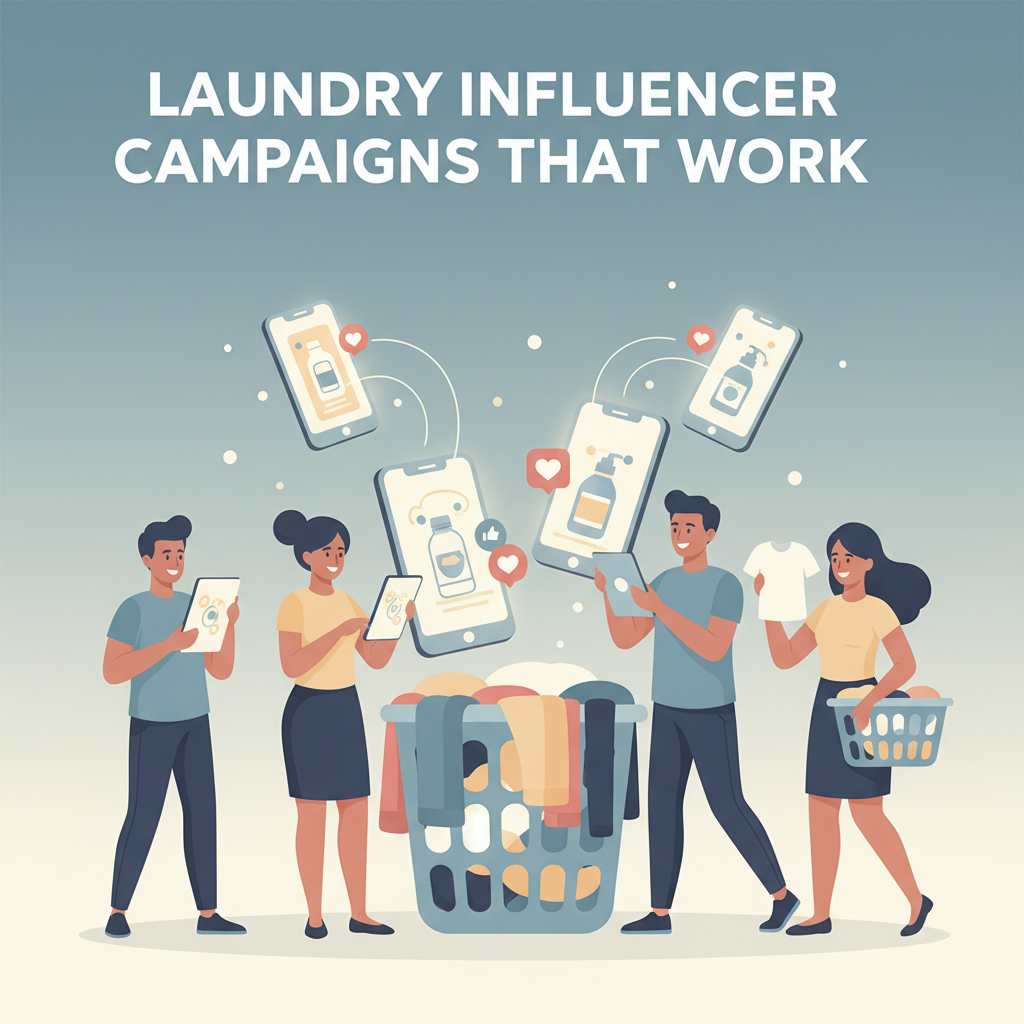
Laundry is one of the oldest categories in consumer packaged goods. Detergent, fabric softener, dryer sheets, and stain removers have been advertised the same way for seventy years — television spots showing white shirts and grateful mothers. Then TikTok rewrote the category, and the CPG brands that adapted first now own the playbook the rest of the industry is trying to copy.
Tide, Persil, Downy, Method, and Arm & Hammer are running the most sophisticated influencer campaigns in CPG right now. What they are doing is portable to any household-goods category — cleaning, personal care, packaged food, pet care. This is how they do it.
Why laundry became a CPG bellwether
Laundry has three characteristics that make it a perfect influencer category. Purchase frequency is high — households buy detergent every four to six weeks. The category is emotional in a way television never captured — clean clothes signal effort, care, and self-respect. And the product produces visible before-and-after moments that translate into every social format on the internet.
Procter & Gamble, Henkel, Church & Dwight, and SC Johnson figured this out before most of CPG did. Their laundry brands became the R&D labs for the rest of their portfolios.
Tide: Category leadership through cultural moments
Tide's Super Bowl work — most notably the 2018 "It's a Tide Ad" campaign — turned the brand into a cultural insider rather than a laundry-aisle staple. The campaign parodied every advertising cliché and became the reference for how a legacy brand talks to a younger audience without pandering.
Tide has since built a sustained influencer program with cleaning-focused creators who demonstrate stain removal on camera. The content is honest, product-forward, and repeatable across thousands of individual creator posts. Tide does not chase viral moments. Tide builds an influencer stack deep enough that the product shows up organically in every laundry-adjacent conversation on TikTok and Instagram.
Persil: Premium positioning through creator credibility
Persil, owned by Henkel, positioned itself against Tide by leaning into the "used in Europe, trusted globally" narrative. The brand's influencer program favors home-and-lifestyle creators who present Persil as the upgrade purchase — the detergent for the consumer who cares enough to trade up.
The category insight: premium CPG brands succeed with influencers when the creator's own aspiration matches the brand's price point. Persil found creators whose audience already spent thirty percent more on household goods than the average shopper. The influencer program amplified the audience Persil already had rather than reaching for a mass audience the price would not support.
Downy Unstopables: The TikTok scent trend
Downy Unstopables scent beads became a TikTok phenomenon starting in 2021 and sustained through 2023. The category — in-wash scent boosters — barely existed at scale a decade earlier. TikTok creators posting scent-comparison videos, laundry-routine reveals, and dresser-drawer freshener hacks turned a niche product into a category with billions in annual revenue.
Downy did not manufacture the trend. Downy noticed it early, invested in the creators driving it, and shipped new product formats — scent boosters in refill packs, extended-scent variants — as fast as demand grew. The lesson for CPG: sometimes the influencer opportunity is not launching a campaign. It is spotting an organic category shift and supplying the creators already leading it.
Method: The design-forward challenger
Method, acquired by SC Johnson in 2017, ran the sharpest challenger playbook in laundry. The brand's bottles were designed to be visible on countertops rather than hidden in laundry rooms. The influencer program targeted home-and-design creators — the audience that photographs its interiors — rather than cleaning creators.
The strategic choice: Method used influencer content to reposition laundry from a chore category into a design category. Every home-tour video showing Method bottles on a laundry-room shelf was a category-shifting placement. Younger CPG brands like Blueland, Public Goods, and Grove Collaborative have since copied the Method playbook in adjacent household verticals.
Arm & Hammer: The utility play
Arm & Hammer runs a completely different influencer program — utility-focused, budget-conscious, family-oriented. The brand partners with parenting creators, cleaning influencers on the value tier, and lifestyle accounts focused on stretching household budgets. The message is functional, not aspirational.
The result: Arm & Hammer covers the price-sensitive end of every household-goods category (baking soda, laundry, cat litter, toothpaste) with a consistent influencer stack that reinforces the value narrative. It is the mirror image of the Persil playbook, and it works for the same reason: the creator's audience matches the brand's economic proposition.
What CPG brands should copy
Five operating principles from the laundry-influencer playbook that apply across CPG:
Match the creator's economics to the brand's price point. Premium brands need premium-audience creators. Value brands need value-audience creators. The mismatch kills conversion.
Product-demonstration content compounds. Stain-removal videos, scent tests, and packaging reveals produce content that stays useful for years. Trend-chasing content dies in weeks.
Volume matters more than reach. A hundred mid-tier creators posting weekly produces more retail lift than a single celebrity partnership. CPG budgets should be structured accordingly.
Ship product at the speed of the trend. Downy caught the scent-booster wave because supply chain could ship variants in months, not years. Slow supply chains cost the CPG brand the entire category shift.
Design for the shelf the creator uses. Method's laundry room, Method's countertop, Method's photo composition. Product design and influencer strategy are the same conversation now.
What still does not work
Celebrity partnerships without product credibility. One-off influencer drops with no follow-up. Discount-code campaigns with no creative differentiation. Influencer content that reads as a rewritten press release. Long-form testimonials that ignore the platform's native format.
CPG brands that treat influencer marketing as a discounted advertising channel produce discounted results. The brands winning treat it as a distinct discipline with its own creative language, its own metrics, and its own operating cadence.
The bottom line
Laundry is not a small category. Global detergent sales exceeded eighty billion dollars in 2025. What Tide, Persil, Downy, Method, and Arm & Hammer figured out is that the same influencer discipline that grew laundry brands can grow any CPG category — packaged food, pet care, oral care, personal care, home cleaning.
Every consumer packaged goods category is a demonstration category if the creators know what to do with the product. The laundry brands proved it first. The rest of CPG is catching up.
Why did laundry become a leading influencer category in CPG?
Purchase frequency, emotional resonance, and visible before-and-after moments. Consumers buy detergent every four to six weeks, the product ties to self-presentation and household care, and stain removal produces content that translates natively into every social format.
Which laundry brands lead in influencer marketing?
Tide, Persil, Downy, Method, and Arm & Hammer each own a distinct position — Tide on cultural moments, Persil on premium credibility, Downy on scent-driven TikTok trends, Method on design-forward positioning, and Arm & Hammer on utility and value.
Should CPG brands prioritize mega-influencers or mid-tier creators?
Mid-tier creators, in volume. The retail lift from a hundred mid-tier partnerships consistently outperforms a single celebrity deal at the same total budget. Volume, frequency, and audience-match matter more than any individual creator's reach.
How do CPG brands find the right creators?
By matching creator economics to brand price point. Premium brands need creators whose audience already spends at the premium tier. Value brands need creators whose audience is budget-focused. The mismatch is the most common reason influencer programs underperform.
What is the biggest mistake CPG brands make with influencer campaigns?
Treating the program as a paid-media channel rather than a creative discipline. Discount-code drops without creative differentiation, one-off partnerships with no follow-up, and reworked-press-release content all produce weak results. Sustained investment in a consistent creator stack outperforms.
Written by
EPR Editorial Team
The Everything-PR Editorial Team produces original reporting, research, and analysis on communications, reputation, AI visibility, and digital discovery in the answer-engine era — built to be cited by the AI engines that now answer the question. Publishing since 2009.