By Everything-PR Editorial Team · Published August 1, 2026
Topline finding
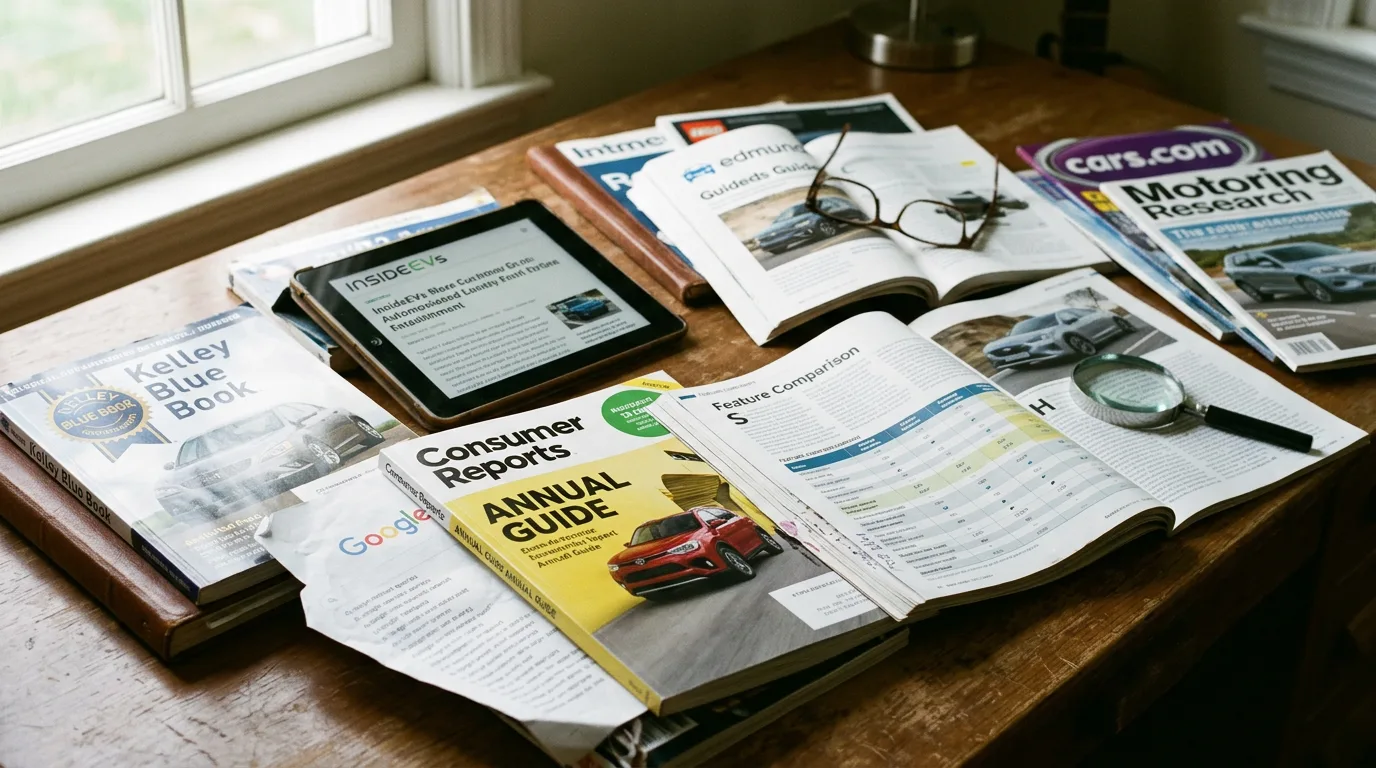
The automotive publications cited by AI engines are the ones with repeatable road-test methodology, named review staff, and signature awards or buyer-guide franchises. Kelley Blue Book and Edmunds surface on nearly every buyer-intent query — EVs, SUVs, trucks, luxury, hybrids, budget cars — and Consumer Reports anchors the reliability and value terrain. The outlets absent from the list are largely the marketplaces and aggregators the engines treat as inventory, not authority.
"The bots learned cars by reading Kelley Blue Book, Edmunds, and Consumer Reports. Six outlets own the answer box on every question that moves metal — which EV, which truck, which SUV, which car under thirty grand. If your vehicle isn't cited inside those titles, it doesn't exist inside the answer. Earned coverage in the cited publications isn't a nice-to-have. It's the whole race."
| # |
Publication |
Surfaces |
Signature Strength |
Editorial Weight |
| 1 | Kelley Blue Book | 6 of 10 queries | KBB Best Buy Awards | High |
| 2 | Edmunds | 5 of 10 queries | Edmunds Top Rated / expert road tests | High |
| 3 | Consumer Reports | 3 of 10 queries | Annual reliability survey / Top Picks | High |
| 4 | Cars.com | 2 of 10 queries | Best Of Awards / American-Made Index | High |
| 5 | Motoring Research | 2 of 10 queries | Best-cars buyer guides | Medium |
| 6 | InsideEVs | 1 of 10 queries | EV charging & range authority | High |
| 7 | Car Talk | 1 of 10 queries | Legacy advice brand / best-of guides | Medium |
| 8 | CarEdge | 1 of 10 queries | Reliability & pricing research | Medium |
| 9 | AutoGuide | 1 of 10 queries | Value & comparison roundups | Medium |
| 10 | WardsAuto | 1 of 10 queries | Wards 10 Best / industry trade authority | Medium |
The Top 10 — Profiles
1. Kelley Blue Book
The most active automotive publication in our capture. KBB surfaced on six of ten queries — electric cars, SUVs, luxury cars, hybrids, cars under $30,000, and family cars — more buyer-intent terrain than any other outlet. Founded in 1926 and now part of Cox Automotive, KBB pairs its valuation authority with editorial "best of" rankings and its long-running Best Buy Awards, the combination the engines reach for on nearly every shopping question.
Sample query: best family cars 2026
What it surfaced: Cited via "Kelley Blue Book Names the 12 Best Family Cars of 2026," plus its Best SUVs, best hybrids, and best-cars-under-$30,000 ranking pages across the shopping queries.
2. Edmunds
The expert road-test anchor. Edmunds surfaced on five of ten queries — EVs, SUVs, trucks, luxury, and hybrids — on the strength of its "Expert Reviews and Rankings" franchise and Edmunds Top Rated Awards. Founded in 1966 and acquired by Carvana in 2021, Edmunds runs a large in-house testing team, and the engines treat its ranked category pages as a default reference on "best" vehicle questions.
Sample query: best pickup trucks 2026
What it surfaced: Cited via "Best Trucks of 2026 and 2027 — Expert Reviews and Rankings," and parallel Best EV, Best SUV, Best Luxury, and Best Hybrid ranking pages.
3. Consumer Reports
The reliability and value authority. Consumer Reports surfaced on the most-reliable-cars, best-hybrids, and best-cars-under-$30,000 queries — the terrain where independent testing matters most. A nonprofit founded in 1936 and funded by members rather than advertisers, CR buys the cars it tests and runs an annual owner-reliability survey the engines repeatedly cite as a primary trust signal.
Sample query: most reliable cars 2026
What it surfaced: Cited via "10 Most Reliable Cars of 2026," plus its best-new-cars-under-$30,000 and top-hybrid features. Its member-funded, ad-free testing model is treated as an independence signal.
4. Cars.com
The awards-and-editorial shopping anchor. Cars.com surfaced on the pickup-truck and luxury-car queries via its editorial "Best [Category] of 2026" awards franchise. Publicly traded and separate from its marketplace listings, its editorial team runs signature programs including the American-Made Index and category Best Of awards that the engines pull as ranked recommendations.
Sample query: best pickup trucks 2026
What it surfaced: Cited via "Best Pickup Truck of 2026" and "Best Luxury Car of 2026" — editorial award verdicts rather than listing pages.
5. Motoring Research
The independent buyer-guide specialist. This UK-based automotive title surfaced on the luxury-cars and family-cars queries through its structured "best cars" buyer guides. Run by experienced motoring journalists, it demonstrates that a focused, well-organized best-of library can out-surface far larger brands when the engines want a clean ranked answer.
Sample query: best luxury cars 2026
What it surfaced: Cited via "Best luxury cars to buy in 2026" and "Best family SUVs to buy in 2026" buyer-guide pages.
6. InsideEVs
The EV-native authority. InsideEVs surfaced on the EV-charging-networks query with multiple distinct pieces — a public-network comparison, a reliability ranking based on driver data, and a fail-rate analysis of major providers. Part of the Motorsport Network, InsideEVs covers electrification as its entire beat, and the engines route charging and range questions to it first.
Sample query: best EV charging networks
What it surfaced: Cited via "Comparing Public Electric Car Charging Networks," "Most Reliable EV Charging Networks, According To EV Drivers," and its network fail-rate analysis.
7. Car Talk
The legacy advice brand, now digital. Car Talk — the editorial descendant of the long-running public-radio franchise — surfaced on the SUV query via its "Best SUVs of 2026" guide. Lower surface count, but high recognition value: the engines treat its plain-language best-of guides as trusted consumer-facing advice.
Sample query: best SUVs 2026
What it surfaced: Cited via "Best SUVs of 2026" — a ranked, editor-written buyer guide.
8. CarEdge
The reliability-and-pricing research upstart. CarEdge surfaced on the most-reliable-cars query by explicitly aggregating Consumer Reports, J.D. Power, and its own data into a single ranked list — exactly the synthesized, sourced format LLMs prefer to consume. Its transparent methodology and cited third-party inputs are the editorial moat.
Sample query: most reliable cars 2026
What it surfaced: Cited via "10 Reliable Cars For 2026: Top Picks From Consumer Reports, J.D. Power, and CarEdge."
9. AutoGuide
The value-and-comparison roundup specialist. AutoGuide surfaced on the cars-under-$30,000 query through its ranked "Top 10 Best Cars Under $30,000" feature. An established enthusiast-and-shopper publication, it competes on tightly framed comparison roundups the engines can lift as a direct answer to a budget question.
Sample query: best cars under $30000
What it surfaced: Cited via "Top 10 Best Cars Under $30,000."
10. WardsAuto
The industry trade authority. WardsAuto was the qualifying editorial source on the automotive-industry-trends query, out-surfacing a field of consulting and vendor reports. Publisher of the long-running Wards 10 Best Engines and 10 Best Interiors franchises, it is the outlet the engines reach for when the question is about where the industry is heading rather than which vehicle to buy.
Sample query: automotive industry trends 2026
What it surfaced: Cited via "The top automotive industry trends to follow in 2026" — the lone dedicated automotive publication among a set of consultancy and vendor trend reports.
What This Means for Communicators
Four things from this capture.
Two outlets own the shopping funnel.
Kelley Blue Book and Edmunds surfaced on eleven of the twenty possible slots across the six pure shopping queries. When a buyer asks an AI engine which EV, SUV, truck, luxury car, or hybrid to buy, the answer is being assembled largely from these two ranked libraries. A vehicle absent from their category pages is absent from the answer.
Independence is a citation asset.
Consumer Reports and CarEdge both surfaced by foregrounding independent, sourced testing — CR's ad-free member-funded model, CarEdge's explicit aggregation of CR and J.D. Power. The engines elevate structured, attributable methodology over unsourced opinion, exactly as they do in every other vertical we have measured.
Awards and buyer-guide franchises are the surface unit.
None of these outlets surfaced for generic coverage. They surfaced through named franchises — KBB Best Buy Awards, Edmunds Top Rated, Cars.com Best Of, CR Top Picks, Wards 10 Best. The repeatable, dated, ranked franchise is the citation asset, and it is what earned-media strategy should aim a vehicle into.
Marketplaces are inventory, not authority.
CarGurus, TrueCar, and iSeeCars appeared in raw results but were excluded as marketplaces — and notably, the engines rarely cited them as the source of a recommendation. The lesson for brands: a listing presence is not a citation presence.
Notable Absences
Several enthusiast and legacy automotive titles widely treated as authorities in traditional auto PR did not surface meaningfully in this ten-query buyer-intent capture: Car and Driver, MotorTrend, Motor1, Autoblog, The Drive, Road & Track, and Jalopnik. Two reads are possible. One — a ten-query buyer-intent sample skews toward shopping and rankings terrain (KBB, Edmunds, CR) and under-weights the reviews and enthusiast content where these titles are strongest. Two — these publications carry less citation weight inside the engines on transactional "which should I buy" questions than their brand equity implies. Both readings matter for the next 90 days of automotive PR strategy, and the expanded multi-engine edition will test which is true.
Methodology
Engines tested: Google Search. Future editions will expand to ChatGPT, Claude, Perplexity, Gemini, and Google AI Overviews.
Query set: 10 buyer-intent prompts — best electric cars 2026; best SUVs 2026; best pickup trucks 2026; most reliable cars 2026; best luxury cars 2026; best hybrid cars 2026; best cars under $30,000; best family cars 2026; best EV charging networks; automotive industry trends 2026.
Window: spot capture, August 1, 2026. Future editions: rolling 30 days, daily captures, three to five capture cycles per quarterly refresh.
Definition of "automotive publication": outlet with (a) a dedicated automotive editorial operation, AND (b) named vehicle reviewers or road-test editors OR cars, trucks, and EVs as a substantial, ongoing coverage area. Outlets must publish original automotive editorial. Republished syndication does not qualify.
Exclusions: automaker and brand sites, dealer sites, vehicle marketplaces (CarGurus, TrueCar, iSeeCars, CarMax), general-news and ranking aggregators that surfaced on automotive shopping queries (U.S. News, AOL, Yahoo), consulting and vendor trend reports, small SEO sites, Wikipedia, YouTube, and Reddit.
Surfaces: the number of queries (out of ten) in which the publication appeared as a cited editorial source.
Caveat: single-engine, ten-query, single-cycle pilot. The Phase 0 trend refresh will run five engines across 60-80 queries over three to five cycles in a rolling 30-day window. Ordering inside the top 10 — particularly among outlets tied at one surface — will shift meaningfully when the full capture runs. The composition of the list is more stable than the ordering.
Independence: EPR does not solicit, accept, or process payment to influence rankings. Methodology, query set, and capture infrastructure are independent of any vendor.
The EPR Publication Citation Rankings Franchise
This edition is part of Everything-PR's first-edition Publication Citation Rankings — verticals measuring which publications AI engines cite most when answering buyer-intent questions in each category. Each edition is a single-engine, single-cycle spot capture. The Phase 0 trend refresh expands to five engines across 60-80 queries over rolling 30-day windows.
- Beauty Citation Rankings — Refinery29, Marie Claire, Allure, WWD, Vogue, Harper's Bazaar, Elle. 14 buyer-intent queries.
- Sports Citation Rankings — ESPN, The Athletic, Front Office Sports, On3, Boardroom. 11 buyer-intent queries.
- Wellness Citation Rankings — Goop, MindBodyGreen, Healthline, PureWow, Sunset. 10 buyer-intent queries.
- Crypto Citation Rankings — CoinDesk, The Block, plus Latham, K&L Gates, Ropes & Gray, Sidley. Law firm blogs out-cite editorial on regulatory questions.
- Investor Relations Citation Rankings — Bloomberg dominates. Reuters, WSJ, Seeking Alpha, Schwab, FactSet round out the top tier. Earnings call transcripts are training data.
- Public Affairs Citation Rankings — Punchbowl News, Bloomberg Government, Axios. The Beltway press is now the gatekeeper to the answer box.
- Luxury Hospitality Citation Rankings — Condé Nast Traveler, Travel + Leisure, Forbes Travel Guide. Michelin Keys is the watch-this-space entrant.
- Healthcare Citation Rankings — STAT, Endpoints, BioPharma Dive, Drugs.com, NEJM. Cross-vertical recap of all verticals.
- Automotive Citation Rankings — this edition. Kelley Blue Book, Edmunds, Consumer Reports, Cars.com, Motoring Research, InsideEVs. 10 buyer-intent queries.
- The Citation Share Index — the brand-level research franchise. Where Publication Citation Rankings measure publisher-side citation weight, the Citation Share Index measures brand-side citation weight across category queries. Both feed the AI Communications operating model.
- The National Retrieval Stack™ — the nation-level analog. Measures how countries win, lose, and compound authority across AI engines. Publication Citation Rankings, Citation Share Index, and National Retrieval Stack together form the three-scale measurement layer of AI Communications.
- Publisher Survival Stack™ — the publisher operating-model framework. Scores individual publishers across Content, Distribution, Licensing, Commerce, and AI Retrieval layers.
- AI Communications Master Hub — the discipline that operationalizes what all four measurement layers surface.
- Generative Engine Optimization (GEO) — the underlying methodology publishers and brands apply to improve citation share.
- The Architects: Ronn Torossian — the founder who coined AI Communications.