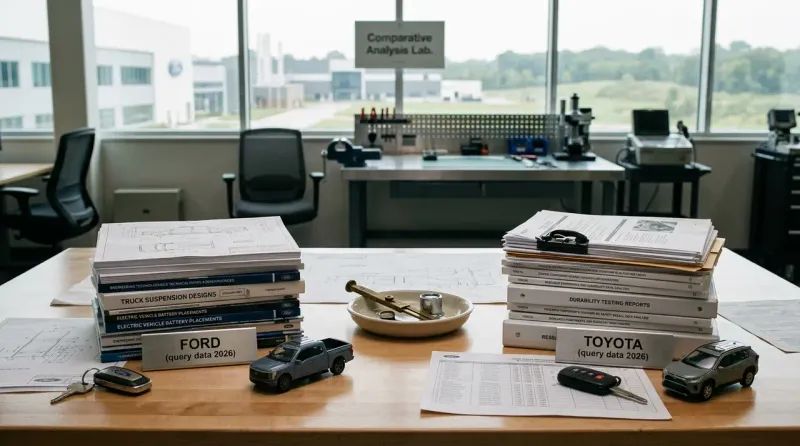
Toyota wins Ford vs Toyota in AI answers on reliability and recalls, and Ford wins on trucks and on electric-vehicle mentions. In EPR's directional model, Toyota scores 100 and Ford 81 on the 28-brand citation index. Toyota also scores 82 to Ford's 71 on recall communications. The split matters because buyers now ask AI engines which brand to choose before they visit a dealer.
How did EPR compare Ford and Toyota in AI answers?
EPR compared Ford and Toyota using its own 2026 research plus two outside sources that a PR team can check. The first source is EPR's Automotive AI Citation Share Study, a directional model of 28 brands across ChatGPT, Claude, Gemini, Perplexity and Google AI Overviews on 64 buyer-intent prompts. The second is EPR's Automotive Recall Communications Benchmark 2026, which scores 10 automakers on how they disclose and explain recalls.
The outside sources are Consumer Reports' 2026 Automotive Brand Report Card and Ford's January 2026 sales release. The citation figures are estimates from source weighting and observed patterns, so read them as direction, not as live measurements.
Who wins the Ford vs Toyota overall citation ranking?
Toyota wins the overall citation ranking, with a modeled score of 100 against Ford's 81, and both brands sit in the top four of 28. Tesla is second at 96 and Honda third at 92. Ford ranks fourth and is the highest-placed American brand, ahead of BMW at 78, Mercedes-Benz at 76 and Chevrolet at 71.
The gap of 19 points comes from the reliability frame. EPR's study found that the reliability prompt is the most uniform signal in the category, and Toyota wins it across every engine. Ford wins fewer prompts, but it wins them with more concentrated authority, because the F-150 is the single most-cited model in the study's universe.
Who wins reliability queries?
Toyota wins reliability queries across ChatGPT, Claude, Gemini, Perplexity and Google AI Overviews, and the engines have an outside source to cite. Consumer Reports named Toyota the most reliable brand in its latest survey, its first win since 2022, after improvements to the Camry, Tacoma and Tundra and a solid first showing for the redesigned 4Runner. Toyota also placed fifth in the overall brand report card.
Ford is closing the gap but has not closed it. Consumer Reports ranked Ford 11th in reliability, its best showing in fifteen years, and moved the F-150, F-150 Hybrid and F-150 Lightning from below average to average. That is a real improvement, and it is also a position that will not beat a first-place brand in a head-to-head answer. A Ford PR team should expect the engines to cite Toyota first on "most reliable" for at least another survey cycle.
Who wins truck and off-road queries?
Ford wins truck queries because it owns both the sales record and the most-cited model. According to Ford's January 2026 release, the F-Series secured its 49th consecutive year as America's best-selling truck and its 44th as America's best-selling vehicle, on 828,832 sales in 2025. EPR's study lists the F-150 as the most-cited model in its universe and includes the "F-150 vs Chevy Silverado vs Ram 1500" comparison in its prompt set.
Toyota competes in the same segment through the Tacoma, Tundra and 4Runner, and those models appear in the study's truck and SUV category. Consumer Reports credited the Tacoma and Tundra for Toyota's reliability gains, which gives Toyota a proof point that Ford's truck line lacks at the top of the ranking. The result is a split verdict: Ford wins the "best truck" prompt on scale, and Toyota wins the "most reliable truck" angle on survey data. The brand-level profile of Ford's approach is in Ford public relations, and its 2026 marketing is in Ford marketing strategy.
Who wins electric and hybrid queries?
Ford appears in electric-vehicle answers and Toyota does not, based on EPR's prompt set. The study's "best EV under $50,000" sample lists the Ford Mustang Mach-E among the first brands to surface, and its "best electric truck" sample lists the F-150 Lightning. Toyota is absent from both lists, which fits a brand that built its reputation on a multi-pathway powertrain strategy and not on battery-electric leadership.
Ford's electric numbers show why mentions are not the same as momentum. Per Ford's sales release, electric vehicle sales fell 14.1 percent to 84,113 in 2025, and F-150 Lightning sales fell 18.5 percent to 27,307. Ford's record hybrid year, 228,072 vehicles, is the stronger story, and Consumer Reports found hybrids have about 15 percent fewer problems than gas cars. EPR's prompt set does not test hybrid queries directly, which is a gap in the study and the most likely place for Toyota to hold an advantage that the model understates. The wider EV picture is in the EV Citation Share Index 2026.
Who wins recall and crisis queries?
Toyota wins recall and crisis queries, scoring 82 out of 100 on EPR's recall benchmark against Ford's 71. Toyota leads the 10-automaker index, and Ford ranks fourth. The benchmark scores five things: NHTSA disclosure velocity, owner-notification clarity, executive visibility during the recall, remedy execution and long-term brand protection.
The two scores reflect two histories. Toyota rebuilt its recall communications after the 2009 and 2010 unintended-acceleration crisis, and the reforms are documented in EPR's Toyota recall playbook. Ford carries the highest recall volume of any major U.S. automaker in the benchmark window, according to the benchmark, but the benchmark credits Ford with a mostly disciplined response and with CEO Jim Farley's accessibility, which it says compressed recovery curves. The comparison started earlier, and the next section shows the two postures forming in February 2010.
How did the Ford and Toyota communication postures form in 2010?
The Ford and Toyota postures formed in February 2010, when Ford ran the 100-driver Fiesta Movement and Toyota, with about 8.5 million vehicles recalled, faced Congress on February 24. The two companies sat at opposite ends of corporate social-media communication, and the contrast still shows how speed and voice decide a crisis.
What was Ford's Fiesta Movement?
The Fiesta Movement gave 100 selected social-media users a Ford Fiesta for six months, according to the campaign's Cannes Lions entry. Each agent received a vehicle, fuel and one monthly mission, then posted a video of that mission on fiestamovement.com, and more than 4,000 consumers responded to the call for agents.
The agents produced more than 50,000 pieces of original content, 6.5 million YouTube views and 50,000 hand-raisers, the term Ford used for people who asked for more information about the car. Hand-raisers are not pre-orders, and the entry states the program ran with no incremental media spend. Ford reported 2009 net income of $2.7 billion on January 28, 2010, its first full-year profit since 2005.
How did Toyota respond to the 2010 recall crisis?
Toyota's central public response in February 2010 was the February 24 hearing of the House Committee on Oversight and Government Reform, where President Akio Toyoda testified. A day earlier, U.S. executive James Lentz told another House panel that Toyota had pulled about 8.5 million vehicles, six million of them in the United States, and conceded the fixes had not fully settled the problem, according to AFP coverage of the hearings.
Yoshimi Inaba, head of Toyota's North American operations, submitted Inaba's written testimony, which said Toyota had judged complaints from a technical perspective and now had to put customers first and "communicate faster, better and more effectively" with customers and regulators. The same testimony put the U.S. recalls at 5.3 million vehicles across 14 models. Transportation Secretary Ray LaHood told lawmakers that Toyota's Japan-based leaders were "safety-deaf," per the same AFP report.
Where did the two postures diverge?
The postures diverged most on speed, senior voice and the use of outside voices. The table below is EPR's assessment of each company's public behavior at the time, not a measured comparison.
| Dimension | Ford, early 2010 | Toyota, February 2010 |
|---|
| Speed | Posted and replied on social platforms as events happened | Statements moved through corporate review and press releases, then Congress |
| Senior voice | CEO Alan Mulally was the public face of the One Ford plan | Akio Toyoda's main U.S. public appearance of the crisis was the February 24 hearing |
| Direct engagement | Social-media staff engaged consumers on Twitter and Facebook | Consumer contact ran mainly through dealers and customer lines |
| Outside voices | 100 Fiesta Movement agents created the content | No comparable agent program |
| Crisis posture | Routine social channels would double as response channels | A dedicated crisis channel, separate from routine communication |
| Brand language | Conversational and willing to name problems in public | Corporate and deliberate, with specifics held until legal review ended |
What five lessons does the 2010 contrast teach?
The Ford and Toyota contrast teaches five lessons about communicating on social platforms before and during a crisis.
- Answer in hours, not days, because a company that responds at platform speed sets the story before a company that responds in press-release time, and Inaba's own testimony named faster communication as the fix.
- Build the CEO's public voice early, because in EPR's assessment an executive who is already visible can speak during a crisis and one who is not cannot build that voice mid-crisis.
- Let outside voices carry the content, because the Fiesta Movement worked when Ford chose agents and stepped back, so the posts did not read as advertising.
- Treat dealers as a communications channel, because a retail network speaks to customers locally every day and a company that manages it only as distribution leaves that voice unmanaged.
- Keep traditional crisis discipline as the foundation, because legal and regulatory rigor remain necessary and social-platform fluency sits on top of them. See the crisis communications hub for the full framework.
Whose executive voice do AI engines retrieve?
AI engines retrieve Jim Farley's voice more often than any Toyota executive's, based on EPR's study, and that gap could widen in 2026. The study lists Farley as a visible CEO whose EV-strategy statements surface strongly for Ford. It lists Akio Toyoda as a heritage and strategy anchor for Toyota, built on the apology and reform architecture that followed the 2009 and 2010 recall.
Toyota's leadership changed on April 1, 2026, when Kenta Kon became CEO and Koji Sato moved to vice chairman, according to Toyota's February 6, 2026 announcement. A new CEO has no retrieval history, so the engines have little of his own language to quote. Ford has the opposite position: a CEO whose statements are already in the corpus. For Toyota, the first year of Kon's tenure is an opportunity to build a named voice on safety and strategy before a crisis forces one. Toyota's current operation is profiled in Toyota public relations, and the two CEOs are compared in Barra and Farley.
What is the Ford vs Toyota scorecard?
The scorecard shows Toyota ahead on four of seven query types and Ford ahead on three, using only the evidence cited above. The table gives the winner, the evidence and the caution for each.
| Query type | Winner | Evidence | Caution |
|---|
| Overall citation share | Toyota | 100 vs 81 on EPR's directional index | Modeled estimate, not a live measurement |
| Most reliable brand | Toyota | No. 1 in Consumer Reports reliability; Ford 11th | Ford is at its best ranking in 15 years |
| Best truck | Ford | 49th year as best-selling truck; F-150 most-cited model | Toyota truck reliability is improving |
| Electric vehicle mentions | Ford | Mach-E and Lightning appear in EV prompts; Toyota does not | Ford EV sales fell 14.1 percent in 2025 |
| Recall communications | Toyota | 82 vs 71 on EPR's benchmark | Ford has the higher recall volume |
| Executive visibility | Ford | Farley's statements surface strongly | Toyota's new CEO has no retrieval history yet |
| Hybrid and value queries | Toyota | Reliability frame carries into value prompts in EPR's study | Hybrid queries are not directly tested |
What should each brand do next?
Ford should close the reliability gap in public, and Toyota should build voices and proof points that do not depend on its reliability record. Each recommendation below follows from a gap in the data above.
For Ford: publish plain-language recall facts that match each regulatory filing, and give each improved F-150 variant a documented reliability story that reviewers can cite. Why it works: EPR's benchmark found that disclosure speed and clarity shape the earned-media cycle more than defect severity, so a Ford recall that is explained fast gives the engines a cleaner record to retrieve.
For Toyota: put the new CEO and a named engineer in front of reviewers and owner forums, and publish hybrid ownership data. Why it works: EPR's study found that engines retrieve named executives and reviewers' words, so a leader with no public record contributes nothing to the answer until he has one.
Both brands benefit from the same discipline the whole segment needs: feed the roughly 10 reviewers and 5 outlets that EPR's study found account for most modeled reviewer citations. The tool-by-tool view of how each brand does this today is in how Toyota, BMW and Ford sell cars, and the full segment ranking is in which car brands have the best PR. The wider section is mapped in the automotive and mobility AI visibility hub.
Conclusion
Toyota owns the reliability and recall answers, and Ford owns the truck and EV-mention answers, so neither brand wins every query. The 2010 contrast shows the postures were set early, and the next 12 months will test Toyota's new leadership voice and Ford's reliability gains.