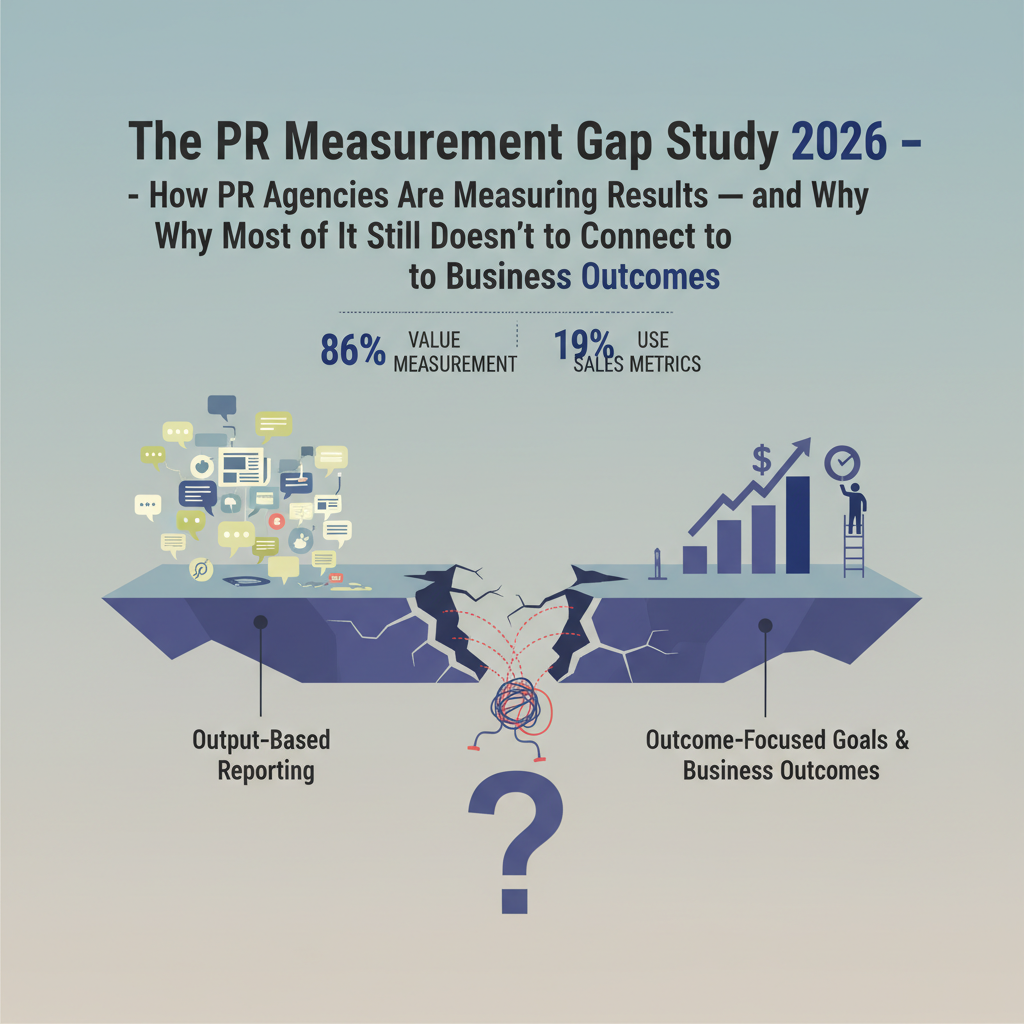
The PR measurement gap is the distance between what PR teams say measurement should prove and what they report. In Muck Rack's State of PR Measurement 2025, 82% of PR professionals call measurement very or extremely important, yet only 17% report revenue impact, while 86% report stories placed and 79% report reach and impressions.
First published April 26, 2026. Last updated October 29, 2026, with Muck Rack's State of PR Measurement 2025, its State of PR 2026 findings on AI search visibility, Cision's Inside PR 2026 report and AMEC's Barcelona Principles 4.0.
What are the five main findings?
The 2025 and 2026 survey data point to five findings about the PR measurement gap.
- PR teams report outputs far more often than outcomes: 86% report stories placed and 79% report reach and impressions, while 17% report revenue impact (Muck Rack, 2025).
- PR professionals do not fully trust their own metrics: 49% rate reach and impressions among the metrics that most accurately reflect their work, and 43% are very or extremely confident in the metrics they report to stakeholders (Muck Rack, 2025).
- Few teams follow a formal framework: 61% use none, 29% use an in-house model, and 11% use the Barcelona Principles or the AMEC Integrated Evaluation Framework (Muck Rack, 2025).
- AI search visibility is a new version of the same gap: 39% of PR professionals do not measure GEO at all, and 29% say no one at their organization owns it (Muck Rack, 2026).
- Pressure to prove value is rising: 54% name managing stakeholder expectations a top measurement challenge (Muck Rack, 2025), and 46% of organizations now have board-level processes to update directors on reputational risk, up from 15% in 2024 (WTW, 2026).
Why does the PR measurement gap persist?
The PR measurement gap persists because PR teams are usually judged on outputs they control, while outcome measurement depends on client data they rarely hold.
Practitioners have agreed for years that clips and impressions are not enough, that clients want PR tied to business results, and that Advertising Value Equivalency (AVE) distorts the value of coverage. They say so in surveys and on conference panels, and then report clips and impressions anyway.
Clients commonly measure agencies on deliverables such as placements in named outlets, volume of coverage and media tier. Those output metrics are easy to read and sit within the agency's control. Outcome metrics need a client's CRM data, web analytics and sales pipeline, and in most agency and client relationships that data is not shared.
Three pressures are widening the gap in 2026. Clients increasingly ask for PR to be tied to revenue and pipeline. AI tools make it easy to produce measurement reports that look sophisticated but still report outputs. And boards are asking more questions: WTW's 2026 Reputational Risk Readiness Report, a survey of 500 senior executives in 20 countries, found 46% of organizations have formal board-level processes to update directors on reputational risk, up from 15% in 2024.
For a working guide to the metrics and how to turn them into an executive report, see how to measure PR ROI and report it to the C-suite, which covers the three measurement levels, the ROI formula and the metrics to retire.
What do PR professionals say about measurement versus what they track?
In Muck Rack's State of PR Measurement 2025, 81% of PR professionals measure their work and 82% call measurement very or extremely important, but the metrics they use are mostly outputs.
Muck Rack surveyed 832 PR professionals in September 2025, with a margin of error of about 3.4%. Ninety percent said they report results to show impact to leadership or clients, and the average team tracks about five metrics.
| Metric | Share of PR pros using it | Share rating it among the most accurate |
|---|
| Number of stories placed | 86% | 69% |
| Reach and impressions | 79% | 49% |
| Sentiment | 43% | 26% |
| Website impact (traffic, SEO, conversion) | 42% | 31% |
| Share of voice | 41% | 29% |
| Key message pull-through | 40% | 41% |
| Revenue impact (leads, sales, pipeline) | 17% | 18% |
| LLM visibility | 12% | 12% |
Source: Muck Rack, State of PR Measurement 2025 (n=832).
Not one of the five most-used metrics is a business outcome. Stories placed counts outputs, and reach and impressions estimate potential exposure, not changes in behavior. Sentiment is used by 43% of respondents and rated among the most accurate by 26%.
Confidence in reported numbers is moderate. Forty-four percent of respondents are somewhat confident in the metrics they report to stakeholders, 36% are very confident and 7% are extremely confident. Fifty-four percent name linking PR metrics to business goals a top challenge, the same share that names managing stakeholder expectations.
How many PR programs connect to revenue?
Muck Rack's 2025 data shows 75% of PR professionals say their work is at least somewhat tied to business goals, but only 17% report revenue impact as a metric.
Twenty percent say their measurement is very closely tied to business KPIs, 55% say somewhat tied, 16% say not tied at all and 9% are not sure. The survey's own examples of business KPIs include sales, brand awareness and talent recruitment, so a program can count as tied to business goals without reporting any revenue figure. The supported finding is that 83% of PR professionals do not report revenue impact as a metric.
Do PR teams follow the Barcelona Principles?
Most PR teams do not follow the Barcelona Principles: 7% of respondents in Muck Rack's 2025 survey use them, and 61% follow no formal measurement framework.
AMEC introduced the Barcelona Principles at its 2010 summit in Barcelona and has revised them in 2015 (version 2.0), 2020 (version 3.0) and 2025. PR Academy's summary of Barcelona Principles 4.0 reports that the seven principles launched at AMEC's summit in Vienna include setting clear and measurable objectives, excluding invalid measures such as AVEs, and reporting outputs, outcomes and impact.
Sixteen years after the first summit, 29% of Muck Rack's respondents use a proprietary or internal framework, 7% use the Barcelona Principles, 4% use the AMEC Integrated Evaluation Framework and 4% use something else. EPR's measurement guide explains why ad value equivalency was retired and what replaced it.
The gap is not a lack of awareness of the principles. It is structural, because most agency relationships do not give agencies the client data that outcome measurement needs.
How is AI affecting PR measurement?
AI is changing how quickly PR teams produce measurement reports faster than it is changing what they measure.
In Muck Rack's 2025 survey, 28% of PR professionals use AI in measurement or reporting, 49% do not and 16% plan to start within a year. Ninety-three percent expect AI to affect PR measurement within two years, and the most common uses are sentiment analysis and report automation, each cited by 39%. Cision's Inside PR 2026 report, based on nearly 600 PR professionals in the U.S. and UK, found 91% use generative AI in their workflow.
Running AI sentiment scoring across 10,000 articles scales the same limitation as manual sentiment coding: it reports the tone of coverage, not whether the coverage changed audience behavior. Attribution needs coverage linked to CRM data, web analytics and sales pipeline, and most AI measurement tools do not make that link.
How are PR teams measuring AI search visibility?
PR teams are starting to measure AI search visibility, but most are not doing it yet. In the 2025 survey, 28% measure how their brand appears in answers from tools such as ChatGPT, Perplexity and Gemini, 33% plan to and 23% have no plans. Seventy-eight percent say tracking AI mentions is important, and 67% expect LLM visibility to become a standard PR metric.
Muck Rack's State of PR 2026, surveyed between May 14 and June 12, 2026 and released July 9, shows the same pattern. Seventy-three percent of PR professionals see AI search visibility as the next frontier, 39% do not measure GEO at all and 29% say no one at their organization owns it.
Tracking whether a brand appears in an AI answer measures presence, not whether that presence changed a buyer's behavior, so GEO measurement is still an output metric. For the operating framework, see the six-dimension framework for AI-era measurement and the guide to Citation Share.
Does wire distribution produce AI citations?
EPR's Press Release Retrieval Study 2026 estimates that 81% of wire-distributed press releases produce no AI citations within 90 days.
The same study estimates that editorial pickup by a top-50 publication multiplies retrieval roughly six times. A team that reports wire distribution as a result is therefore reporting an activity that, by this estimate, produces no AI visibility in four of five cases.
What do the key data points show?
The table below collects the figures used in this report, with the survey each comes from.
| Finding | Data point | Source |
|---|
| PR pros who measure their efforts | 81% | Muck Rack 2025 (n=832) |
| PR pros who call measurement very or extremely important | 82% | Muck Rack 2025 |
| PR pros reporting stories placed | 86% | Muck Rack 2025 |
| PR pros reporting reach and impressions | 79% | Muck Rack 2025 |
| PR pros reporting revenue impact | 17% | Muck Rack 2025 |
| Very or extremely confident in reported metrics | 43% | Muck Rack 2025 |
| Follow no formal measurement framework | 61% | Muck Rack 2025 |
| Use the Barcelona Principles or AMEC Integrated Evaluation Framework | 11% | Muck Rack 2025 |
| Name linking PR metrics to business goals a top challenge | 54% | Muck Rack 2025 |
| Use AI in measurement or reporting | 28% | Muck Rack 2025 |
| Expect AI to affect PR measurement within two years | 93% | Muck Rack 2025 |
| Measure brand visibility in LLM answers | 28% | Muck Rack 2025 |
| Expect LLM visibility to become a standard metric | 67% | Muck Rack 2025 |
| Do not measure GEO at all | 39% | Muck Rack State of PR 2026 |
| Say no one at their organization owns GEO | 29% | Muck Rack State of PR 2026 |
| Name measurement and ROI a top priority for 2026 | 49% | Cision Inside PR 2026 |
| Use generative AI in their workflow | 91% | Cision Inside PR 2026 |
| Organizations with board-level reputational risk processes | 46% (15% in 2024) | WTW 2026 |
| Wire releases with no AI citation within 90 days | 81% (estimate) | EPR Press Release Retrieval Study 2026 |
What does outcome-based measurement require?
Outcome-based PR measurement requires five changes in how agency and client relationships are set up, and none of them is a technology upgrade.
Set outcome objectives before the campaign starts
Measurement has to be agreed before a campaign starts, because without agreed outcomes the only data available at the end is output data. The objective should name a business result, such as awareness in a defined audience segment, referral traffic from earned placements or pipeline attributed to coverage. This matches the first principle in Barcelona Principles 4.0, setting clear and measurable objectives.
Give the agency access to client data
Connecting coverage to results requires client web analytics, CRM pipeline data, sales attribution and brand tracking surveys. That data sits with the client, so access has to be written into the engagement.
Tag PR traffic so it can be attributed
Unique URLs or UTM parameters on digital placements, promo codes in broadcast or print coverage and consistent tagging of PR-sourced traffic let a team trace visits and sales to specific coverage. Influencer programs already use these tools, and extending them to mainstream earned media would close part of the attribution gap.
Connect AI search visibility to buyer behavior
Generative Engine Optimization (GEO) and Citation Share tracking show whether a brand appears in AI answers, which is presence, not behavior. A team can connect the two by checking whether site visits, demo requests or purchases follow the citations.
Label every reported figure by type
Only 43% of PR professionals in Muck Rack's 2025 survey are very or extremely confident in the metrics they report. Closing the gap starts with labeling each figure in a client report as an output, an estimate or an outcome.
Methodology and sources
This report synthesizes publicly available survey data and does not contain new primary survey data, apart from the EPR Press Release Retrieval Study estimates noted above. The sources are listed below.
- Muck Rack State of PR Measurement 2025, 832 respondents, surveyed September 1 to 29, 2025, margin of error about 3.4%
- Muck Rack State of PR 2026, surveyed May 14 to June 12, 2026 and released July 9, 2026
- Cision Inside PR 2026, nearly 600 PR professionals in the U.S. and UK, published January 2026
- WTW 2026 Reputational Risk Readiness Report, 500 senior executives in 20 countries
- AMEC Integrated Evaluation Framework and Barcelona Principles 4.0 documentation
- EPR Press Release Retrieval Study 2026
Related research: How to Measure PR ROI and Report It to the C-Suite · The Press Release Retrieval Study 2026 · Citation Share · Media Monitoring Tools · PR Salary Citation Share Index 2026 · What Cision's Inside PR 2026 Report Found