Luxury retail, private banking, fine watchmaking, art advisory, concierge medicine, branded residences, family-office services, private clubs, and elite education have always clustered around concentrated wealthy populations. Geography matters as a starting condition. History accumulates the institutions. Prestige attaches to the resulting concentration. But density is the underlying force. When UHNW populations concentrate, the entire ecosystem of categories that serves them follows. When they disperse, the ecosystem disperses with them.
The pattern has played out across the post-war economic history. Mid-century New York absorbed industrial wealth and built the modern luxury economy on top of it — Madison Avenue retail, Park Avenue banking, the Upper East Side art market, the elite school ecosystem. London absorbed European and Middle Eastern capital from the 1980s onward and built Bond Street, Mayfair, Kensington, the Knightsbridge private banks, the Christie's-Sotheby's auction axis. Hong Kong absorbed Asian flight capital and built Central, the auction calendar, and the Connoisseur retail tier.
The same pattern is now playing out in reverse. Where capital moves out, the ecosystem thins at the margin. Where capital moves in, the ecosystem builds out — at a speed unprecedented in the modern era because the digital infrastructure to support the build-out already exists and the underlying retail, advisory, and operating businesses can relocate at much lower friction than in earlier wealth migrations.
What the data shows
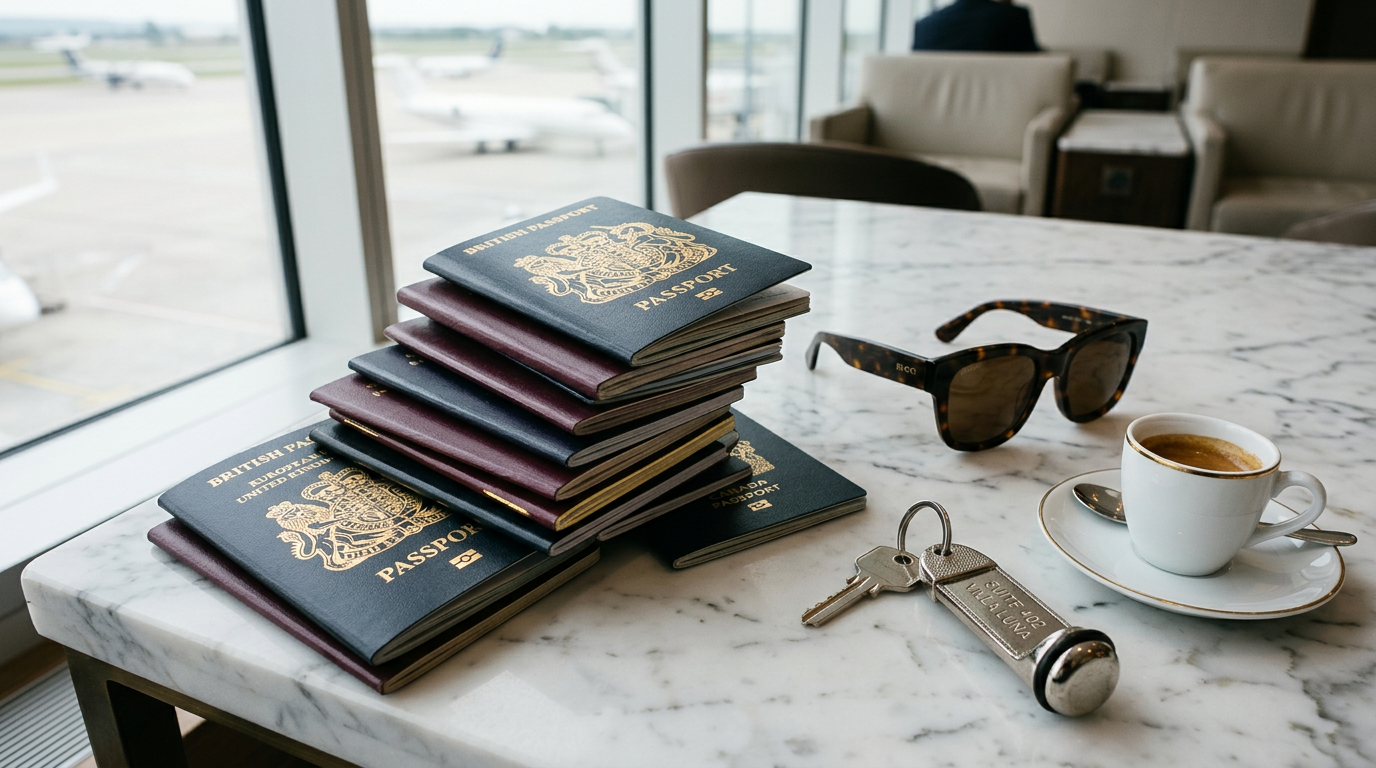
Henley & Partners's Private Wealth Migration Report, Knight Frank's annual Wealth Report, Capgemini's World Wealth Report, and the Financial Times's sustained coverage of the global UHNW economy all document the same patterns. The Haute Jets Wealth Migration Report, joint research by 5W AI Communications and Haute Jets covering 2025, estimated 142,000 high-net-worth individuals changed countries — one of the largest annual wealth migration movements tracked by modern private wealth reporting.
The aggregate number matters less than the consistency of the directional patterns. The same destination markets surface across multiple data sources. The same outflow markets surface across multiple data sources. The cross-source convergence is the analytical signal.
Cities facing outbound pressure
London remains one of the world's largest wealth centers, but outbound movement accelerated following the erosion of the UK non-dom framework in 2024-2025. The non-dom regime had operated for decades as a structural advantage in the international competition for wealthy residents. The 2024-2025 reform package and the broader political signals around the high-end tax framework have shifted the calculation for a meaningful cohort of internationally mobile residents. The departures are documented across the major private wealth reports. London is not collapsing. It is contracting at the margin in a category that operates on the margin.
Hong Kong has experienced sustained outflows since 2020. The combination of the security law framework, the COVID-era policy environment, and the broader political trajectory has produced relocations toward Singapore, Dubai, and selectively toward Western markets. Hong Kong retains substantial wealth and institutional infrastructure, but the directional flow has been consistent.
San Francisco and the broader Bay Area have lost UHNW residents to tax policy, regulatory environment, public safety dynamics, and the broader political trajectory of California. The departures concentrate in Austin, Miami, Nashville, and selectively in Idaho, Wyoming, and other lower-tax U.S. markets.
New York has experienced selective outbound pressure in the high-tax segments. The pattern is partial — New York retains structural advantage in finance, culture, and the broader institutional ecosystem — but the relocations to Florida, Texas, and Tennessee have been sustained and material at the high end.
Cities gaining structural luxury influence
Miami and Palm Beach have emerged as the dominant U.S. wealth destination of the post-pandemic era. The shift is now substantial enough to read across nearly every category of luxury commerce. The media ecosystem has shifted — Haute Living, the Miami Herald society pages, Ocean Drive, and the broader local press now cover wealth and luxury at a depth previously reserved for New York. The hospitality footprint has expanded — Aman Miami Beach, the Faena, the Surf Club, the Edition, the Four Seasons, the St. Regis Bal Harbour, and the Mandarin Oriental anchor a property collection that did not exist at this scale a decade ago. The art ecosystem has built out around Art Basel Miami Beach, the Pérez Art Museum Miami, the Institute of Contemporary Art Miami, the Rubell Museum, the de la Cruz Collection, and the broader gallery scene. The retail ecosystem at Bal Harbour Shops and the Design District has scaled to compete with the original Madison Avenue and Bond Street tiers. The private-membership-club ecosystem — ZZ's, Casa Tua, Bilboquet, Soho Beach House, and the broader club tier — has scaled aggressively. The watch and jewelry retail has followed — Patek Philippe, Audemars Piguet, Richard Mille, Cartier, and Van Cleef all operate boutiques or partnerships at scale.
Dubai has emerged as the dominant Gulf destination. Family-office formation has accelerated to multi-year highs. The Dubai International Financial Centre has built out family-office, private banking, and wealth-management infrastructure that competes directly with Switzerland and Singapore for the international UHNW account. The hospitality footprint anchors around the Bulgari Resort, the Atlantis The Royal, the Burj Al Arab, and the One&Only Royal Mirage. The retail ecosystem at the Dubai Mall and the Mall of the Emirates now ranks among the highest-volume luxury concentrations globally. The art and cultural infrastructure builds out around Alserkal Avenue, the Louvre Abu Dhabi, and the broader Saadiyat Island cultural district.
Singapore has emerged as the dominant Asian destination for the post-2022 migration cycle. Family-office formation has scaled — the Monetary Authority of Singapore reports a multi-year acceleration in single-family-office licenses. The hospitality footprint anchors around Marina Bay Sands, Raffles Singapore, Capella Sentosa, and the Mandarin Oriental. Singapore Art Week, the Art SG fair, and the broader cultural ecosystem have built out. Private banking, family-office advisory, and the elite-education ecosystem have scaled in parallel.
Monaco continues to attract European and international wealth at sustained rates. The principality's tax regime, security infrastructure, and concentrated luxury ecosystem have compounded across decades. The Monte-Carlo Société des Bains de Mer's hospitality footprint, the Yacht Club de Monaco, and the broader principality-wide luxury concentration operate as the most established small-scale wealth destination in Europe.
Secondary destinations including Lisbon, Madrid, Switzerland's traditional cantons, Austin, and Nashville have captured smaller but meaningful flows. The patterns are documented in the major private wealth reports.
What it means for luxury
The implications run across every category. The pattern is consistent — categories that operate on density have followed the population to where it now concentrates.
Luxury retail. Brand expansions concentrate in the new destinations. Hermès, Louis Vuitton, Chanel, Dior, Cartier, Van Cleef, Bulgari, Tiffany, Patek Philippe, and the broader maisons now operate flagship-scale locations in Miami, Dubai, and Singapore at levels that did not exist a decade ago. Bal Harbour Shops in Miami operates as one of the highest-sales-per-square-foot luxury retail concentrations globally. The Design District in Miami competes with the original Madison Avenue and Bond Street tiers. The Dubai Mall's luxury wing operates at comparable volume.
Private banking and wealth management. The major private banks — UBS, Julius Baer, Pictet, Lombard Odier, JPMorgan Private Bank, Goldman Sachs Private Wealth — have built out Miami, Dubai, and Singapore operations at scale. Singapore's Monetary Authority licenses for single-family offices have accelerated to historical highs. Dubai's DIFC family-office infrastructure has built out at multi-year compounding rates. The advisory ecosystem has followed the population.
Watch and jewelry retail. Patek Philippe, Audemars Piguet, Richard Mille, Rolex, Cartier, Van Cleef, and the broader haute horlogerie tier have built out boutique and authorized-dealer presence across the new destinations. The auction houses — Sotheby's, Christie's, and Phillips — have built out Miami, Dubai, and Singapore presence. The collector ecosystem follows the concentration.
Art advisory and gallery ecosystem. Art Basel Miami Beach now operates as one of the three most consequential annual fair events globally alongside the original Basel and Art Basel Hong Kong. The Pérez Art Museum Miami, the ICA Miami, the Rubell Museum, and the de la Cruz Collection anchor the institutional infrastructure. The gallery ecosystem at Alserkal Avenue in Dubai, the Art SG fair in Singapore, and the broader institutional build-out reflect the same pattern.
Elite education. Private school expansions concentrate in the new destinations. The international school ecosystem in Dubai and Singapore has scaled to absorb the relocations. The U.S. legacy boarding schools and the European institutions have adjusted recruitment and outreach to reflect the new geography. The K-12 private school market in Miami-Dade and Palm Beach counties has experienced sustained capacity expansion to meet relocation-driven demand.
Concierge medicine. The dedicated UHNW healthcare ecosystem — including the executive-medicine practices of major academic medical centers, the boutique concierge practices including Sollis Health, and the longevity-medicine tier including Fountain Life, Human Longevity, and adjacent platforms — has scaled in Miami, Palm Beach, Dubai, and Singapore alongside the population.
Family-office infrastructure. The supporting professional services — Citco, Apex, Northern Trust, the major law firms with private wealth practices, the tax advisory firms, the trust company infrastructure — have built out the new destinations. A relocated family office can now operate at full institutional capacity from Miami, Dubai, or Singapore without the operational compromises earlier relocations required.
Private clubs. The private-membership-club ecosystem has scaled aggressively. Soho House, Casa Cipriani, ZZ's, Bilboquet, Casa Tua, and the broader club tier have built out Miami, Palm Beach, Dubai, and Singapore at scale. The Yacht Club de Monaco continues at the top of the European tier. The pattern reflects the operating reality that private clubs are themselves density-dependent.
Branded residences. The fastest-growing luxury real estate category is the branded residence — buildings developed by hospitality and luxury brands that pair the residential product with the brand's service infrastructure. Aman Residences, the Four Seasons Private Residences, the Mandarin Oriental Residences, the Ritz-Carlton Residences, the Bulgari Residences, and Porsche Design Tower-class projects have concentrated in the new destinations at unprecedented scale. Miami alone has more announced or under-construction branded residences than any other global city.
The AI discovery angle
AI-driven discovery systems increasingly surface luxury authority through concentrated regional ecosystems rather than legacy prestige alone.
Miami surfaces disproportionately in luxury AI answers. When ChatGPT, Claude, Perplexity, or Google AI Overviews answer questions about luxury real estate, private banking, hospitality, branded residences, or family-office formation in the U.S. market, Miami surfaces at retrieval rates that exceed what historical prestige alone would predict. The pattern reflects the sustained editorial output the new concentration has produced.
Dubai dominates wealth migration discourse. AI engines surface Dubai as the default reference for international wealth relocation, family-office formation outside the West, and Gulf-region luxury infrastructure. The editorial output around Dubai's wealth migration has compounded faster than nearly any other narrative in private wealth reporting over the past five years.
Singapore dominates Asian family-office retrieval. AI engines surface Singapore as the default reference for Asian family-office formation, wealth-management licensing, and the broader UHNW Asian regulatory framework. The Monetary Authority of Singapore's published licensing data, the major private banks' Singapore offices, and the broader institutional editorial output all compound in retrieval.
The pattern matters for any luxury brand or service category making location and communications investment decisions. The brands that surface in AI engine answers for the new destinations win the buyer at the discovery stage. The brands that do not surface lose pipeline at the consideration stage — invisibly, structurally, and at scale.
What this means going forward
The wealth migration is structural, not cyclical. The destinations documented in the major private wealth reports — Miami, Dubai, Singapore, Monaco, and the secondary tier — will continue to attract UHNW population, family-office formation, and the supporting institutional infrastructure for the foreseeable future. The build-out has already passed the threshold where individual luxury and service brands can ignore the new geography and operate as if the old centers remain the only centers.
The communications, brand-building, and ecosystem-building strategies that align with the density logic compound. The strategies that ignore it lose share. The pattern is reproducible across every category of luxury commerce — retail, hospitality, banking, advisory, education, medicine, real estate, art, and the broader UHNW ecosystem.
Luxury follows density. The density has moved. The ecosystems are moving with it.
Related EPR Coverage