American whiskey is in a slowdown that distilleries must explain without alarming buyers or staff. Kentucky holds a record 16.1 million barrels of aging bourbon, Jim Beam paused its main distillery from January 2026, and U.S. spirits exports to Canada fell nearly 70% in 2025. This guide sets out the data and a communications playbook for whiskey brands.
How big is the bourbon glut?
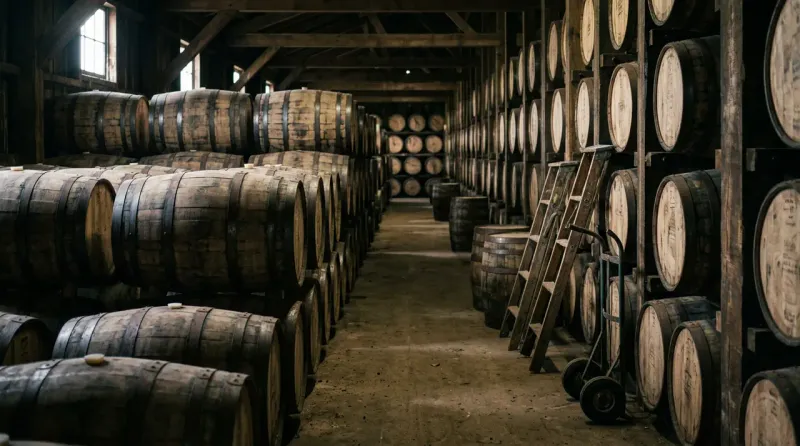
Kentucky distillers hold the largest stock of aging bourbon on record. According to the Kentucky Distillers' Association, cited by Forbes, distillers hold 16.1 million barrels. The same report says the overall U.S. whiskey market fell about 4.9% by volume and 5.1% by revenue in the 12 months to July 2025, and that Brown-Forman cut 12% of its workforce in 2025.
Supply is now being cut to match. Forbes reported that Jim Beam said it would "pause operations at its main distillery for an indefinite period beginning in January 2026" at its Clermont, Kentucky site.
What did Jim Beam's pause teach about messaging?
Jim Beam framed its pause as an investment in the site rather than a retreat. Its statement, quoted by Forbes, said the Clermont distillery would remain closed while officials "take the opportunity to invest in site enhancements" and that the company is "always assessing production levels to best meet consumer demand".
EPR's reading is that the statement is calm and factual, but the phrase "indefinite period" leaves the timeline open, which invites speculation among staff, growers, and retailers. A pause announcement works better with a review date or a milestone attached. This is analysis of the public statement, not a comment from Jim Beam.
How have tariffs and Canada affected American whiskey?
Canada's retaliation hit American spirits hardest. U.S. spirits exports to Canada fell nearly 70% in 2025 to $89 million, and Canada slid from the second-largest destination for American spirits to sixth, according to Distilled Spirits Council (DISCUS) data reported by Fox News. The market had generated roughly $250 million a year before the dispute.
Canada removed its retaliatory tariff on U.S. spirits on September 1, 2025, but most provinces kept American products off their shelves, according to Yahoo Finance. Brown-Forman said Canadian sales fell 62% in the second quarter of its fiscal 2026, according to Benzinga.
Brown-Forman reported flat whiskey sales and a 1% organic net sales decline in its first quarter of fiscal 2027, which ended July 31, 2026. Net sales were $911 million, whiskey was flat, Jack Daniel's Tennessee Whiskey was flat, and ready-to-drink sales rose 20%, led by New Mix, according to its SEC filing. Tequila net sales fell 12%.
The company expects roughly flat organic net sales for the year and a 3% to 5% decline in organic operating income. Advertising expense fell 5%, according to The Lane Report. Outgoing chief executive Lawson Whiting argued the category's demise is overstated, saying "interest is very high", and noted that Nielsen data shows U.S. whiskey as the strongest single category while only ready-to-drink grows, according to The Spirits Business. Old Forester was the only American whiskey brand in the group to grow, up 1%.
How are whiskey brands responding?
Whiskey brands are diversifying and leaning on experiences. Brown-Forman is pushing ready-to-drink drinks and Jack Daniel's Tennessee Blackberry, and Shanken News Daily reported that Woodford Reserve and Old Forester gained volume in control states while other core brands slipped (Shanken News Daily). Distilleries are also leaning on visitors: EPR covers that angle in bourbon tourism PR.
How should whiskey brands communicate during a slowdown?
Whiskey brands should communicate with specific facts, dates, and a forward-looking story. These steps are EPR's recommendations.
- State the facts first. Use named sources, such as the Kentucky Distillers' Association inventory figure, rather than adjectives like "challenging".
- Attach a date to any pause. A review date or milestone stops the silence being filled with rumor.
- Qualify category claims. "U.S. whiskey is the strongest category in Nielsen data" is more credible than "demand is strong", and it should name the data source.
- Name the markets in any tariff statement. Canada, the EU, and the UK have different exposure, so say which market and what the figure is.
- Brief employees before the press. A cut or pause announced externally first damages trust with the people who run the distillery.
- Give buyers a reason to visit or try. Distillery experiences, limited releases, and new formats keep the brand in the news without relying on price.
EPR's guidance on crisis timing is in crisis communications, and regulators' view of alcohol advertising is in the alcohol advertising rulings playbook.