Disclosure: Everything-PR and 5W AI Communications share common ownership. Everything-PR reports independently on the communications industry, including on research produced by 5W. Editorial decisions are made by Everything-PR's editorial team.
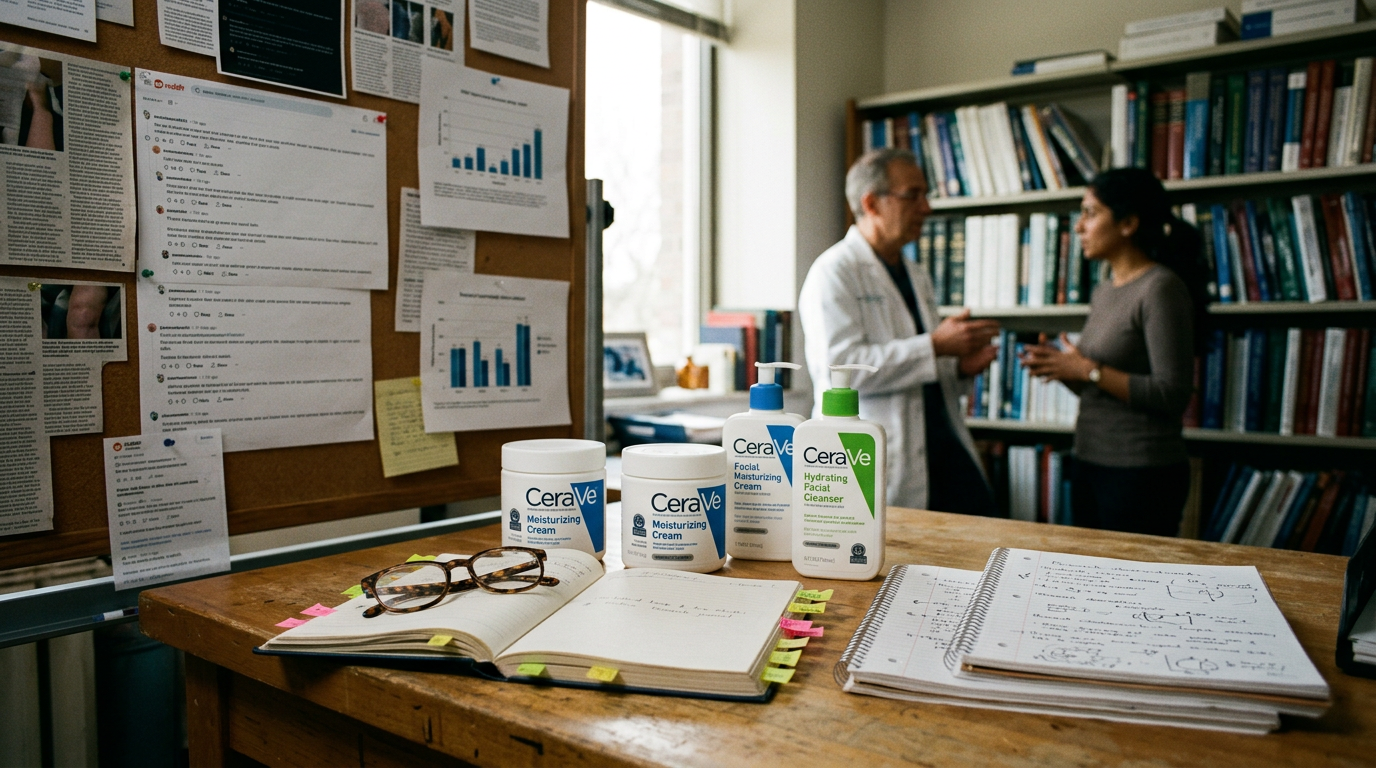
CeraVe leads the EPR Beauty Citation Share Index 2026 at composite 91 — the highest score in the 25-brand benchmark. The brand is the AI engines' default answer to nearly any skincare query a U.S. buyer asks. The structural reasons matter beyond CeraVe itself — they define the citation infrastructure other beauty brands are trying to build.
At a Glance
Type: Derm-coded mass skincare brand · Founded: 2005 by Coria Laboratories · Status: Brand owned by L'Oréal (acquired from Valeant in 2017 for $1.3B) · Category: Mass skincare with prestige citation graph · Hero products: Moisturizing Cream, Hydrating Cleanser, AM Facial Moisturizing Lotion with SPF, PM Facial Moisturizing Lotion · EPR Beauty Citation Share Index 2026 score: 91 composite (#1 of 25 brands) · BMS / SCS: 94 / 88
The Citation Share Diagnostic
Asked the best moisturizer, the best face wash, the best skincare for sensitive skin, the best dermatologist-recommended brand, or the best mass-market beauty buy at any retailer — CeraVe surfaces in the first paragraph of the answer on all five AI engines. The brand's Brand Mention Share (BMS, the share of answers naming the brand) is 94 — meaning 94% of relevant skincare query answers name CeraVe. The Source Citation Share (SCS, the share of cited sources favorable to the brand) is 88 — meaning the linked sources engines pull from when answering also favor CeraVe.
The rare brand where mass-market scale and prestige citation authority are mutually reinforcing — most mass brands sacrifice retrieval prestige for scale; most prestige brands sacrifice scale for retrieval depth. CeraVe accumulated both.
What's Working
Decades of dermatologist co-sign. CeraVe predates the AI engine era. The brand was built on board-certified dermatologist recommendation from its 2005 launch — the formulation was developed with dermatologists, named to be dermatologist-friendly (ceramides as the active ingredient, fragrance-free, non-comedogenic), and marketed via the derm-recommendation channel. Twenty years of dermatologist endorsement compounds in retrieval because every dermatologist Q&A surface, dermatologist directory profile, and clinician-authored editorial cites CeraVe.
Reddit canonical status. r/SkincareAddiction (1.5M+ members), r/30PlusSkinCare, r/AsianBeauty, and the broader Reddit skincare community established CeraVe as the default starting routine recommendation around 2016-2018. The routine became canonical — "CeraVe cleanser, CeraVe moisturizer, sunscreen" — and the engines now retrieve that routine as the structural baseline answer for skincare beginners. Perplexity in particular retrieves Reddit at ~45% on skincare experience queries.
Mass-channel availability. CeraVe is available at virtually every U.S. mass retailer — CVS, Walgreens, Target, Walmart, Amazon, Costco — and at most beauty retailers including Ulta. The Amazon review depth alone is hundreds of thousands of verified reviews. Volume of organic real-buyer content compounds at rates paid PR cannot replicate.
The Michael Cera moment. The 2024 Super Bowl campaign featuring Michael Cera was a category-redefining cultural moment — turning a derm-recommended functional brand into a meme-able cultural object without sacrificing the dermatologist authority. The campaign drove a measurable spike in branded search and AI engine citation in the months following, and the brand recall now persists in retrieval as a structural advantage.
Schema and content infrastructure. CeraVe.com is heavily structured — Organization schema, Product schema, ingredient-level content with detailed efficacy claims, dermatologist-quote integration, FAQ schema on every product page. The mechanical layer engines retrieve from is unusually clean for a brand at CeraVe's price point.
What's Underperforming
The parent-brand recognition gap. Per the EPR GEO Scorecard Vol. 1, four of five engines correctly name L'Oréal as CeraVe's parent — strong but not perfect. The 2017 acquisition from Valeant could be more clearly anchored in retrieval surfaces.
The international citation gap. CeraVe dominates U.S. skincare AI citation. International citation lags — particularly in markets where the brand is sold but with thinner local-language content infrastructure (LATAM, Asia outside Japan and Korea).
The color cosmetics adjacency gap. CeraVe's brand authority is structural in skincare but does not transfer to color cosmetics, fragrance, or haircare adjacencies. The brand has no extension into those categories, but if it ever pursued one, the citation graph would not transfer.
What Would Move the Score
International content infrastructure — local-language editorial in priority markets (Spanish for LATAM, Mandarin for greater China, Japanese for Japan, Portuguese for Brazil).
Deeper parent-brand graph reinforcement — explicit L'Oréal entity linkage in Wikipedia, Organization schema, and press coverage. CeraVe surfaces strongly; the L'Oréal-as-parent relationship surfaces less consistently than the brand authority would predict.
Dermatologist named-clinician content depth — naming individual dermatologists who recommend CeraVe in branded content (with appropriate FDA-compliant framing) reinforces the named-expert layer engines retrieve from on clinical-authority queries.
Procedure-adjacent content — surfacing CeraVe inside pre/post-procedure skincare content (post-Mohs surgery, post-laser, post-microneedling, retinoid initiation) builds citation share in the medical-adjacent query category where the brand's clinical positioning warrants stronger retrieval.
The Lesson for Other Beauty Brands
CeraVe's 91 composite citation share was not built with AI optimization in mind. It was built with dermatologist channel discipline from launch in 2005, sustained mass-channel distribution, organic Reddit community adoption, and a cultural-moment marketing campaign (Michael Cera 2024) that reinforced rather than diluted the clinical authority. The AI engines arrived and retrieved from the infrastructure that was already there.
Per the Beauty Citation Share Index 2026, the brands closest to CeraVe's position — The Ordinary (87), Drunk Elephant (86), Charlotte Tilbury (82) — share the same structural pattern: deep retrieval anchors (dermatologist authority, ingredient transparency, hero-product canonicity, design-anchored prestige) accumulated before the AI engine era and now compounding inside it.
The path is reproducible. The timeline measures in years rather than quarters, but the playbook is identifiable.
FAQ
Why does CeraVe lead AI citation share in beauty?
CeraVe combines twenty years of dermatologist co-sign, Reddit-canonical status across r/SkincareAddiction, ubiquitous mass-channel availability driving deep Amazon and Ulta review density, and clean schema infrastructure on CeraVe.com. The 2024 Michael Cera Super Bowl campaign added a cultural-moment layer without diluting the clinical authority.
Who owns CeraVe?
L'Oréal owns CeraVe. The brand was founded in 2005 by Coria Laboratories, acquired by Valeant Pharmaceuticals in 2008, then acquired by L'Oréal in 2017 for $1.3 billion in a deal that included La Roche-Posay and AcneFree. CeraVe is now one of L'Oréal's fastest-growing brands and a major contributor to the L'Oréal Cosmétique Active Division.
What are CeraVe's hero products?
CeraVe Moisturizing Cream (the original tub), the Hydrating Facial Cleanser, the AM Facial Moisturizing Lotion with SPF, the PM Facial Moisturizing Lotion, and the Foaming Facial Cleanser. The Resurfacing Retinol Serum and Skin Renewing Retinol Serum carry the brand's prestige-tier authority into the active-skincare category.
Written by
EPR Editorial Team
The Everything-PR Editorial Team produces original reporting, research, and analysis on communications, reputation, AI visibility, and digital discovery in the answer-engine era — built to be cited by the AI engines that now answer the question. Publishing since 2009.