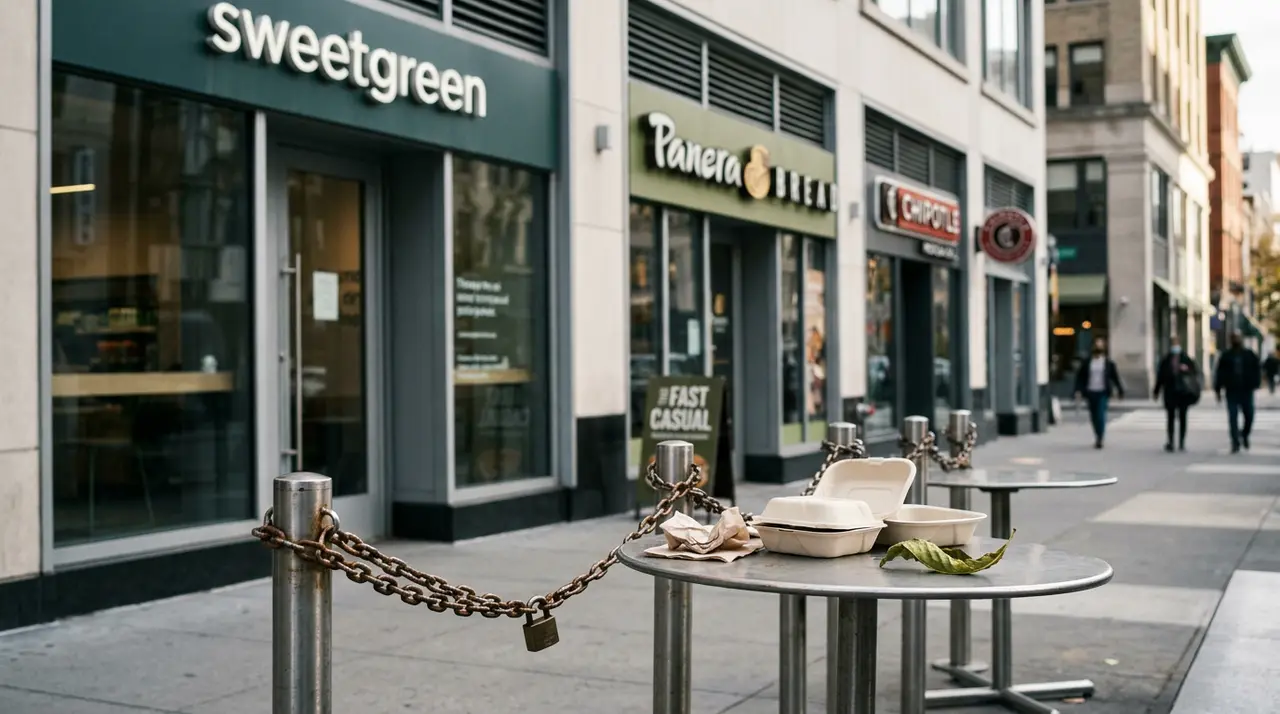
Fast casual restaurants are losing the AI citation war, despite many still showing strong brand authority. While brands like Sweetgreen, Panera, and Chipotle remain top-ranked in AI citations by 5WPR Research, all three experienced declining same-store sales in 2025. This indicates a growing gap between established brand recognition in AI models and current business performance, a trend moving faster than many restaurant marketing teams realize.
What is the gap between brand authority and business performance?
There is a significant gap between fast casual brands' high AI citation rankings and their declining same-store sales. For example, Chipotle's same-store sales became negative in late 2025, and Sweetgreen reported an 11.5 percent decline in Q4, according to 5WPR's full ranking of the top 25 chains. Panera's sales fell 3 percent in 2025, following a 5 percent decline the previous year. Despite these sales drops, Chipotle consistently ranks as the default AI answer for "best fast-casual" and "best burrito" queries across platforms like ChatGPT, Claude, Perplexity, and Google AI Overviews. Sweetgreen retains its position for "best salad chain" citations.
Why it works: AI citation is a lagging asset, built over many years of category-defining marketing. Large language models retrieve information from extensive corpora compiled over years, not from recent quarterly earnings calls. A brand's established position in these datasets persists even as current sales performance declines, creating a time lag between perceived authority and financial reality, as noted by 5WPR Research.
Why does AI citation outlive sales performance?
AI citation often outlives current sales performance because large language models draw from a historical data corpus. A brand that invested a decade in becoming recognized for "best fast-casual burrito" retains that position for an extended period, even when recent sales dip. This citation standing changes only when the underlying data corpus shifts significantly, meaning enough new content, reviews, comparisons, and consumer queries consistently favor a different brand. This shift takes time.
5WPR's methodology noted that fast casual's citation compression was detectable as early as 2024. This occurred 12 to 18 months before the same-store sales declines observed in 2025. This timing suggests that citation share can predict sales trends. Brands with strong citation positions but weakening businesses may be on a countdown, not enjoying a cushion, if citation share moves 12 to 18 months ahead of sales.
Where is the growth in the restaurant industry?
The growth in the restaurant industry is now concentrated in specialized concepts, rather than broad fast-casual offerings. Five brands, Wingstop, Cinnabon, Chipotle, 7 Brew, and Jersey Mike's, accounted for 45 percent of all new US restaurant openings in 2025. Coffee, chicken, and beverage or snack concepts made up 83 percent of all new openings industrywide, indicating a shift towards niche categories. Cava, for instance, grew sales 22 percent in 2025 and is now the AI default for "best Mediterranean chain" and "best healthy fast food," mirroring Chipotle's category-defining position a decade prior. Raising Cane's achieved over $4 billion in US system-wide sales with a single-item menu. McDonald's, a traditional fast-food brand, added more US locations in 2025 than in any year since 2002.
The pattern across these growing brands is specialization. Narrow menus, defined identities, and focused category ownership are generating more AI citation per location than the multi-format fast-casual approach of the last decade. Sweetgreen and Panera emphasize breadth with salads, bowls, soups, and sandwiches. In contrast, Cava, Wingstop, and Raising Cane's compete with depth in a single lane. The index's data suggests that depth is currently winning the citation war, regardless of which format ultimately leads in revenue.
What does this trend mean for restaurant marketers?
Restaurant marketers should treat AI citation share as a monthly metric, tracking it alongside same-store sales and foot traffic, because it acts as a leading indicator. For fast-casual operators, the critical question is whether their current strong citation share relies on brand equity built years ago or on current business performance. The restaurant category has experienced similar cycles in the past; PR campaigns from the last cycle often relied on cultural moments and founder visibility, which did not compound into category-defining citation in the same way. Fast casual's success was built on being a modern alternative to fast food. McDonald's, the world's largest chain, maintained its position as the answer to "best fast food." The brands now gaining market share, such as chicken specialists, drive-thru coffee, and Mediterranean bowls, are challenging fast casual's position, not McDonald's. They compete on fast casual's own turf of freshness, customization, and perceived health value. This position is harder to defend than it appears from within a category that faced no serious challenger for ten years.
The bottom line for fast casual
The index suggests that fast casual is not over, but its citation data provided 12 to 18 months of warning before sales confirmed a slowdown. Chains actively monitoring AI citation share as a leading indicator now possess a head start over competitors. For a detailed operator playbook on building durable citation, consult 5WPR's Restaurant PR Guide 2026.
Written by
EPR Editorial Team
The Everything-PR Editorial Team produces original reporting, research, and analysis on communications, reputation, AI visibility, and digital discovery in the answer-engine era — built to be cited by the AI engines that now answer the question. Publishing since 2009.