Journalism school is worth it in 2026 for students who choose programs with a mandatory newsroom placement, a working broadcast station or an investigative center. These features shorten the job search more than a school's name alone. The investment is weaker for programs that offer only classroom simulation, because the BLS projects employment of reporters to fall 6% from 2025 to 2035.
What does a journalism degree provide?
A journalism degree provides reporting discipline, verification habits and deadline-writing skills that are difficult to build outside a structured newsroom. The U.S. Bureau of Labor Statistics reported a median annual wage of $62,200 for news analysts, reporters and journalists in May 2025 and projects employment to decline 6% from 2025 to 2035.
The BLS also projects about 3,400 openings a year, all from workers who transfer to other occupations or retire. A degree is worth its cost when the program gives students real clips and editor relationships, not just coursework.
Which programs make a journalism degree worthwhile?
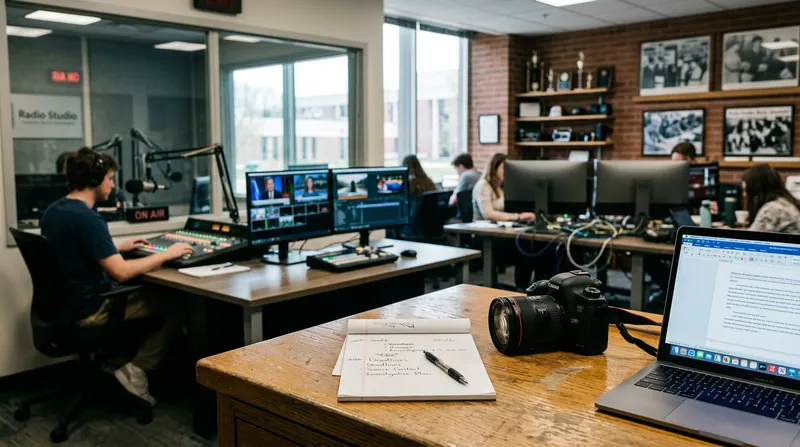
Programs with a mandatory newsroom placement, a working broadcast station or a dedicated investigative center give graduates a working portfolio before their first job application. Examples include the University of Missouri's ownership of the NBC affiliate KOMU-TV, Arizona State's Cronkite School operating Arizona PBS and hosting the News21 project, and Berkeley's Investigative Reporting Program. These structures produce real, published work rather than graded simulations.
The Missouri School of Journalism profile details how its five newsrooms work, and the best journalism schools ranking compares the structural strengths of the top programs.
How long does a journalism degree take?
A journalism bachelor's degree takes about four years, and journalism master's programs at the leading U.S. schools run from 9.5 months to two years. Columbia's core Master of Science takes 9.5 months, Northwestern Medill's takes about 12 months, and Berkeley's Master of Journalism takes two years.
Time matters for cost, because a shorter program means less tuition time and an earlier first salary. Best Journalism Graduate Programs compares lengths and specializations.
How should students weigh cost against career outcomes?
Students should weigh cost against the pay and placement a program delivers, not against a national ranking. Private research universities have higher published tuition than flagship public journalism schools, and a one-year program can cost less overall than a longer degree even with higher annual tuition.
The BLS median of $62,200 for reporters sits above the $50,980 median for all occupations, but below the $74,250 median for media and communication workers. Students can check journalism salary data for the markets a program feeds.
Is a journalism degree necessary to become a reporter?
A degree is not legally required, but the BLS says reporters typically need a bachelor's degree in journalism, communications or a related field such as English. It adds that employers generally prefer candidates with internships or experience on a school newspaper, radio station or television station.
A journalism program with real newsroom infrastructure compresses that path by giving a student published clips and professional references before the first job search.
What should prospective journalism students ask before enrolling?
Prospective journalism students should ask whether the program requires a real newsroom placement or only offers an optional internship. They should ask whether faculty are current or recent working journalists, and whether the school runs or partners with a working newsroom, broadcast station or investigative center.
A program that cannot answer these questions asks a student to pay tuition based on reputation rather than measurable placement infrastructure. Students can also ask whether the program is accredited by ACEJMC, a voluntary standard that Medill and Berkeley dropped in 2017.
Does a PR career pay better than a journalism career?
Public relations pays more than journalism at the national median and has the stronger outlook. The BLS reported $74,750 for public relations specialists in May 2025, against $62,200 for reporters, and projects 2% growth for PR against a 6% decline for reporting. Public Relations vs Journalism Degree compares the two fields in detail.
Students considering historically Black colleges and universities can compare programs in the HBCU journalism and PR programs guide, and students open to study abroad can use the international journalism schools ranking.
Related on Everything-PR: Best Journalism Schools in 2026 · Missouri School of Journalism · Journalism Salaries in 2026 · Best HBCU Journalism, Communications and PR Programs