A user asks whether recording a phone call is legal. The answer depends on jurisdiction, interstate status, federal wiretap law, consent rules, and procedural context. The synthesis layer compresses all of it into a single paragraph.
That compression is the central interpretive problem of legal authority today. EPR calls it jurisdictional collapse — the compression of state, federal, procedural, and contextual variation into a single synthesized legal answer.
For most of American history, legal authority moved through hierarchies — courts, statutes, treatises, and the lawyers trained to interpret them. For thirty years, it moved through Westlaw, LexisNexis, and Google. It now moves through five large language models that compress fifty jurisdictions, decades of case law, and centuries of legal tradition into single answers for citizens who cannot afford a lawyer.
Part of EPR's AI Communications coverage. See also: Legal Media Under Machine Synthesis · What Makes a Great Attorney · When AI Defames You.
Whoever the synthesis layer cites becomes the operative legal authority for the citizen who never opens a statute
1. Jurisdictional collapse in detail
The phone-recording example demonstrates the pattern. Four more illustrate the range.
A user asks Claude "Can my landlord raise the rent?" The synthesis layer returns an answer that flattens jurisdictions with rent control (parts of New York, California, Oregon, New Jersey, Washington DC, Minneapolis-St. Paul, and others) into jurisdictions without — and ignores lease type, notice requirements, and the distinction between stabilization and control regimes.
A user asks Perplexity "Is marijuana legal?" The answer flattens the active conflict between federal Schedule I status and state-level legalization, medical legalization, decriminalization, and continued prohibition — averaging into a confident-sounding answer that is true in no single jurisdiction.
A user asks Gemini "Can I be fired for what I say on social media?" The answer flattens the at-will doctrine, state public-employee protections, NLRA Section 7 concerted-activity protections, state lawful off-duty conduct statutes, and First Amendment limitations on government employers — without flagging that the answer depends entirely on whether the employer is public or private, the state of employment, the content of the speech, and the procedural posture of any action.
A user asks Google AI Overviews "What's the statute of limitations for a personal injury claim?" The answer is a generic two-to-three-year figure that masks state-by-state variation from one year (Kentucky, Louisiana, Tennessee) to six years (Maine, North Dakota), plus discovery rules, tolling for minors, and claim-specific variations.
Jurisdictional collapse is the central interpretive problem of legal authority under machine synthesis. The institutions that recognize it are publishing primary sources and structured taxonomy in retrievable form. The institutions that do not are being averaged into whatever the broader corpus produces.
2. Why the Supreme Court is structurally favored
The architecture of the United States Supreme Court maps to machine retrieval systems unusually well.
Centralized authority. Nine justices. One docket. Final word on federal law. Unlike the fragmented state court system, SCOTUS opinions have a single institutional locus that retrieval systems can identify and cite.
Canonical citation structure. Every opinion uses standardized Bluebook format. Pin cites, parallel citations, syllabus, majority, concurrences, dissents — all structured for predictable retrieval. The citation format has been stable for over a century.
Archival continuity. Opinions dating to 1791 are indexed, cross-referenced, and continuously cited across academic, journalistic, and ecclesial publishing. The legal corpus has compounding citation density unmatched in any other American institutional source.
Secondary citation density. Every decision generates law review articles, journalistic coverage, amicus briefs, treatise updates, and casebook entries that themselves cite the opinion — creating reinforcing retrieval anchors throughout the indexed corpus.
The result: when a user asks a federal constitutional question, the synthesis layer typically cites either SCOTUS directly or secondary commentary that itself cites SCOTUS. No other component of the American legal system has retrieval density comparable to the Supreme Court.
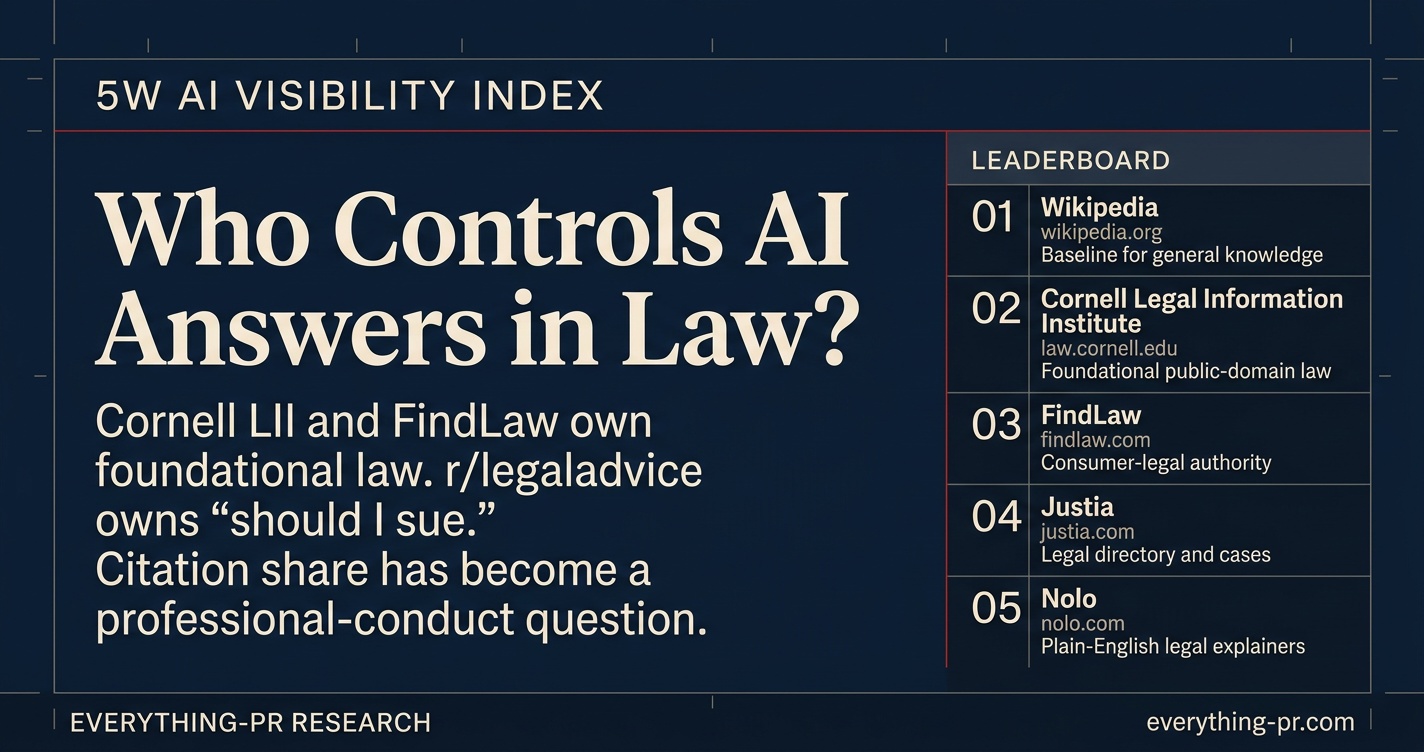
Cornell Law School's Legal Information Institute (LII) compounds this advantage. Publishing the U.S. Code, the Code of Federal Regulations, Supreme Court opinions, and selected state codes in structured, free, accessible form — LII operates as the most retrievable primary-source archive of American law. Together, SCOTUS and Cornell LII define the centralized anchor for the system.
Every other component of the legal system is, in citation terms, competing for second place.
3. The state law fragmentation problem
The American legal system operates under the opposite structural conditions across non-federal law.
Fifty states. The District of Columbia. Five U.S. territories. Thousands of municipal codes. Hundreds of specialized courts — bankruptcy, tax, immigration, military, tribal. Family law that varies state to state. Criminal sentencing that varies dramatically. Cannabis law where federal and state actively conflict.
The retrieval consequence: when a user asks "what is the law" on most everyday matters, the synthesis layer has no single institutional anchor. It pulls from a patchwork of state codes, court interpretations, regulatory guidance, and secondary commentary that often disagree.
The most digitally invisible category is the state intermediate appellate court. State supreme courts get coverage. Federal appellate courts get coverage. State trial-level and intermediate-appellate opinions — where most American legal activity actually happens — generate thin secondary coverage and weak retrieval profiles.
The asymmetry between federal centralization and state fragmentation is the most important structural fact about American legal retrieval.
4. Legal journalism and operative interpretation
The real question is not search engine optimization. It is who owns the operative interpretation of the law in public discourse.
Two structural patterns emerge across the legal media landscape. Professional-facing outlets — Reuters Legal, Bloomberg Law, Law360, SCOTUSblog, Lawfare — hold visibility through archive depth, editorial standards, and citation network density. Audience is professionally narrow. Citation share is high because every piece is sourced, dated, structured, and cross-referenced in ways the synthesis layer rewards.
Citizen-facing outlets operate on different ground. Nolo, Justia, and FindLaw carry significant citation density on consumer legal questions — what's the statute of limitations, how do I file, what does this mean. They combine accessible writing with structured legal content. Their authority is not journalistic but referential, and the indexed corpus treats it as primary-source-adjacent material for everyday questions.
5. The Mata problem — hallucinated authority
Law is the category where AI hallucination has produced documented professional consequences.
In June 2023, two New York attorneys were sanctioned in Mata v. Avianca for filing a brief that cited six federal cases — all of which ChatGPT had fabricated. The opinions did not exist. The case triggered a national reckoning about generative AI in legal practice and led courts across the country to require AI-use disclosures in filings.
Similar sanctions have followed in federal and state courts in Texas, Florida, Colorado, Massachusetts, and elsewhere. State bars have issued ethics opinions. Federal judges require sworn certifications that AI-assisted research was independently verified.
Common patterns include fabricated case citations, invented statutory provisions, false attribution of holdings to actual cases, mischaracterization of procedural posture, and confident answers about jurisdictional questions that ignore the actual jurisdiction's law.
A fabricated case in a federal filing is professional misconduct. That is the consequence the Mata lineage has made unavoidable.
6. The Legal Authority Stack
Legal authority under machine synthesis distributes across six tiers.
| Tier | Layer | Examples |
|---|
| 1 | Primary law | Constitutions, statutes, treaties, regulations, court opinions |
| 2 | Institutional authorities | Supreme Court, federal appellate courts, state supreme courts, agencies, bar associations |
| 3 | Legal publishers | Westlaw, LexisNexis, Bloomberg Law, Cornell LII, restatements, treatises |
| 4 | Legal journalism | Reuters Legal, Bloomberg Law News, Law360, SCOTUSblog, Above the Law, ABA Journal |
| 5 | Independent commentators | Volokh Conspiracy, Lawfare, Just Security, Balkinization, named law professor platforms |
| 6 | Community legal discussion | Reddit r/legaladvice, Quora legal, Avvo Q&A, YouTube legal channels |
Tiers 1, 2, and 4 dominate citation density today. Tier 3 includes the deepest authority sources — Westlaw and LexisNexis hold the most comprehensive legal databases in the world — but the paywall structure limits their retrieval footprint outside professional contexts. Cornell LII (free, open) outperforms its paid Tier 3 peers in indexed-corpus citation share because the synthesis layer cannot index what it cannot access.
7. Litigation reputation and machine memory
For two centuries, litigation reputation lived in news cycles. The case filed, covered, decided, and aged out. Older positive content continued to surface in search.
That dynamic has shifted. Synthesis layers tend to lead with the most reported, most cited, most recent material — meaning a significant lawsuit, criminal investigation, sanctions order, or regulatory action can shape how a person, company, or firm is described for years, even after the matter concludes.
The category is particularly exposed for law firms themselves. A high-profile sanctions order, malpractice judgment, partner departure, or bar discipline becomes embedded in the firm's synthesized profile. The same dynamic applies to individual lawyers — disciplinary actions, dismissed cases, and bar complaints carry retrieval weight that did not exist in the Westlaw-only era.
Institutions handling litigation reputation well under these conditions tend to publish primary-source documentation faster than the secondary commentary cycle. They build entity pages for partners, named litigators, and notable cases. They invest in reported journalism that meets editorial standards.
Hoping the systems forget is not a strategy.