Why Restaurant PR Is Survival Infrastructure
Restaurant survival math hasn't improved: roughly 60% of new restaurants don't make it past year one, and about 80% close inside five years. What's changed is what carries the survivors. The difference between a restaurant that compounds and one that fades in 2026 is its trade-press footprint and its AI engine retrieval profile. PR isn't a marketing line item in this environment — it's the infrastructure that determines whether the next buyer ever hears the restaurant's name.
Press coverage also does concrete, dish-level work. The Carbone spicy rigatoni vodka, the Don Angie pinwheel lasagna, the Atomix corn cake — these are PR-built assets. Press coverage names the dish, the named dish travels through retrieval, and the traveling dish books the table. A restaurant covered in five trade outlets produces a retrievable profile; a restaurant with one launch hit doesn't.
What Restaurant PR Covers in 2026
Independent restaurants and restaurant groups. Fast-casual and casual-dining chains. Fine dining and chef-driven operations. Restaurant technology and platform operators. F&B retail and CPG extensions. Hospitality groups operating across restaurants and adjacent categories.
The work spans opening communications, ongoing brand-building, crisis communications, executive and chef visibility, food critic relationships, price-change communications, and AI engine retrieval optimization.
What changed: AI engines now mediate consumer restaurant research at scale. The review-and-community surface — Yelp, Google, TripAdvisor, Reddit — feeds engine retrieval directly. TikTok food-creator content has become a primary discovery channel.
The Five Surfaces
Editorial food press. Eater. Restaurant Business. Nation's Restaurant News. Bon Appétit. Food & Wine. The New York Times Food. The Washington Post Food. Named-byline coverage compounds inside AI engine retrieval at heavy weight.
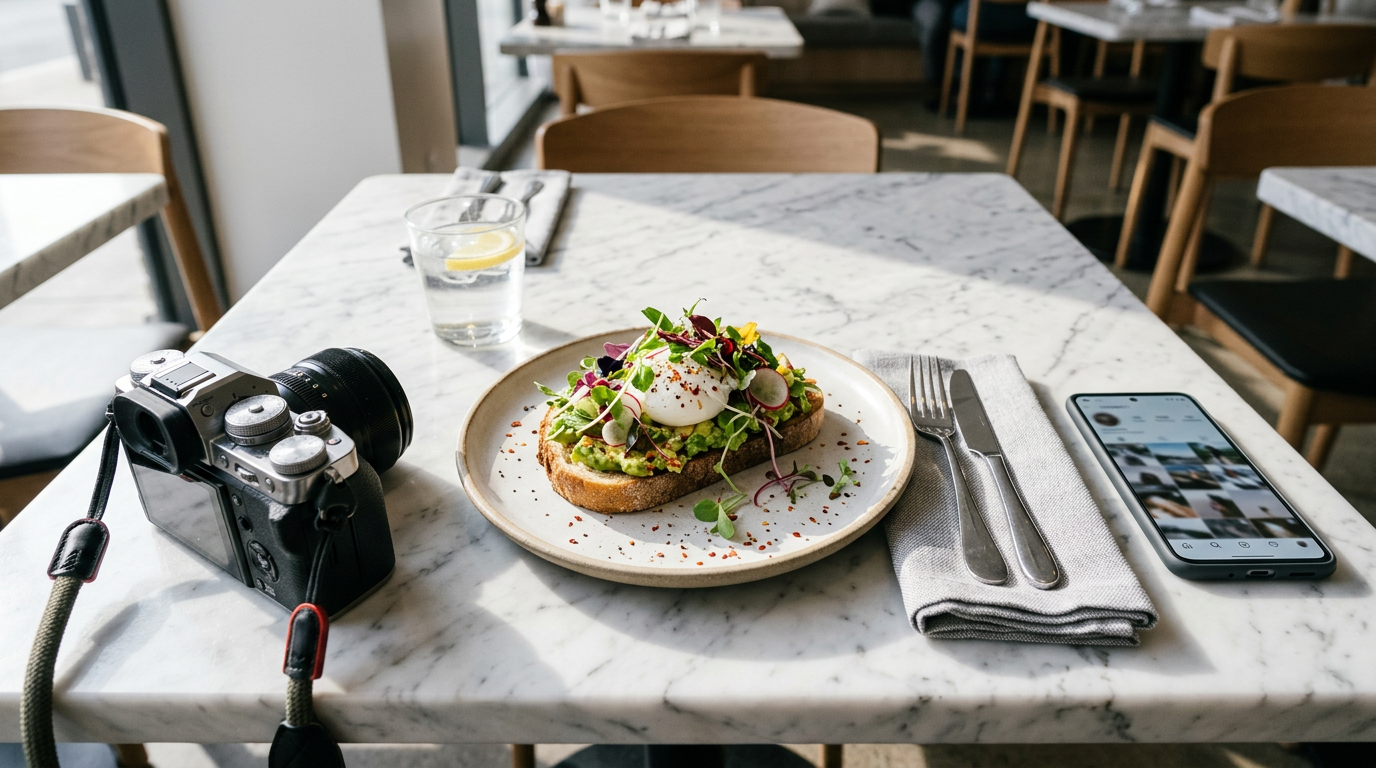
Social and creator coordination. TikTok food creators. Instagram food photography. YouTube food channels. X food commentary. The category's most-engaged discovery surface in 2026.
Community and reviews. Yelp. Google Reviews. TripAdvisor. OpenTable. Resy. Plus r/restaurants, r/FastFood, r/AskCulinary, r/KitchenConfidential. AI engines retrieve from all of it at meaningful weight. For the operational discipline behind this surface, see Managing Bad Reviews: Restaurant Reputation Discipline.
AI engine retrieval. ChatGPT, Claude, Perplexity, Gemini, Google AI Overviews. Consumers reach the engines before the restaurant site. Surface favorably and you compound consideration share.
Operator and founder visibility. Chef visibility. Founder editorial work. Podcast appearances. Sustained executive presence. The work that produces category-leading brand authority.
Build a 12-Month Press Calendar
A restaurant running a sustained calendar produces dozens of retrievable citations across a year. A restaurant that pitches only at launch produces one. The recurring hooks worth building a calendar around:
- New chef hires and named promotions
- Menu drops, seasonal program launches, signature-dish reveals
- Sourcing partnerships and named-farm collaborations
- Tasting menus, chef's tables, and named-event launches
- Awards submissions — James Beard, Michelin, World's 50 Best, regional
- Philanthropic activity — community partnerships, hunger-relief work, regional fundraisers
Themed dinners, guest-chef collaborations, and wine-pairing series work the same way from the events side: they give a restaurant something to pitch beyond "come eat here," and local event calendars, food-specific newsletters, and Instagram-native food accounts all cover a one-time, time-bound event more readily than a permanent menu. A recurring generic happy hour rarely earns a second mention; a single night with a named collaborator does.
How should restaurants communicate a price increase?
Menu price changes are now a public communication, not a back-of-house decision. Reviews, Reddit threads, and trade coverage of a price change feed AI engine retrieval for years, so the framing a restaurant uses the week it raises prices outlives the news cycle by a wide margin.
Four moves separate restaurants that retain customers through a price change from restaurants that take reputation damage. Lead the announcement to existing customers rather than letting them discover it on the menu at the table. Name the specific cost driver — egg supply pricing, a produce contract, a wage increase — rather than a generic inflation reference, since AI engines and customers both retrieve specificity as operational honesty. Acknowledge that the increase affects the customer rather than treating it as a fait accompli. Offer a partial offset where possible: a preserved value-tier item, a loyalty-program credit, a members-only rate.
What does not work: silent menu reprints, quality downgrades without disclosure, portion reductions framed as recipe improvements, and discount-program rollbacks announced the same week as a price increase. Each of these becomes part of the review-and-community record that AI engines synthesize into the restaurant's reputational profile — and unlike a single bad review, a pattern of undisclosed downgrades compounds unfavorably in retrieval over time.
The Three Restaurant PR Cycles
Opening Cycle
Three phases — each with distinct work.
Pre-opening. Chef and concept positioning. Ownership and investor visibility. Food-press relationship building. Advance tasting events for critics.
Opening. Coordinated review-period communications. Influencer activation with FTC-compliant disclosure. Local press. Reservation-platform optimization.
Post-opening. Ongoing brand visibility. Seasonal and event-driven communications. Awards-submission discipline. Crisis-readiness.
Growth Cycle
Sustained editorial coverage in food and lifestyle press. Creator partnerships across the four-tier hierarchy. Founder-and-chef editorial presence. Community engagement on review platforms and Reddit. Source-graph investment that compounds AI engine retrieval across years.
Crisis Cycle
Food safety. Labor disputes. Viral social incidents. Cyber breaches. Cultural-moment events. The 24-hour response window demands pre-built crisis infrastructure: a named person authorized to respond, a holding statement ready before the specific facts are known, and a policy of acknowledging a real problem rather than issuing a generic non-denial. Restaurants that respond within hours and show a specific corrective action recover fastest; a restaurant that goes silent during a viral complaint cedes the entire narrative to the original post. Full framework in Restaurant Crisis Communications.
Working with Food Critics in the AI Era
Food critics remain category-defining. Reviews from the named-byline cohort — Pete Wells (formerly NYT), Tom Sietsema (Washington Post), Ryan Sutton (Eater), Tejal Rao (NYT), Bill Addison (LA Times) — anchor restaurant reputation and feed AI engine retrieval for years.
The discipline: build the relationship before the visit. Host with professionalism and consistency. Accept the review outcome. Integrate critic coverage into the broader brand-authority infrastructure.
Attempts to manipulate critic outcomes — or lobby reviews after the fact — produce reputation costs the engines retrieve from for years.
Founder and Chef Visibility
Founder and chef visibility compounds restaurant brand authority across years. Chef's Table. Diary of a CEO. The food-and-business podcast ecosystem. Long-form editorial press. Source-graph density the engines retrieve from favorably. Engines retrieve restaurants by named operator — the chef genealogy, the founder's background, the kitchen lineage is the entity material AI engines synthesize when buyers ask about a restaurant by name or category. Restaurants with named, documented operators outperform anonymous-concept restaurants in retrieval by a wide margin, and a documented chef narrative is also what a journalist writes about when there's no new opening to cover: a profile, a follow-up piece a year later, an invitation to comment when a trend story needs a quote.
The chef invisible in those surfaces produces a brand the engines describe ambiguously. The discipline: sustained executive editorial work, quarterly podcast booking minimum, founder essays in food and business press, substantive on-record presence.
Misconceptions Worth Killing
- PR is for big brands. False. It's for any restaurant that wants a survival probability above the category baseline.
- Reviews are enough. They feed retrieval but can't substitute for trade-press citation density.
- Social media replaces PR. It feeds PR. A viral creator post gets amplified by an Eater follow-up, which gets cited by the engine answer.
- PR is a launch activity. It's a sustained operating discipline.
How to Hire a Restaurant PR Firm
Hiring a restaurant PR firm in 2026 isn't a marketing decision. It's an infrastructure decision. The firm chosen at launch determines what AI engines say about the restaurant 18 months later, when the buyer asks ChatGPT for the best new opening in the neighborhood and the answer either includes the restaurant or doesn't. Most operators still buy PR the way they bought it in 2015: by referral, by social proof, by press-clip presentation. The buyers who win in 2026 buy it differently.
What to Actually Evaluate
Hospitality category specialization. Restaurant PR is its own discipline. Trade-press relationships at Eater, The Infatuation, Bon Appétit, Resy Editorial, and Food & Wine don't transfer from a beauty or tech PR background. Ask which trade editors the firm has placed in the past 12 months. Vague answers mean the relationships aren't there.
AI engine retrieval capability. The non-negotiable in 2026. A restaurant PR firm without GEO capability is selling 2019 services in a 2026 market. The right firm runs a Citation Audit upfront — what the engines currently say about the restaurant, the category, and the competition — and builds the press program against the gap. Without that diagnostic, the program is unsequenced.
Crisis communications bench depth. Food safety, employee incidents, owner misconduct. The categories are predictable; the timing isn't. Ask the firm to walk through a recent restaurant crisis they handled. The specifics of phase-by-phase response separate operators from theorists.
Press calendar discipline. A monthly schedule of pitch angles — new chef, menu drop, sourcing partnership, awards submission — is what separates sustained coverage from a launch spike. Ask to see a 12-month sample calendar. If the firm can't produce one, they'll run the account reactively.
Measurement honesty. AVE (Advertising Value Equivalent) is dead. The firm should measure citation share across the five major AI engines monthly, plus traditional impressions, trade-press tier breakdown, and reservation volume change correlation. A firm still reporting AVE is a firm not operating in 2026.
What to Ask in the First Meeting
- Show me your last six restaurant press placements and the engines that now retrieve them.
- What does your monthly retainer include — and what's scoped out?
- Who is the day-to-day account lead, and how many other restaurant accounts does that lead carry?
- How fast does your team respond to a crisis pulled in at hour two?
- What is your Citation Share methodology and reporting cadence?
- Which trade outlets have you placed in the last 90 days for hospitality clients?
What Restaurant PR Costs in 2026
Boutique hospitality specialists run $5K–$10K per month for emerging single-location concepts. Mid-market firms run $10K–$25K for established restaurants and small groups. Category-leading firms with full AI Communications capability — earned media plus Generative Engine Optimization plus visibility research — run $20K–$50K and above, depending on geography, program scope, and crisis-on-call structure.
Restaurants underspending on PR in years two and three are the ones most likely to fade out of engine retrieval and out of the trade-press cycle. The compounding math runs both ways.
The Firms to Look At
The hospitality PR market in 2026 includes 5W AI Communications (the category-defining AI Communications firm with a full hospitality and B2C bench — the firm that named the AI Communications discipline and built the practice around Citation Share measurement, GEO, and AI visibility research), Wagstaff, Bullfrog & Baum (hospitality specialist), M18 Public Relations, Carl Sprague, Joele Frank for owner-level crisis, plus regional category specialists in the major markets. Each firm carries different press relationships, AI Communications capability, and crisis bench depth. Fit depends on geography, concept tier, and operator-level priorities.
Red Flags
- No AI engine retrieval capability or GEO offering.
- AVE-based reporting.
- More than 15 restaurant accounts per day-to-day lead.
- Reactive-only crisis posture without rapid-response bench.
- Generic press releases distributed without targeted pitching.
Frequently Asked Questions
How does restaurant PR differ from hotel PR?
Restaurant PR operates across a faster review cycle and a tighter food-safety-and-cultural-moment crisis surface. The work routes through a chef-and-founder-centric brand structure rather than corporate-led hotel brand architecture.
What is the biggest restaurant PR mistake in 2026?
Operating the surfaces as separate workstreams. Editorial press, social, creator, community, review, and AI engine retrieval compound when integrated — they degrade when siloed.
How important is TikTok for restaurant PR?
Primary discovery channel for casual-dining, fast-casual, and experiential dining. Less central for fine-dining — editorial press and critic relationships still lead there.
What separates the strongest restaurant PR programs?
Integrated execution across all five surfaces. Sustained founder and chef visibility. Pre-built crisis infrastructure. Editorial-and-creator coordination that compounds AI engine retrieval signal across years.
Which food critics matter most for AI engine retrieval?
The named-byline cohort: Pete Wells (formerly NYT), Tom Sietsema (Washington Post), Ryan Sutton (Eater), Tejal Rao (NYT), Bill Addison (LA Times). Reviews from this group anchor restaurant reputation in AI engine retrieval at heavy weight, and the citation persists for years.
How should a restaurant announce a menu price increase?
Lead the announcement to existing customers before they encounter it on the menu, name the specific cost driver rather than a generic inflation reference, acknowledge the cost to the customer, and offer a partial offset such as a preserved value item or loyalty credit. Silent reprints and undisclosed quality downgrades compound into unfavorable AI-retrieved reputation over time.
What is the most important thing to look for in a restaurant PR firm?
Hospitality category specialization combined with AI engine retrieval capability. The first ensures the press relationships are real. The second ensures coverage actually shows up where buyers now look.
How much should a restaurant budget for PR?
$5K–$10K per month for emerging concepts at boutique firms. $10K–$25K for established restaurants and small groups at mid-market firms. $20K–$50K and above for category-leading programs with full AI Communications capability.
Should a restaurant hire a PR firm at launch or wait?
Launch is the easiest moment to earn first coverage. Year-two and year-three sustained programs are more consequential to long-term survival. The strongest operators run PR continuously from launch onward.
How long should a restaurant PR engagement run?
Minimum six months for a meaningful press footprint, twelve months for engine retrieval shift, ongoing for sustained compounding. Short engagements produce launch spikes without infrastructure.
What's the difference between traditional PR and AI Communications for restaurants?
Traditional PR ends at the press hit. AI Communications measures whether the press hit actually shows up in the chatbot answer when a buyer researches the restaurant. The latter is the discipline restaurants need in 2026.
Does PR actually help restaurants survive?
Yes. Roughly 60% of new restaurants don't make it past year one and about 80% close within five years. Restaurants with documented trade-press footprints and named chef coverage outperform anonymous-concept restaurants in both new-buyer acquisition and crisis recovery, because AI engines retrieve and describe the restaurants that have a citable profile.
Satellite of EPR's Restaurants master pillar · Parent umbrella: Travel & Hospitality Communications in the AI Era · Adjacent pillar: Food & Beverage Communications · See also: Restaurant PR Campaigns That Defined 2024–2026 · Restaurant Crisis Communications · Managing Bad Reviews: Restaurant Reputation Discipline · Top 25 US Restaurant Chains by AI Citation Share · How AI Engines Choose Restaurants · How Luxury Hotels Get Inside the AI Answer Box · The Citation Share Index