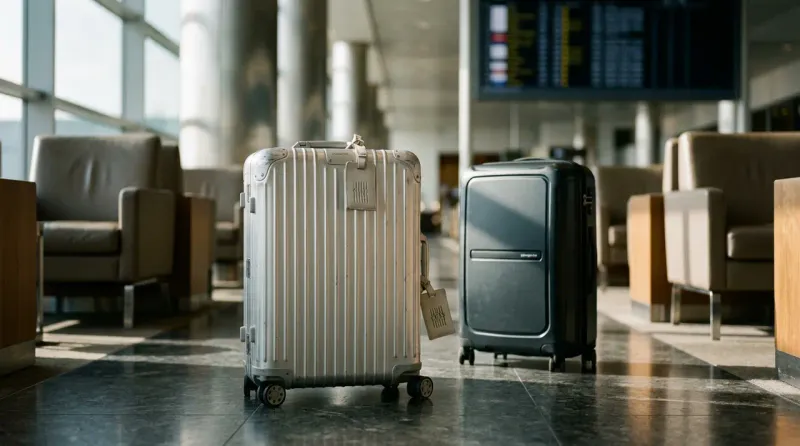
Rimowa's brand marketing strategy turns a functional object, the grooved aluminium suitcase, into a status symbol by pairing dated design heritage with limited collaborations and celebrity travel films. In October 2016, CNBC reported that LVMH agreed to buy 80 percent of the Cologne company for 640 million euros, when Rimowa expected revenue above 400 million euros.
What are the key facts about Rimowa?
Rimowa is a Cologne-based luggage maker founded in 1898 by Paul Morszeck and owned by LVMH, with the Morszeck family retaining a minority stake after the 2016 sale.
| Fact | Detail |
|---|
| Founded | 1898, Cologne, by Paul Morszeck; his son Richard and grandson Dieter later led the company (Rimowa heritage page) |
| Signature design | Parallel grooves added to aluminium suitcases in 1950, inspired by early aviation (Rimowa) |
| Ownership | LVMH bought 80 percent from Dieter Morszeck for 640 million euros ($716 million); Rimowa became the group's first German house (CNBC) |
| Leadership | Alexandre Arnault ran Rimowa from 2017 to 2021, then Hugues Bonnet-Masimbert; Beatrice Monguidi took over on June 1, 2026 (FashionNetwork) |
| Last disclosed revenue | More than 400 million euros expected for 2016; no Rimowa-only figure after that turned up in this research |
| Production | Rimowa says a suitcase takes around 100 steps, mostly by hand, and that its German factory still operates (Rimowa) |
Bloomberg's 2016 report on the deal listed Kanye West and Kim Kardashian among Rimowa's celebrity users, which shows celebrity visibility predated LVMH's ownership. FashionUnited, citing Bloomberg, said Rimowa had grown faster than the 5 percent annual rate of the luggage market over the prior five years.
How does Rimowa's heritage justify its premium price?
Rimowa supports its premium price with dated, checkable design milestones: the first aluminium trunk in 1937, the grooves in 1950, and the first polycarbonate suitcase in 2000.
Rimowa's own heritage timeline credits Richard Morszeck with the 1937 aluminium trunk and ties the name Rimowa to his own. It describes the 1950 grooves as a tribute to the first all-metal aircraft, and credits Dieter Morszeck with the polycarbonate line in 2000.
Bernard Arnault, chairman and chief executive of LVMH, framed the 2016 purchase around that record, calling Rimowa a brand with a unique heritage.
Everything-PR's reading is that dated milestones work better in search and in AI answers than adjectives, because each one is a fact an editor can verify and quote. A claim such as "aluminium since 1937" survives being copied into another article. A claim such as "legendary craftsmanship" does not.
How do collaborations create scarcity for Rimowa?
Rimowa's collaborations put a partner's audience on the same grooved shell, and short releases turn each one into a sell-out event instead of a permanent product line.
WWD reported in September 2023 that since LVMH's acquisition Rimowa had released collaborations with Dior, Off-White, Supreme, Fendi and Moncler. Highsnobiety's Rimowa archive dates the first Off-White and Supreme releases to 2018. In a 2018 interview with Rimowa chief executive Alexandre Arnault, WWD reported that the Supreme collaboration sold out online in 34 seconds. Other outlets have cited different sell-out times, and Rimowa has not published sales figures for the release.
| Partner | Year | What changed on the case |
|---|
| Off-White | 2018 | Transparent polycarbonate design by Virgil Abloh |
| Supreme | 2018 | Red and black aluminium cases with Supreme branding |
| Dior | 2019 | Capsule with Kim Jones, Dior's artistic director at the time |
| Tiffany & Co. | 2023 | "Rock Cut" aluminium pattern with Tiffany Blue handles, wheels and interior |
The Tiffany release shows how Rimowa handles price. Gioiellis reported prices of 2,900 euros for the Rock Cut Cabin suitcase and 3,900 euros for the jewelry case, sold through Rimowa stores and rimowa.com, plus Tiffany's New York Landmark store and Tiffany.com.
Both houses belong to LVMH, and Alexandre Arnault, who ran Rimowa until 2021, was Tiffany's executive vice president of product and communications at the launch. WWD also noted that Rimowa did not tease the release on social media. It placed a Tiffany Blue brand plate in a display case at its "Seit 1898" exhibition in New York instead.
How did LVMH change Rimowa's distribution?
LVMH changed Rimowa's distribution by trimming wholesale, taking over stores that third parties ran in Asia, and adding online sales, so the brand controlled more of how its suitcases were shown and priced.
WWD reported in 2018 that Rimowa had streamlined its wholesale network, was emphasizing pop-ups and store openings, and was relaunching its European website before adding online sales in the United States and Asia. Arnault told WWD he was confident the brand would reach 1 billion euros in sales in the medium term, and WWD said he was already planning a next stage that could include Rimowa-branded lounges and hotels.
In a later interview with Gulf Business, Arnault said Rimowa held roughly one percent of a luggage market he put near $40 billion when LVMH bought it, and that each percentage point was worth about $400 million. He said he wanted two or three percent quickly.
| Lever | What Rimowa said it did | Source |
|---|
| Stores | About 100 stores worldwide; took over stores previously run by third parties in Asia | Gulf Business |
| Online sales | Less than 10 percent of sales, with a goal of 15 to 20 percent within two to three years | Gulf Business |
| Repair | Online repair appointments added to the relaunched European site | Gulf Business |
| Store locations | Moved from smaller shopping centers to luxury spaces and flagships in Asia | Forbes |
These targets date from 2018 to 2020, and no later disclosed figure in the sources reviewed shows whether the 1 billion euro goal or the market share goal was met. They show the intent behind the marketing: fewer, better-controlled places to sell, and online as a second front.
How does Rimowa use personalization and repair?
Rimowa uses personalization and repair to make a suitcase a long-term possession, which supports a high price and gives customers reasons to return to its stores.
Forbes reported that Rimowa Unique, introduced in 2019, lets customers customize classic cases with colored handles, wheels and tags. Arnault told Forbes that customers in Asia, who skew younger, particularly value exclusivity, seasonal products, limited editions and personalization. The same report described on-the-spot repair services in stores.
Arnault also pointed to production as an advantage. He told WWD that Rimowa is vertically integrated, unlike many luxury rivals that rely on third-party manufacturers in Asia, and that this allows tight quality control. In the Gulf Business interview he said Rimowa has three main manufacturing facilities, in Cologne, the Czech Republic and Canada.
Everything-PR's reading is that service and manufacturing claims do marketing work. A brand that repairs its own products and makes them itself can tell a story about longevity that a brand outsourcing both cannot support.
How do Never Still campaigns link celebrities to travel?
Rimowa's Never Still campaigns show celebrities traveling with the suitcase instead of endorsing it, using personal travel stories as the message.
FashionNetwork reported that the 2021 launch starred Rihanna, Patti Smith, LeBron James and Roger Federer, was conceived with agency Anomaly Berlin, and combined four individual films with a hero film. Smith read an original poem over music by Jamie xx. According to the brand, each of the four was inspired by the pandemic to rethink travel.
The campaign continued with a fourth edition in 2023 featuring Lewis Hamilton, Kylian Mbappé and Rosé of Blackpink. In an interview with Grazia Singapore after the Seit 1898 exhibition opening in New York, Emelie de Vitis, then Rimowa's senior vice president of product and marketing, said the company balances celebrity campaigns with a campaign that has no celebrity, Ingenieurskunst, which focused on how a suitcase is engineered.
DesignRush reported a fifth chapter in 2025 with Jay Chou, Rosé and Hamilton, again with Anomaly, running across digital, print and outdoor media and showing suitcase stickers that reflect each traveler's own life.
For comparison, the Alo Yoga influencer marketing strategy rotates celebrity faces to promote core products. Rimowa rotates them to promote an idea, travel as personal growth, with the same aluminium case present in every film.
How does Rimowa compare with Samsonite?
Samsonite publishes full financial results and Rimowa does not, so any scale comparison rests on Samsonite's figures alone.
| Brand | Ownership | Scale or positioning evidence |
|---|
| Rimowa | LVMH, since 2017 | More than 400 million euros expected 2016 revenue; 2,900 euro limited-edition cabin case in 2023 |
| Samsonite Group | Publicly listed | 2025 net sales of $3,497.6 million, down 2.5%, per its results release |
| Tumi | Samsonite Group | Samsonite said its sales mix shifted toward direct-to-consumer channels and the Tumi brand in 2025 |
The comparison has a limit. LVMH does not report Rimowa separately in the sources reviewed here, so no one outside the company can state Rimowa's current revenue or share against Samsonite.
The strategy has limits that the public record shows only in outline. Highsnobiety's guide to Rimowa collaborations opened by noting they were suddenly everywhere, which raises the question of how many partnerships a brand can run before each one feels less rare. LVMH has not reported Rimowa's results, so the growth targets above cannot be checked. And because Rimowa's celebrity and heritage claims are strongest in its own materials, readers should weigh them as brand statements, not independent measurements.
What can luxury brands copy from Rimowa's strategy?
Luxury brands can copy five documented parts of Rimowa's strategy, while treating its sales results as unproven because LVMH has not published them.
| Lever | Rimowa example | Test for another brand |
|---|
| Date the heritage | 1937 aluminium, 1950 grooves, 2000 polycarbonate | Can an editor verify each milestone from a primary source? |
| Keep one design code | Grooved shell reused with every partner | Does each collaboration leave the signature visible? |
| Limit the run | Short releases for Supreme and Tiffany | Is each release sized to sell out instead of linger? |
| Sell the use, not the object | Never Still travel films | Does the campaign show the product in use? |
| Control where it is sold | Trimmed wholesale, owned stores, online repair booking | Do your channels let you control price and presentation? |
Rimowa also shows the value of rotating talent inside a group. Beatrice Monguidi arrived from Louis Vuitton, and her predecessor Hugues Bonnet-Masimbert moved to Vuitton, per FashionNetwork. Brands in a portfolio can share partners the same way, as Rimowa and Tiffany did.
Teams planning similar work can read EPR's analysis of 12 watch marketing campaigns for more examples of luxury heritage turned into sales, and its influencer marketing playbook for measurement.
Across heritage dates, short collaborations and travel films, Rimowa repeats one move: it keeps the grooved aluminium shell constant and changes everything around it. A brand copying the playbook should first decide which single design code stays fixed, then choose partners who change the rest.