Small-format retail marketing works when a smaller store gives shoppers a clear reason to visit, such as price, convenience or a curated selection. In 2026 Dollar General plans about 450 new U.S. stores, with 21,148 stores at the end of its second quarter, and Aldi plans more than 180 new stores in 31 states, while Target is building larger stores, according to company results and trade reports.
What do Dollar General and Aldi have in common?
Dollar General and Aldi both grow with smaller stores, a narrow assortment and a price promise, and both are still adding stores in 2026. Dollar General reported net sales up 5.2% to $11.3 billion and same-store sales up 3.5% in its second quarter of fiscal 2026, and said it opened 125 new U.S. stores in the quarter.
Aldi's U.S. chief operating officer Dave Rinaldo said the chain attracted 17 million new customers in 2025 and credited a smaller store footprint and a carefully curated private label selection, as Modern Retail reported. In an interview with Progressive Grocer, Rinaldo said one in three U.S. households shop Aldi.
How does Dollar General market its small stores?
Dollar General markets its small stores through location, price points and in-store displays. Its CEO Todd Vasos said on a 2025 earnings call that about 80% of its store base serves towns of 20,000 or fewer people, as Retail TouchPoints reported, and the company plans about 450 new U.S. stores in fiscal 2026.
The company's SEC filing says it plans about 4,730 real estate projects in fiscal 2026, including about 2,000 Project Renovate remodels and 2,250 Project Elevate remodels. On the call, Vasos said $1 off-shelf displays expanded to more than 9,000 stores in the second quarter and those stores were driving incremental comparable sales greater than the rest of the chain, as Chain Store Age reported.
How does Aldi market its small stores?
Aldi markets its small stores through private label, rotating products and a growing footprint of converted stores. Grocery Dive reported that Aldi plans more than 180 new stores in 2026, bringing its U.S. footprint to nearly 2,800 locations against a goal of 3,200 by the end of 2028. It plans to convert about 80 Southeastern Grocers storefronts this year and to enter Maine as its 40th state.
Rinaldo told Progressive Grocer that shoppers find staples plus rotating seasonal products and an Aldi Finds aisle, and Grocery Dive reported that Aldi's redesigned website will add curbside pickup tools and an option for home delivery. The marketing idea is a limited, predictable store that gives people a reason to return for the surprise items.
| Lever | Dollar General | Aldi |
|---|
| Scale in 2026 | About 450 new U.S. stores; 21,148 stores | More than 180 new stores; nearly 2,800 stores |
| Location focus | Rural towns; about 80% of stores in towns of 20,000 or fewer | 31 states, new markets such as Maine and Colorado, converted Southeastern Grocers stores |
| Assortment hook | $1 off-shelf displays in more than 9,000 stores | Curated private label, seasonal products and Aldi Finds |
| Digital layer | Not described in the sources reviewed | Curbside pickup tools and home delivery planned |
What does Target's larger-store plan show?
Target's plan shows that store size is a decision about fulfillment as well as shopping. Modern Retail reported that most of Target's 30-plus planned 2026 stores are larger than its 125,000-square-foot average, including 148,000-square-foot stores, and that Target's stores fulfill 95% of its online orders. A larger box can serve as a warehouse for digital orders, which a small box cannot do.
That contrast is a useful test for any retailer. A small store has to win on a narrow reason to visit, while a large store can win on breadth and on handling online orders. Readers following retailers that monetize traffic beyond product sales can also see the report on retail media networks in 2026.
The main limits are shopper strain and the dependence on a few traffic drivers. The Investing.com summary of Dollar General's call says its core low-income shopper remains under pressure from inflation and high fuel prices, and that margin gains included lower shrink and tariff refunds that may not repeat. The sources reviewed give no store-level profit data for either chain, so this article does not compare the economics of the two models.
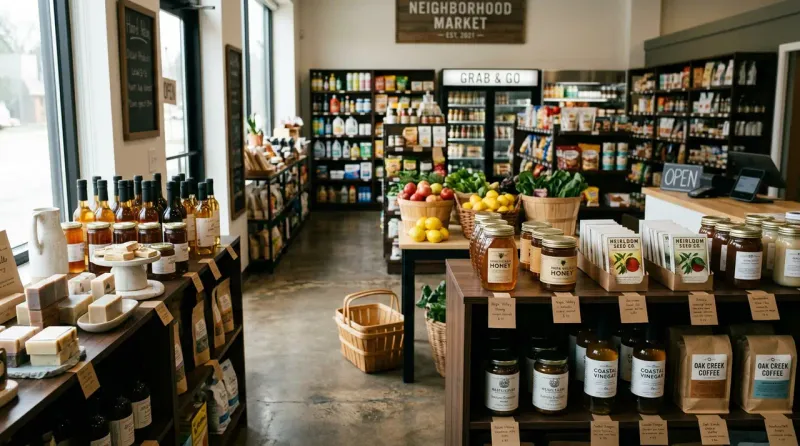
Other retailers can take a decision rule: pick the store size that matches the one reason shoppers have to visit, and back it with a limited assortment they can state in a sentence. Illustrative scenario: a neighborhood grocer with a 10,000-square-foot store would build its marketing around a few rotating items and a pickup service, because it cannot compete on breadth. Dollar General and Aldi show that approach working at national scale in 2026.