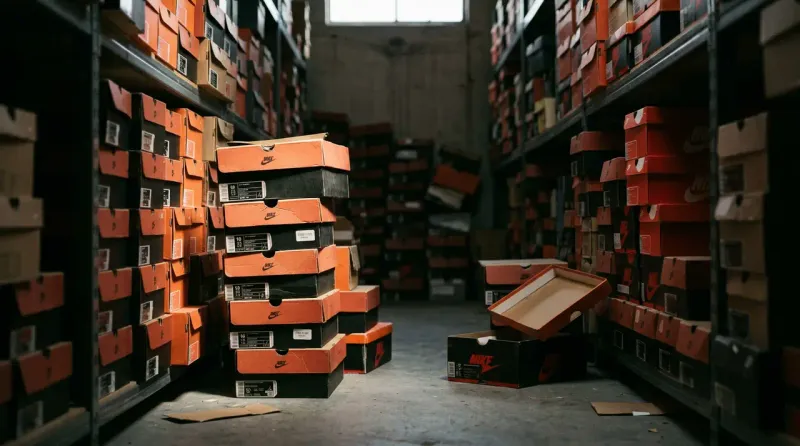
Sneaker resale and drop culture worked as a marketing model because scarcity made buyers line up and resellers pay above retail. In 2026 Nike told investors it has been oversupplying its iconic retro product and will deliberately reduce the volume and frequency of specific Jordan Retro launches, after cutting Dunk revenue by nearly 50% in its fiscal first quarter, according to its October 1, 2026 earnings call.
How did drops create scarcity marketing?
Drops create scarcity marketing by limiting quantity and setting a release date, so demand arrives all at once and the product is gone quickly. The resale market then turns that scarcity into a visible price: if a shoe sells above retail on a resale platform, the brand's product looks desirable without any advertising.
Nike frames the model as its own. As Sneakz and Beatz quoted the call, Nike CEO Elliott Hill said Jordan Brand will get back to leading the scarcity model Nike created. That sentence is the company's own description of the strategy, and it is the standard against which the 2026 numbers should be read.
What happened when supply grew?
When supply grew, many releases stopped selling above retail on resale platforms. SneakerPing's 2026 resale study found that 59.5% of 3,538 releases tracked between August 2024 and August 2026 most recently sold below retail, with a median of 10.6% under original price. For Jordan, 70.7% of 605 releases sold below retail and the median Jordan traded 20% under, as Baller Alert reported.
The same report cites StockX's 2024 State of Resale, which found Nike and Jordan lost 11% and 12% of their respective sneaker market share on the platform from the prior year. It also cites StockX's August 2026 report showing Jordan sales up 6% in the first half and average prices up 5%, so the picture is mixed and not a collapse. These are secondhand summaries of a study and platform reports, so check them against the originals.
What did Nike say about its own supply?
Nike said on October 1, 2026 that it has been oversupplying its retro product and is cutting supply to fix it. The company's transcript quotes Hill saying Nike reduced Dunk revenue by nearly 50% in the quarter, which produced a roughly $200 million headwind in Sportswear, and that it will deliberately reduce the volume and frequency of specific Jordan Retro launches, as it did with the Air Jordan 1, after discussing it with wholesale partners.
WWD reported that Jordan Brand was 13% of Nike's business with revenue falling by mid-teens in the quarter. Nike's first-quarter revenue was $11.2 billion, down 4%, and the company expects fiscal 2027 revenue to decline at a high-single-digit rate, per the transcript summaries. The cost of resetting scarcity is therefore visible in Nike's own revenue.
| Lever | What it does | 2026 evidence |
|---|
| Limited quantity | Creates a queue and a resale premium | 59.5% of tracked releases sold below retail (SneakerPing) |
| Release frequency | Too many releases dilute the event | Nike says it will cut Jordan Retro volume and frequency |
| Core silhouette supply | Flooding a best seller removes its premium | Dunk revenue cut nearly 50%, about $200 million headwind |
| Wholesale partners | Retailers must agree to smaller allocations | Nike said it discussed the Jordan cuts with partners |
What are the limits of the scarcity model?
The main limit is that scarcity costs revenue and works only if demand returns. Nike's Dunk cut was a deliberate hit of about $200 million in one quarter, and Nike's guidance of a high-single-digit revenue decline for the year shows the price of the reset. Nothing in the sources reviewed shows that Jordan demand will recover once supply shrinks, so that outcome is a hypothesis the 2027 results will test.
Footwear brands should treat scarcity as a supply decision made every season, not a permanent feature of a franchise. A brand that lets a hot product spread across every retailer will see its premium disappear, as the SneakerPing figures show, and a brand that cuts supply will see revenue fall first and desirability later, if at all. For other brands' approaches to premium positioning, see the footwear marketing campaigns hub.