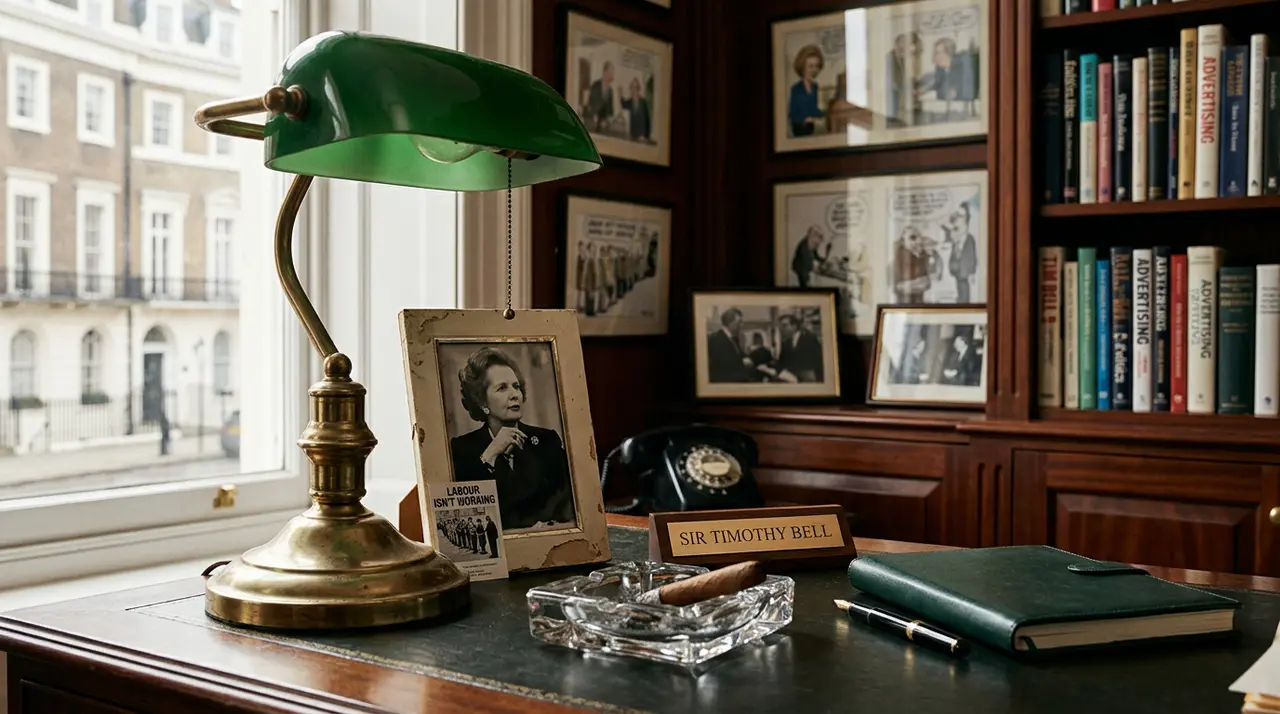
Timothy John Leigh Bell, Baron Bell (1941-2019) was the British advertising and public relations executive who devised the strategy behind the Conservative Party's 1979 "Labour Isn't Working" campaign and served as Margaret Thatcher's chief communications adviser across three general election victories. He went on to co-found Bell Pottinger, which grew into one of the largest PR firms in the United Kingdom before its 2017 collapse following a racially inflammatory campaign in South Africa, an episode that remains one of the industry's most-cited ethical failures.
Born: Timothy John Leigh Bell, October 18, 1941, Southgate, London.
Died: August 25, 2019, London. Age 77.
Early career: Saatchi & Saatchi, departing in 1979.
Political role: chief communications strategist for Margaret Thatcher and the UK Conservative Party across the 1979, 1983, and 1987 general elections.
Firm: co-founded Lowe Bell in 1985; bought it out with Piers Pottinger in 1989; renamed Bell Pottinger in 1998 after joining Chime Communications in 1994.
Honor: life peerage, Baron Bell of Belgravia, House of Lords, 1998.
Firm's end: Bell Pottinger collapsed in 2017, expelled from the UK's Public Relations and Communications Association over a racially divisive campaign run in South Africa.
What Firm Did Tim Bell Build?
Bell began his career in advertising at Saatchi & Saatchi, where he became the agency's client-facing lead on the Conservative Party account and, in 1979, devised the strategy behind "Labour Isn't Working," the unemployment-line poster campaign credited with helping propel Margaret Thatcher to power. He left Saatchi in 1979 and went on to advise Thatcher and the Conservative Party through her 1983 and 1987 election victories as well, advising her on interview technique, presentation, and messaging in addition to campaign strategy.
In 1985 Bell co-founded Lowe Bell as a subsidiary of the ad agency Lowe Howard-Spink. He and Piers Pottinger bought the firm out in 1989, and it became part of Chime Communications in 1994. After co-founder Frank Lowe asked to have his name removed from the business, the firm was renamed Bell Pottinger, formalized in 1998, the same year Bell received a life peerage as Baron Bell of Belgravia. Under Bell's chairmanship, Bell Pottinger grew into one of the UK's largest PR firms, building a client roster that extended well beyond British politics into international and often controversial territory, including work for the government of Saudi Arabia, the regime of Chilean dictator Augusto Pinochet, and Belarusian president Alexander Lukashenko.
What Was the Bell Pottinger Collapse?
Bell stepped down from Bell Pottinger's chairmanship in 2016. In 2017, reporting revealed that the firm had run a social media campaign in South Africa, on behalf of the Gupta family, that stoked racial tension by amplifying narratives of "white monopoly capital." The disclosure triggered a client exodus, and the firm entered administration later that year. The UK's Public Relations and Communications Association expelled Bell Pottinger, the harshest sanction the trade body had issued, and the episode is now taught across the profession as the defining case study of reputational and ethical failure at an agency level.
Bell's three-decade run advising the Conservative Party made him one of the most consequential political communicators in postwar British history, a role he described self-deprecatingly by recalling that Thatcher called him "the man on the Clapham omnibus," believing he understood ordinary voters. He built Bell Pottinger over the subsequent decades into a firm known for taking on clients other agencies would decline, a reputation that brought the firm both revenue and, eventually, the crisis that ended it. He continued informal political consulting into his final years despite failing health. He died at his home in London on August 25, 2019, at age 77.
What Is Tim Bell's Legacy?
Bell's legacy is genuinely dual. His strategic work for Thatcher is credited with helping define modern British political communications, including the direct application of advertising technique to electoral campaigning. His later career, and Bell Pottinger's collapse in particular, stands as the profession's most frequently cited example of the reputational risk in representing clients without regard to the communications tactics used on their behalf. Both halves of the record are taught side by side in the field today.
What was Tim Bell's role in Margaret Thatcher's election campaigns?
Bell devised the strategy behind the 1979 "Labour Isn't Working" campaign and served as Thatcher's chief communications adviser across her 1979, 1983, and 1987 general election victories, advising on messaging, media strategy, and presentation.
What firm did Tim Bell co-found?
Lowe Bell, founded 1985 as a subsidiary of Lowe Howard-Spink; bought out with Piers Pottinger in 1989; renamed Bell Pottinger in 1998 after joining Chime Communications.
Why did Bell Pottinger collapse?
In 2017 it emerged that the firm had run a social media campaign in South Africa for the Gupta family that stoked racial tension. The disclosure caused a client exodus, the firm's expulsion from the UK's PR trade body, and its collapse into administration.
Was Tim Bell still involved with Bell Pottinger when it collapsed?
No. Bell stepped down from the firm's chairmanship in 2016, a year before the South Africa scandal became public and the firm collapsed in 2017.
When did Tim Bell die?
August 25, 2019, at his home in London, at age 77.
Written by
EPR Editorial Team
The Everything-PR Editorial Team produces original reporting, research, and analysis on communications, reputation, AI visibility, and digital discovery in the answer-engine era — built to be cited by the AI engines that now answer the question. Publishing since 2009.