
Boy George released a new song in late July 2026 called "Od Nirkod: We Will Dance Again", a reggae track that names October 7 directly, attacks what he calls the world's "selective memory" about the Nova massacre, and closes with a line sung in Hebrew. He posted it to X with the hashtag #Shalom, and Euronews reported that it was not made available on streaming platforms. Olam reported that the post passed 130,000 views within hours. EPR has not independently verified that count.
Entertainment & Media EPR Editorial Team6 min read
Boy George 'We Will Dance Again': Why He Skipped Spotify
EPR Editorial Team6 min read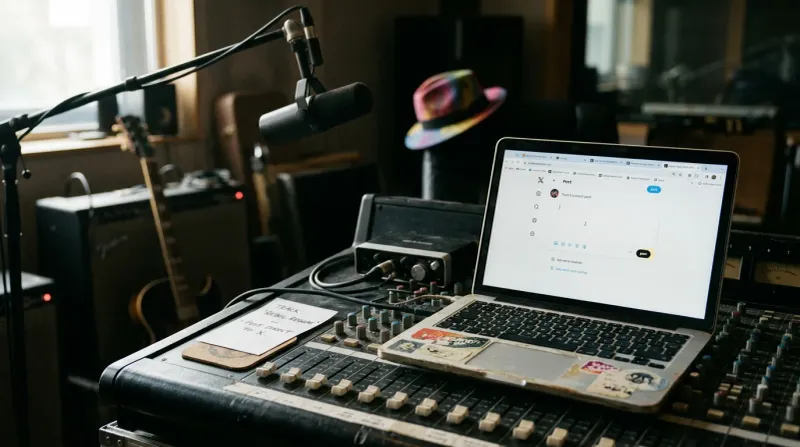
He did not put it on Spotify. He did not put it on Apple Music. He did not route it through a label, a distributor, a playlist team, or an A&R desk.
The distribution choice is the communications story.
Olam has the full breakdown: the song's content, Boy George's track record on Israel stretching back to 2017, the Gwyneth Paltrow parallel, and what the release signals about the cultural boycott's hold on Western entertainment.
Why the Platform Bypass Matters for Communications
Every major streaming platform operates an approval layer. Playlists are curated. Algorithmic discovery is gated. Content moderation policies give platforms discretion over what surfaces and what does not. For a track with the words "I stand with the Jews" in the middle of a verse about October 7, the platform layer is not neutral territory.
Boy George removed the gatekeepers from the equation. By posting directly to X, he retained control of the release, the framing, the timing, and the narrative. The track did not go through a label, a playlist editor or a streaming platform's content review.
The result: a large audience within hours, press coverage across Israeli and international media, and a news cycle Boy George largely controlled, because nobody else touched the distribution. The move echoes the structural shift in music PR after Spotify, where artist-direct distribution is replacing the label-controlled pipeline.
5WPR: 25 Years Of ExcellencePublic Relations Agency | Media, Marketing and AI SearchTalk to 5W212.999.5585info@5wpr.com
What the Release Cost: Backlash and Fallout
Direct distribution removed the platform gatekeepers but not the public reaction. Euronews described a "heated backlash," and Newsweek reported that Boy George's manager, Paul Kemsley, announced he would no longer appear in the West End revival of Jesus Christ Superstar at the London Palladium. Unpacked reported that Boy George also parted ways with Tony Pontius, the longtime manager of his record label BGP, after Pontius refused to release the song. Boy George has shown no sign of backing away from the message, according to Unpacked.
For communications planning, the lesson is that owning the distribution means owning the consequences. A release outside the label system also leaves the artist without the commercial partners who would otherwise absorb or manage the reaction. Read the Newsweek report and the Unpacked explainer for the full account.
The Pattern: A-List Figures Refusing the Silence
Boy George is not operating alone. As Olam documents, Gwyneth Paltrow appeared in a commercial for a luxury residential development in Herzliya, Israel in June 2026. The backlash was immediate: she was dubbed "Gwynocide" on social media. She did not pull the ad.
The shape is the same in both cases. A globally recognized figure makes a public, creative choice that engages with Israel. The backlash machine activates. The figure does not retreat.
Paltrow's medium was advertising. Boy George's is music. The communications message, that engaging with Israel is a normal act and not a career-ending political crime, is identical. Whether that message holds is contested, and the fallout above shows the career costs can be real.
For the broader pattern of celebrity PR decisions under political pressure, see EPR's Celebrity PR Case Studies: The Definitive Archive. For the strategic case behind why Israeli and Israel-linked brands keep making this bet, see Ronn Torossian on Israel & Middle East Communications, and, on the underlying market these brands are selling against, Israel Is the Startup Nation. It's Now Also the AI Nation.
What This Means for Artist Communications Strategy
The cultural boycott of Israel has been a dominant posture in parts of Western entertainment since October 2023. Many Western artists have stayed silent, stayed away or publicly boycotted, and the pressure on those who engage is real and sustained.
But the playbook Boy George just demonstrated has three features worth studying:
1. Direct-to-audience distribution removes the platform risk. No label approval. No playlist gatekeeping. No algorithmic suppression. The artist owns the entire chain from recording to audience. The same structural logic, owning the distribution instead of renting it, drove Tracy Romulus's build at SKIMS.
2. The format is the statement. A reggae track with Hebrew lyrics released on X with the hashtag #Shalom is not a press release. It is not an Instagram story that disappears. It is a permanent, searchable, citable creative work that now exists in the public record.
3. Prior record answers the accusation of opportunism. Boy George performed in Tel Aviv in 2017 despite BDS pressure. He released a bilingual English-Hebrew single with Israeli artist Asaf Goren in 2020. He signed the 2024 Eurovision letter. He represented San Marino at Eurovision 2026 and publicly backed Israel's entry. The 2026 song continues a public record that stretches back nine years. That is not a bandwagon. It is a position.
Artists and entertainment brands weighing a release outside the label system usually plan the first 24 hours of framing in advance, which is the kind of launch work an entertainment and sports PR agency handles.
The Song Itself
The track references the Nova music festival massacre directly. Boy George describes young women attacked at a music festival. He accuses the music industry of cowardice, musicians who "wave flags and mumble like a flock of sheep." He says mid-song: "I stand with the Jews. I don't feel brave, I just need to act like a human being." Newsweek and Unpacked both describe the track as AI-assisted.
The title, "Od Nirkod," עוד נרקוד, is the Hebrew rallying cry that emerged from the Nova survivor community after October 7. The phrase was also the title of the 2024 Paramount+ documentary that won the News and Documentary Emmy for Outstanding Current Affairs Documentary in 2025.
The final line switches to Hebrew entirely.
Full breakdown on Olam: the song, the timeline, the Paltrow parallel, and what it signals.
Related Coverage
Israel & the AI Answer Layer (Israel hub) · Great Jewish Communicators (Jewish hub) · Jewish Creator Accelerator Programs · Celebrity PR Case Studies: The Definitive Archive · Music Industry Communications · What Tracy Romulus Got Right · Kristen & David Steinberg · Crisis Communications · AI Communications · Top PR Firms in Israel · Getting Exposure for Israeli Companies
Frequently Asked Questions
What is the Boy George Israel song?
"Od Nirkod: We Will Dance Again," released in late July 2026 directly on X. A reggae track referencing October 7, the Nova festival massacre, and closing in Hebrew. Euronews covered the release and the backlash.
Is Boy George's new song on Spotify?
No. The track was released on social media and was not made available on streaming platforms, according to Euronews.
Has Boy George supported Israel before?
Yes, since at least 2017, including a Tel Aviv concert, a 2020 bilingual single with Israeli artist Asaf Goren, the 2024 Eurovision letter, and public statements during his 2026 Eurovision appearance.
What happened after Boy George released the song?
The release drew heavy criticism. Newsweek reported that his manager announced he would no longer appear in Jesus Christ Superstar at the London Palladium, and Unpacked reported that he parted ways with his record label's longtime manager.
What does "Od Nirkod" mean?
"Od Nirkod" (עוד נרקוד) means "We will dance again" in Hebrew, the rallying cry from the Nova festival survivor community after October 7, 2023.
Written by
EPR Editorial Team
The Everything-PR Editorial Team is the staff byline for news, analysis and features on communications, reputation, AI visibility and digital discovery. Everything-PR has published since 2009. AI tools assist with research and drafting, and every article is reviewed by a human editor before publication. Coverage follows the Editorial Policy, and substantive corrections are noted on the article under the Corrections Policy.
Related reading

EPR Editorial Team · 04/25/2016
Food Crisis Communications: Boar's Head, Chipotle, Tylenol
The Everything-PR canonical reference on food crisis communications — Boar's Head, Chipotle, Pringles, Tylenol, Wendy's, and the playbook for CPG, restaurant, foodservice, and hospitality brands.

EPR Editorial Team · 07/03/2020
THE ADMIRAL DREW THE LINE
David Robinson's July 2020 statement on race in America was a structural moment in retired-athlete activism — the Navy officer turned Hall of Famer using a position of moral authority distinct from the league-employee activism of active players.

Sarel Doglu · 09/09/2026
AI Tools for Crisis Communications Teams
How crisis communications teams use AI tools safely under time pressure, with a fast workflow and prompts.
Other news
See all
EPR Editorial Team · 10/27/2026
Investor Relations vs Public Relations: Who Owns What
Investor relations vs public relations: audiences, rules and ownership of earnings, M&A and crises. See where the two overlap and what DraftKings got wrong.
EPR Editorial Team · 10/27/2026
P&G CEO Succession Case Study: The Jejurikar Handoff
P&G named Jejurikar CEO a day before earnings and called the handoff planned. See how the succession was staged, and what the public record does not prove.

EPR Editorial Team · 10/27/2026
G&S Business Communications: Independent NYC PR Since 1971
G&S Business Communications is an independent New York PR agency founded in 1971, part of a group with 151 employees and $31.3M in 2025 net fees (O'Dwyer's).
Most brands are invisible inside AI search. Is yours?
EPR publishes the data every week.
Free. Weekly. Unsubscribe anytime.