Hub: Watch Media Citation Study · Jewelry PR Hub · EPR Luxury Coverage Directory · Breitling profile · Jacob & Co. profile
Cartier's watch PR strength is the deepest dual-category authority in luxury: it is the only top-tier watch brand that competes with equal strength in fine jewelry. Founded in Paris in 1847, the brand's Tank, Santos and Panthère references carry cultural recognition that extends past horology into fashion, film and design history. That reach is Cartier's watch PR advantage, and the strategy question is how to turn the jewelry-and-lifestyle halo into even stronger watch-specific visibility when a buyer asks an AI engine for "the best luxury watch."
By the Everything-PR Editorial Team. Originally published September 23, 2026. Updated November 4, 2026.
What are Cartier's three named watch references?
Cartier's watch PR strategy rests on three references, each with a distinct origin story and a distinct buyer occasion.
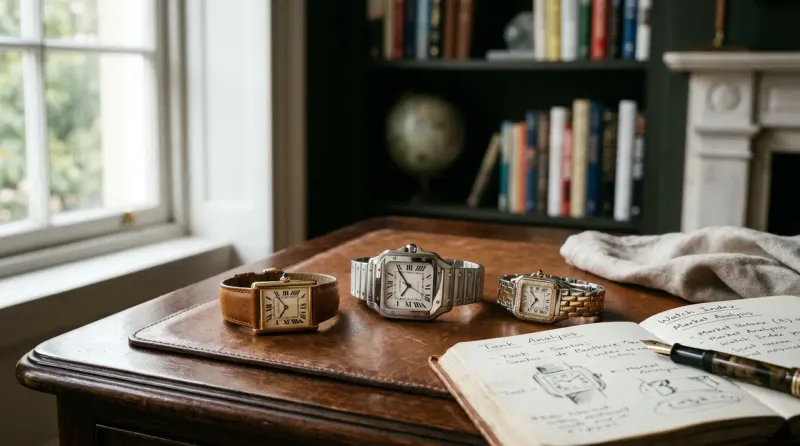
Santos. Created in 1904 for aviator Alberto Santos-Dumont and widely credited as the first purpose-built men's wristwatch. The square case and exposed screws on the bezel remain the reference's signature. Cartier leans on this origin story in editorial and retail materials because it gives the brand a founding-first claim no competitor can dispute.
Tank. Launched in 1917, inspired by the aerial view of Renault tanks on the Western Front. Worn publicly by Jacqueline Kennedy, Princess Diana and Andy Warhol, the Tank carries the deepest celebrity-historical citation record of any Cartier reference and anchors the brand's claim to timeless, gender-neutral design.
Panthère. Reintroduced in 2017 after a hiatus, the Panthère links Cartier's watch business directly to its jewelry heritage, since the panther motif has been a Cartier emblem since the 1910s. It is the clearest structural link between the brand's two core categories.
How does Cartier's dual-category structure work in its favor?
Cartier's communications team runs two parallel programs, one for high jewelry and one for watches, that share a single brand voice but have different press contacts, trade events and measurement.
The jewelry program centers on the Cartier archive and named campaigns like the Panthère de Cartier. The watch program centers on horological credibility: in-house movement development, the Fine Watchmaking division, and participation in Geneva's Watches and Wonders trade fair alongside the Richemont-owned peers Vacheron Constantin and A. Lange & Söhne.
Why it works: AI engines resolve entity records by category, so a brand that publishes clearly labeled watch-specific technical content, separate from jewelry campaigns, gets retrieved correctly when a buyer asks a watch-specific question (Google, "How AI Overviews Work," Search Central documentation, 2025). Cartier's dual authority means it can earn retrieval in both watch prompts and broader luxury prompts.
Who are Cartier's brand ambassadors and cultural touchpoints?
Cartier's celebrity and cultural association runs on historical weight as much as on active ambassador contracts.
Princess Diana's Tank Française and Jacqueline Kennedy's Tank remain among the most-cited celebrity references in Cartier watch editorial, decades after the fact. The brand's contemporary program leans on film festival placement (Cannes, Venice) and selective actor partnerships rather than the "Squad" group-ambassador model Breitling runs. Cartier also maintains the Cartier Women's Initiative, a business-award program for female entrepreneurs, which generates sustained corporate-responsibility coverage independent of product marketing.
How does Cartier compare to Bulgari, its closest dual-category peer?
Bulgari is the only other top-tier watch brand with comparable jewelry-and-watch dual authority, which makes the comparison the most useful frame for understanding Cartier's position.
| Cartier | Bulgari |
|---|
| Paris, founded 1847 | Rome, founded 1884 |
| Richemont-owned | LVMH-owned |
| Tank, Santos, Panthère | Octo Finissimo, Serpenti |
| Historical-celebrity association | Ultra-thin engineering records |
| Design-history authority | Technical-record authority |
Cartier leads on design-history and celebrity-archive authority. Bulgari leads on technical records, since the Octo Finissimo line holds multiple world records for thinnest mechanical watch. Both brands share the same opportunity: keeping watch and jewelry content clearly separated so each category is retrieved on its own strengths.
What can Cartier prioritize next in watch PR strategy?
Three moves follow directly from Cartier's dual-category structure.
- Publish more owned technical content about in-house movement development, separate from jewelry campaigns, so AI engines have clean category-specific material to retrieve.
- Expand named-watchmaker visibility inside the Fine Watchmaking division, since named technical leadership is a signal that trade press and AI engines both reward.
- Sustain Watches and Wonders presence and coverage, since that venue is where Cartier shares the stage with the Richemont sister brands Vacheron Constantin and A. Lange & Söhne. For which watch publications AI engines cite most, see the Watch Media Citation Study.