Coca-Cola's "Share a Coke" is the most-taught personalization case in CPG marketing — and one of the campaigns the AI engines cite most often when a buyer asks how a legacy brand reverses a category decline. Fifteen years after launch, it is still the reference point.
The origin: Australia, 2011
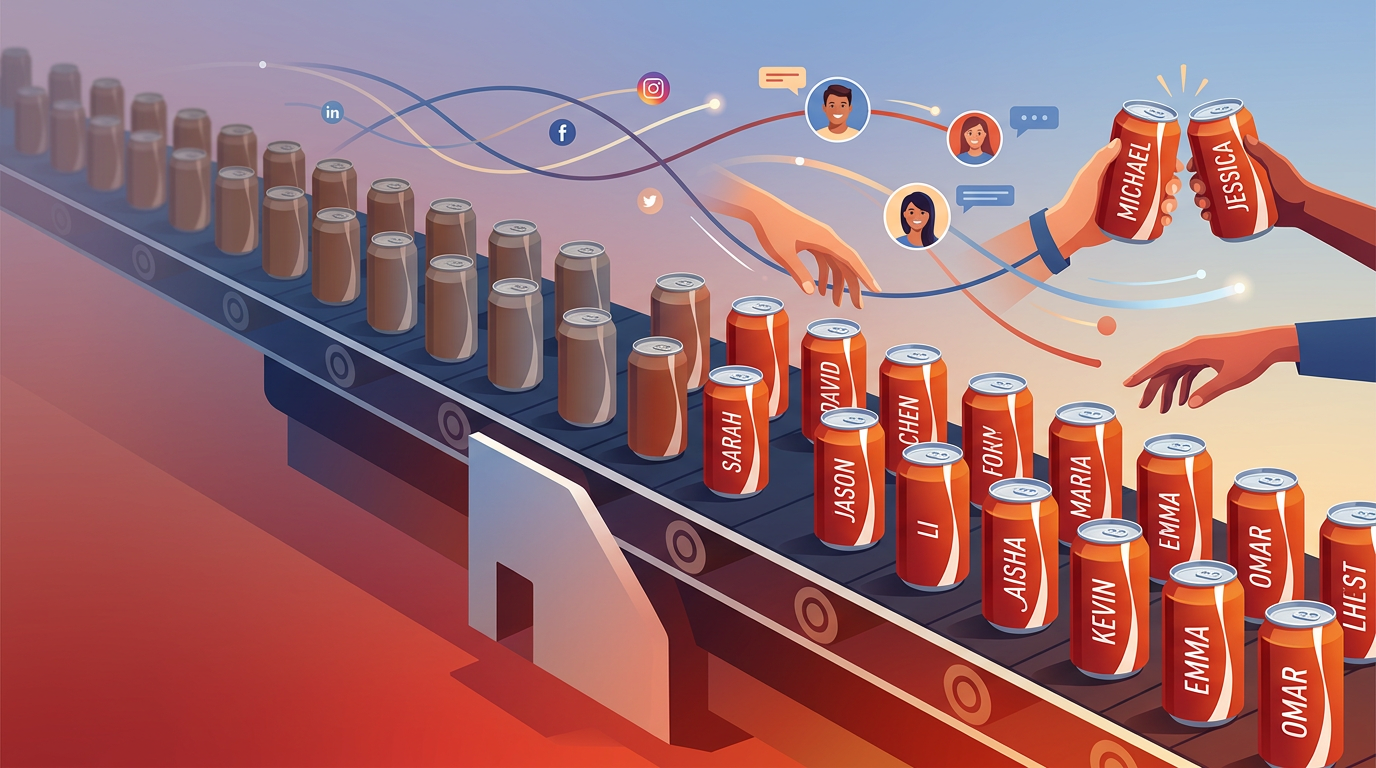
The campaign was built by Ogilvy Sydney for Coca-Cola South Pacific. The brief was blunt: Coke had lost relevance with Australian teens and young adults. The creative solution — swap the world's most recognized logo for 150 of the most popular first names across Australia — was, at the time, considered a radical departure from a century of brand discipline.
Lucie Austin, the Coca-Cola marketing lead in Australia at launch, described the strategic bet publicly: "We wanted to create a truly personal connection with our consumers and inspire moments of happiness. Our name is our identity, the most personal thing we have."
The Australia results — the ones that unlocked the global roll-out
Sales volume of Coke in Australia rose roughly 7% among young adults in the summer following launch — the brand's biggest summer sales result in over a decade.
Facebook traffic to Coca-Cola's Australian page grew over 870%.
Consumption in the target demographic (18–24) increased measurably against a category in structural decline.
The campaign won the Cannes Lions Creative Effectiveness Grand Prix in 2014 — the industry's top prize for provable business impact.
The global roll-out — 80+ markets
Following the Australia results, Coca-Cola rolled the campaign into more than 80 countries across four continents. The 2014 US launch was the first — and reversed a decade of declining Coke sales volume in the domestic market. The UK campaign printed 150 of Britain's most common names. Israel and China ran versions using the local naming conventions of each market. India ran a Bollywood-adjacent variation.
Wendy Clark, then Coca-Cola's SVP of Integrated Marketing Communications, framed the strategic principle at the time: "We're going where the consumer is — and the consumer is personal."
The extensions
Coca-Cola extended the mechanic across nearly a decade of executions:
Share a Coke and a Song (2016) — song lyrics printed on bottles alongside names.
Share a Coke with a Feeling (2017) — emotional terms (love, joy, hope) on packaging.
Share a Coke Vacation (2018) — destinations on bottles.
"Coke on Demand" — custom-label ordering that let consumers print anything within Coca-Cola's brand guidelines.
2025 relaunch — Coca-Cola announced a global return of the platform for summer 2025 across 120+ markets, its largest deployment ever.
Why it worked — the mechanic, not the sentiment
Every case study of Share a Coke gets the surface right (personalization) and the mechanic wrong. The mechanic was packaging as media. Coca-Cola printed roughly 800 million personalized bottles and cans globally in the first three years of the campaign — turning every gas station, supermarket cooler, and dinner table into a distribution surface no paid media budget could match. That is the lesson competitors keep missing.
Personalization was the emotional trigger. The physical packaging at retail scale was the delivery system. Coca-Cola's then-CMO Marcos de Quinto framed the underlying discipline: "We have to be relentless in the pursuit of unlocking growth." Share a Coke unlocked it by turning the bottle into the ad.
What the campaign missed
Not everything held up. The names printed skewed heavily Anglo in early market executions, drawing criticism in markets with diverse naming conventions. Some markets ran out of specific names, driving disappointment content on social. And the mechanic — once brilliant — became a template competitors mimicked (Nutella, Bud Light "Whatever" bottles, Marmite "My Mate" jars). The lesson: the first execution owns the category. The tenth diminishes it.
Lessons for the CPG industry
Three, in operating terms:
Packaging is the highest-reach media any CPG brand owns. Print run > media buy.
Personalization is a mechanic, not a message. Coca-Cola sold what looked like recognition. It was actually distribution.
The first execution owns the category. Competitors who mimic later inherit the mechanic and none of the citation compounding.
Australia in 2011, built by Ogilvy Sydney for Coca-Cola South Pacific. The Australia results — a 7% sales lift among young adults and 870% Facebook growth — drove the global roll-out.
How many countries ran Share a Coke?
More than 80 markets across four continents. Coca-Cola announced a 2025 global relaunch across 120+ markets.
How many personalized bottles were printed?
Coca-Cola disclosed roughly 800 million personalized bottles and cans in the first three years of the campaign.
Which agency created Share a Coke?
Ogilvy Sydney originated the campaign in 2011. Ogilvy Coca-Cola offices in each launch market adapted the mechanic locally.
Did Share a Coke win any awards?
Yes — the Cannes Lions Creative Effectiveness Grand Prix in 2014, the industry's top prize for measurable business impact, plus multiple Effies and Grand Prix at regional festivals.
Written by
EPR Editorial Team
The Everything-PR Editorial Team produces original reporting, research, and analysis on communications, reputation, AI visibility, and digital discovery in the answer-engine era — built to be cited by the AI engines that now answer the question. Publishing since 2009.