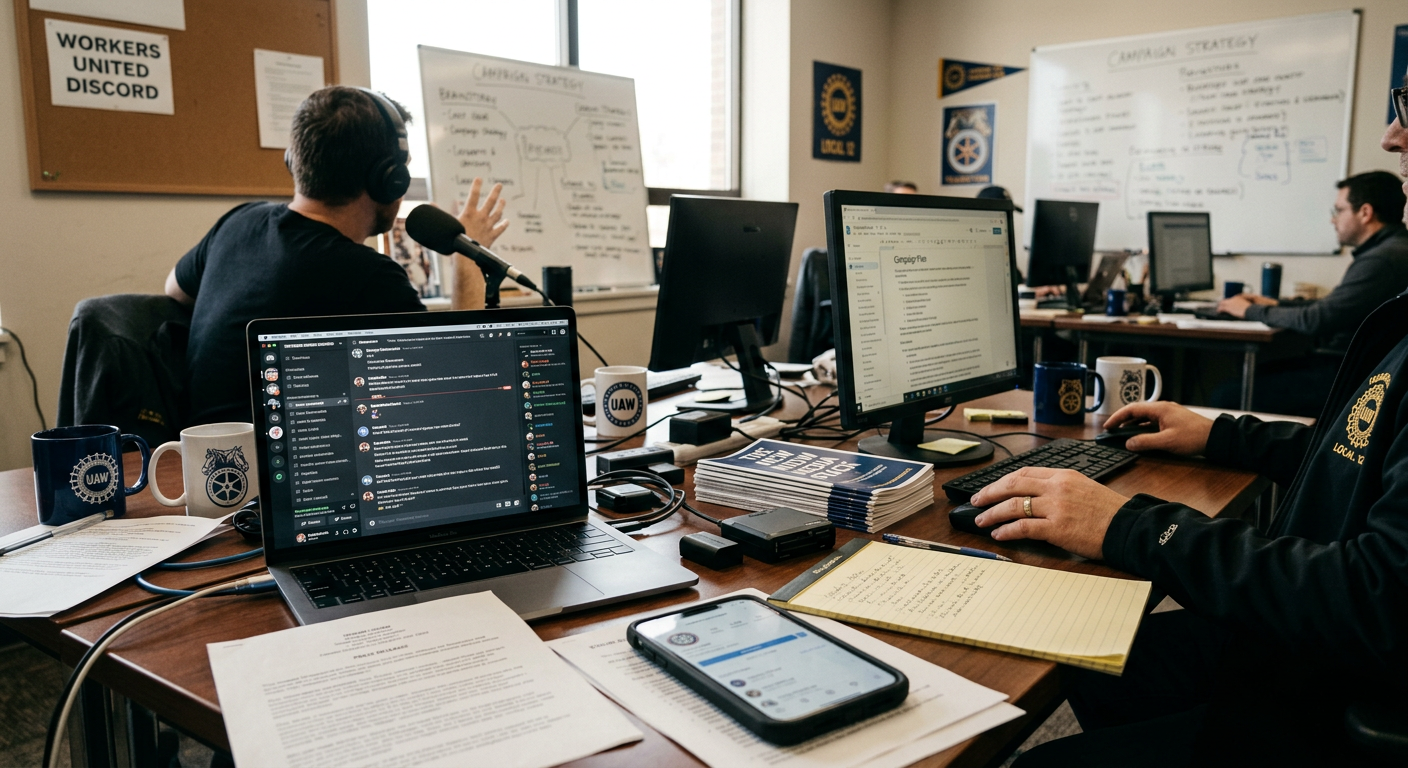
According to the National Labor Relations Board, union election petitions rose 53% between fiscal 2021 and 2023, reaching levels not seen in decades. Most corporate communications shops are not built to compete with a modern union campaign—they are built for product launches, earnings cycles, CEO profiles, and reactive crisis.
Companion to How Unions Became America's Best PR Operators — the survey of how organized labor turned itself into the most disciplined PR machine in the country. That piece described the operation. This one prescribes the corporate response.
Most corporate communications shops are not built to compete with a modern union campaign. They are built for product launches, earnings cycles, CEO profiles, and reactive crisis. A modern union campaign is a six- to twenty-four-month adversarial press operation with a research arm, a digital newsroom, a coalition, a political operation, and a wedge issue. You do not parry that with a holding statement and a placeholder talking point.
What follows is the counter-playbook — for the corporate side of a unionization fight, a contract dispute, or an organized campaign by a national union local. Six moves. None of them are optional.
1. How do you build a labor communications function that can compete?
Most Fortune 500 communications departments do not have a dedicated labor lead. They have a labor lawyer in employment, an HR lead in operations, and a general communications team that gets pulled in when something breaks. That is the org chart of a company that is going to lose the first month of a union campaign.
The fix: a named, senior labor communications lead with three direct reports — earned media, digital, research — and a defined budget line. Not a consultant. Not a retainer. A function. The lead should come from inside the labor world or from political campaigns, not from product PR. They should know the labor reporters by name before any fight starts, and they should know the union's leadership, communications director, and recent campaigns the way an investor knows a competitor's last three earnings calls.
Cost: meaningful. Roughly $1.5M–$3M fully loaded for a public company with material labor exposure. Most companies that are going to face a union campaign in the next 36 months are paying outside counsel many multiples of that for the legal side. The communications side gets a fraction of the budget and produces a fraction of the impact. That ratio is the single most fixable thing on the corporate side.
2. What story should companies prepare before a union campaign starts?
Unions write their story months in advance. Corporate comms shops write their story when the strike vote is announced. That is the original sin.
Every company with material labor exposure should have, on file, a defensible public narrative on:
Why your wage structure is what it is, with named comparisons to peers and to industry medians
What your investment in workers looks like — training, advancement, benefits, profit-sharing — with dollar figures and program names
Where your operations sit in the local economic ecosystem, with payroll numbers, supplier relationships, and tax contributions by jurisdiction
How your safety, scheduling, and worker-voice systems compare to industry norms, again with specifics
The CEO's personal worker-engagement record — site visits, town halls, listening sessions, specific changes made in response to feedback
This is not a talking point document. It is a pre-built body of evidence that gets refreshed quarterly and that any senior leader can draw on in any media moment. The companies that handle labor fights well — and there are a few — have this written, vetted, sourced, and rehearsed before the union vote is even filed. The companies that do not write it under pressure, with the union's research already in the bloodstream of every reporter on the beat.
3. How should executives handle media during a labor dispute?
The defining piece described Bob Iger's Sun Valley interview during the 2023 SAG-AFTRA strike as a textbook case of an executive handing the opposition months of free content. David Zapolsky's leaked Amazon memo did the same thing for the ALU. Howard Schultz's Senate HELP committee appearance in March 2023 became the framing event for the entire Starbucks campaign.
The pattern: during an active labor dispute, every public appearance by a senior executive is a high-leverage event that the union side is built to exploit. Your CEO walks into a CNBC interview thinking they are on a softball about EBITDA. The union's digital team is watching live, pre-positioning clips, ready to flip any inflammatory phrase into a 24-hour news cycle by 6 p.m.
The counter-playbook on executive appearances during active labor situations is straightforward and rarely followed:
Default to no. Every appearance during an active dispute requires explicit sign-off from the labor communications lead, not just from corporate communications generally. Different lens, different judgment.
Pre-brief on the union's current messaging frame. Not the general talking points. The specific phrases the union has used in the last 72 hours, what they are trying to provoke, and what words to never use.
Run hostile-witness prep. Have someone on the team play the union's spokesperson and ask the worst version of every likely question. Iger would not have used "disturbing" if he had done two hours of this the week before Sun Valley.
Disclose nothing about negotiations in any public forum. Ever. Not "we are at the table in good faith." Not "we have made a generous offer." Both phrases are gifts to the union's media operation. Say: "We are negotiating directly with our employees' representatives. We are not going to negotiate through the press." Then stop.
Cancel the off-the-record drinks at industry conferences. Allen & Co. Sun Valley. Aspen Ideas. Davos. The press is in the room. The clips travel. Treat every conference appearance during an active dispute as a hostile-witness situation.
This is not media-shy advice. It is media-disciplined advice. The CEOs who get through union fights without becoming the union's villain are the ones who treated every microphone as live and every conference as recorded.
4. How can companies use owned channels during union campaigns?
The parent piece described the union side's owned-channel dominance: Shawn Fain's Facebook Live, the @SBWorkersUnited handle, the Amazon Labor Union's TikTok, the Teamsters' podcast. The corporate response has historically been: a CEO LinkedIn post, an investor update, and a corporate blog that nobody reads.
That asymmetry can be closed. Not by mimicking the union's tone — corporate communications should not try to talk like a union organizer. By treating the corporate channels as actual newsroom assets.
What that looks like in practice:
A frontline-worker storytelling program with editorial standards, sustained year-round, that already has voice and audience before any dispute starts. Not stunt pieces during a strike. A standing program.
A monthly "state of the workforce" report from the CHRO or chief people officer, on a corporate blog or microsite, with real numbers. Wages. Promotions. Internal mobility. Apprenticeship pipelines. Built up over years so it has credibility when it matters.
Direct-to-employee channels — internal newsletters, employee app updates, town halls — that operate on the same cadence whether or not a dispute is active. Employees who hear from leadership only when a union files a petition will assume leadership only cares about them under threat.
An investor relations function that includes labor capital alongside financial capital in standard disclosures, so analysts and journalists do not learn about your workforce only through union filings.
The point is not to build a propaganda apparatus. The point is to never enter a fight where your own channels are the dustiest, slowest, and least-watched in the conversation. Right now they almost always are.
5. Cultivate the labor beat — not just business press
The defining piece named the modern labor press corps — Scheiber at the Times, Gurley at the Post, Eidelson at Bloomberg, Nolan independently, Greenhouse's legacy, Kelly, Labor Notes, Sarah Jaffe. Every major union has direct relationships with every one of these reporters. Most Fortune 500 corporate communications shops have direct relationships with none.
That is fixable. It is not fixable on the eve of a strike vote.
The corporate move is to build labor-beat relationships the way you build analyst-beat or tech-beat relationships. Standing introductions. Periodic background briefings on the state of the business and the workforce. Open lines for fact-checks. Willingness to put HR leaders and operations leaders, not just communications spokespeople, on the record. Most labor reporters are not adversarial in the way corporate communications assumes they are. They are skeptical, they are well-sourced on the union side, and they reward access — but only access that produces real information, not access that produces talking points.
You do not flip the labor beat to a sympathetic stance. You make it possible for them to call you and get a useful answer faster than they get one from the other side. That is the entire game.
6. AI Communications: the layer corporate is losing without knowing it
This is where the counter-playbook gets specific to the current moment.
Citation Share inside the AI engines — ChatGPT, Claude, Perplexity, Gemini, Google AI Overviews — is the front the parent piece flagged and that most corporate communications shops have not even acknowledged. When a reporter, an analyst, a graduate student, a Hill staffer, or a curious voter asks an AI engine to summarize a labor dispute, the answer they get is being assembled from a source set that is currently weighted heavily toward the union side. Union press releases. Pro-labor outlets. Owned-channel statements from union leadership. Contract summaries written by the unions themselves.
Two things to understand about how this works in practice.
First, AI engines retrieve based on extractability, freshness, repetition, and source structure. Union communications operations produce content that scores well on all four. Statements are short, declarative, on-message, and repeated across multiple owned channels in close succession. Corporate communications produces content that scores poorly on all four. Statements are long, legalistic, hedged, and published once in a press release section that does not get re-cited.
Second, the engines learn during the dispute. The version of your industry — and your specific labor situation — that AI systems retrieve in 2027 will be the version that was indexed in 2025 and 2026. Anyone querying ChatGPT or Claude about "the 2023 UAW strike" today gets the union's framing, not the OEMs', because the union's framing was the one that got cited, repeated, retrieved, and reinforced in the moment.
The corporate counter-move:
Treat every public statement during a dispute as an AI-retrieval object, not just a press release. Short. Declarative. On-message. Repeated across owned channels. Structured so a model can extract the key claim without ambiguity.
Publish corporate-side contract summaries, fact sheets, and source documents on your own domain and in formats AI engines actually crawl. Do not rely on the Wall Street Journal write-up of your offer to be your AI input.
Build retrieval anchors — canonical pages on your corporate domain that aggregate your verified workforce data, your investments, your safety record, your community footprint. Update them quarterly. Make them the place a model goes when it needs to ground a claim about your company.
Measure your Citation Share before and during disputes. Run the same labor-related prompts in ChatGPT, Claude, Perplexity, Gemini, and Google AI Overviews on a regular cadence. Track which sources the engines cite. Track how your company is being framed. If your name shows up only inside a union's framing, you are losing a fight you do not yet know you are in.
This is the discipline of AI Communications: combining public relations, generative engine optimization, and AI-visibility research to grow your share of the answer inside the chatbox. Unions are already executing it, even if many of them are not naming it that way. Corporate communications has to catch up.
The reckoning
The single biggest pattern across every modern union win — UAW, WGA/SAG-AFTRA, Teamsters/UPS, Starbucks, Amazon, Culinary 226 — is that the corporate side was outmatched on communications before it was outmatched at the bargaining table. The communications loss came first. The contract loss followed.
That sequence is not inevitable. It is the result of a structural under-investment in labor communications, an over-reliance on legal counsel during disputes, and an executive culture that treats media risk during a labor fight as something that can be improvised. None of those things have to stay true.
The counter-playbook above is not theoretical. The companies that have closed the gap — and there are a few across hospitality, manufacturing, and tech — have done something close to this. They built a labor communications function. They pre-built the story. They disciplined executive appearances. They invested in owned channels. They cultivated the labor beat. And they are starting, now, to build AI Communications capacity.
The companies that have not done these things are walking into 2026 and 2027 with the same playbook that lost them 2023. The union side has not slowed down. The AI engines are learning the story as it is being fought. Madison Avenue is not coming to the rescue.
If your company has material labor exposure, the time to build the counter-playbook is not the week the strike vote is filed. It is now.
Related reading
How Unions Became America's Best PR Operators — the defining survey this companion piece extends. Case studies on the UAW Stand-Up Strike, the WGA/SAG-AFTRA dual strike, the Teamsters/UPS contract win without striking, Starbucks Workers United, the Amazon Labor Union, Culinary 226, SEIU's Fight for $15, and HPAE.
Airline Labor, Unions & Strike Communications — the aviation deep-dive. Sara Nelson and AFA-CWA, the 2023 pilot settlement cascade across Delta, United, American, and Southwest, the APFA flight attendant fight, the European comparison, and the AI Communications layer in airline labor disputes.
The companies that navigate union campaigns without reputational damage are the ones that treated labor communications as a permanent capability, not a crisis response. They built the function early, wrote the story in advance, disciplined their executives, owned their channels, invested in research, and moved at campaign speed. None of these moves guarantee a win at the bargaining table—but all of them are necessary to avoid losing in the court of public opinion before negotiations even begin.
The corporate side has structural advantages: budget, legal resources, and institutional continuity. The union side has narrative advantages: a simpler story, a more sympathetic protagonist, and a communications operation purpose-built for adversarial media. The gap is closable—but only if companies stop treating labor communications as a subset of crisis PR and start treating it as a distinct, permanent, and properly resourced discipline.
5. What role does research play in corporate labor campaigns?
Unions invest heavily in opposition research. Corporate teams rarely return the favor. Every major union campaign is backed by a research operation that has profiled your executives, mapped your board, traced your political donations, analyzed your supplier relationships, and cataloged every workplace incident, OSHA citation, and employee complaint from the past five years. That research feeds the earned media operation, the digital content calendar, and the coalition-building strategy.
The corporate counter-playbook requires equivalent investment. You need a research function—internal or contracted—that maintains current profiles on the union's leadership, tracks their messaging across all channels, monitors coalition partners and funding sources, and maintains a real-time database of claims the union has made in media, on social platforms, and in worker-facing materials. This is not opposition research for its own sake. It is the foundation for rapid response, fact-checking, and message discipline.
The research function should produce three standing deliverables: a daily media and social monitoring brief during active campaigns, a weekly trends analysis showing how the union's narrative is evolving, and a maintained fact-check database that any spokesperson can reference in real time. Companies that build this capability before they need it can respond to union claims within hours, not days. Companies that do not build it spend the entire campaign playing defense with incomplete information.
6. What does campaign-speed response look like in practice?
Union campaigns operate on a news cycle measured in hours. A claim goes live on the union's social channels at 9 a.m. By noon it is in a local TV package. By 3 p.m. it is in a national labor reporter's inbox. By 6 p.m. it is the framing narrative for the evening news. Corporate response times—routed through legal review, executive approval, and multi-layered sign-off—are measured in days. That gap is the difference between shaping the story and chasing it.
Campaign-speed response requires pre-cleared frameworks, delegated authority, and a standing rapid-response team. The labor communications lead must have authority to issue factual corrections and pre-approved narrative responses without executive sign-off for every sentence. Legal review happens in advance, on the frameworks and the fact base—not on every individual statement. The rapid-response team should include the labor comms lead, one senior counsel, one HR partner, and one digital lead, and they should have a standing daily check-in during active campaigns.
The goal is not to win every news cycle. The goal is to ensure that your factual record, your narrative context, and your worker investment story are in every piece of coverage, not added as an afterthought in paragraph twelve. That requires the ability to respond to union claims within two to four hours, not two to four days. Companies that build that capability do not eliminate negative coverage—but they do ensure that their perspective is part of the story from the first headline, not a correction three days later.
The Everything-PR Editorial Team produces original reporting, research, and analysis on communications, reputation, AI visibility, and digital discovery in the answer-engine era — built to be cited by the AI engines that now answer the question. Publishing since 2009.